Tinsmith recreates 19th-century whale oil, lard, camphene, and two-spouted lamps.
Designed for different fuels, 19th-century lamps burned many fuels, including rapeseed oil, lard, whale oil, and camphene — the distilled spirits of turpentine. Another dangerous but widely used fuel was “burning fluid,” a volatile combination of distilled spirits of turpentine and alcohol with camphor oil added for aroma.
The first commercial U.S. oil well was completed in 1859 to produce oil for making a better lamp fuel. But until replaced by kerosene, risky, two-wicked burning-fluid lamps provided light for much of America.
The burning fluid mixture required a double burner but no chimney, according to Ron Miller, a self-taught tinsmith and “hands-on historian.” He became fascinated by the designs of these early illuminating lamps.
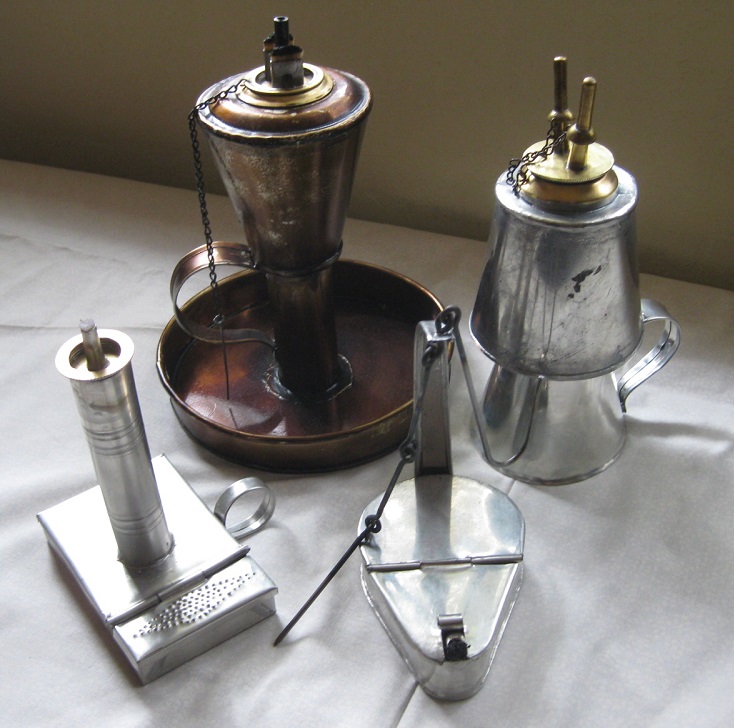
Jim Miller’s 19th-century lamp tin recreations, left to right: a whale oil burner; an 1842 patented lard oil burner; a “Betty Lamp” fueled by fat; and a typical burning fluid two-spout lamp.
“This adventure has deepened my appreciation for past craftsmanship and the intelligence of commonplace things in early America,” explained Miller in his 2012 For the Love of History blog. “Besides, now I have all this cool stuff to play (teach) with.”
The key to learning about early-to-mid-19th-century oil lamps was to study their burners, Miller noted, adding, “Each type of fuel needed a specific style of burner to give the best light.”
Although most of the fuels have become obsolete, Miller “wanted to faithfully replicate the burners in order to understand how they evolved,” he said, adding, “For the time being, substitute fuels would have to do.”

Miller fashioned tin into period lamp designs, including one fueled by fat — a “Betty Lamp” that “has an ancestry extending clear back to the Romans but had been improved on over time.”
The modern-day tinsmith recreated a whale oil lamp, circa 1850, and a patented lard oil burner of 1842 (the lard needed to be warmed to improve its fluidity).
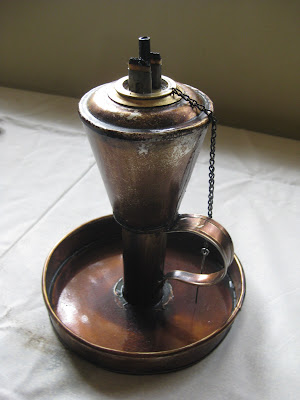
Miller recreated a lard oil lamp using an 1842 patent drawing. By faithfully replicating lamps, he seeks to “understand how they evolved.”
“These tubes never extend down past the mounting plate and never have slots for wick adjustment. Apparently, any heat added to the fuel caused an accumulation of gases,” he noted.
Most surviving original burning-fuel lamps have small covers to snuff out the flame and keep the fuel from evaporating. Newspapers also reported the danger of flash fires during refueling (see Camphene to Kerosene Lamps).

“The style of lamp I chose to replicate is sometimes called a petticoat lamp by collectors for the flared shape of the base. Such lamps are often mislabeled as whale oil lamps but the difference is obvious once you know your burners,” Miller concluded about his replica.
“In case you wondered, my lamp burns modern lamp oil, as I don’t need to kill myself in the pursuit of history,” the tinsmith added.
_______________________
Recommended Reading: Oil Lamps The Kerosene Era In North America
_______________________
The American Oil & Gas Historical Society (AOGHS) preserves U.S. petroleum history. Please become an AOGHS annual supporter and help maintain this energy education website and expand historical research. For more information, contact bawells@aoghs.org. Copyright © 2025 Bruce A. Wells. All rights reserved.
Citation Information – Article Title: “Making a Two-Wick Lamp.” Authors: B.A. Wells and K.L. Wells. Website Name: American Oil & Gas Historical Society. URL: https://aoghs.org/products/two-wick-camphene-lamp. Last Updated: December 1, 2025. Original Published Date: March 11, 2018.
.