Giant oilfield discovery at Hobbs in 1928 launched the New Mexico petroleum industry.
“It was desolate country: sand, mesquite, bear grass, and jackrabbits. Hobbs was a store, a small school, a windmill, and a couple of trees.” — A New Mexico roughneck.
Although the Hobbs discovery came six years after the first oil production (seven years after the first natural gas well), petroleum geologists soon called it the most important single oil find in New Mexico history.
Spudded in late 1927, the Midwest State No. 1 well saw its first signs of oil on June 13, 1928, and the wildcat well was completed November 18 at a depth of 4,065 feet to produce 600 barrels of oil per day. It had been a long journey revealing the giant Hobbs field.
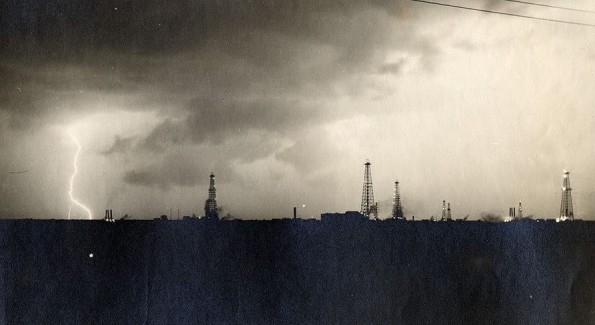
The Midwest State No. 1 well produced 700 barrels of oil per day on state land outside Hobbs, named for James Hobbs, who homesteaded there in 1907. Photo courtesy HobbsHistory.com
“Finding commercial amounts of oil in southeastern New Mexico presented geologists with a perplexing problem in 1928 because the land was too flat,” noted a 2009 article in the Midland Reporter-Telegram.
“Unlike much of West Texas, where surface formations gave the oilmen a hint of where underground formations might be located, the flat, level land in Lea County, New Mexico, shared none of its deep secrets,” reported Bill Modisett.
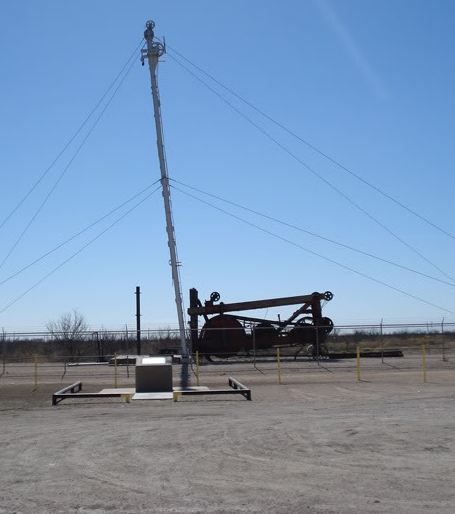
The Midwest State No. 1 — the discovery well for the Hobbs oilfield — is commemorated with a cable-tool rig placed there in 1952 by the American Petroleum Institute.
His article cited Samuel Myres, author of “The Permian Basin: Petroleum Empire of the Southwest,” who noted:
The area presented a special problem to geologists assigned the task of locating drilling sites. Since no surface formations were present to serve as markers of possible underground formations, much guesswork, possibly accompanied with prayers, entered into the exploration process.
It also was expensive to explore for petroleum in vast and remote locations, Myres noted. By the end of 1928, “oil companies had spent between $15,000,000 and $18,000,000…for exploration, leases, and tests in the county.”
By early 2023, the southeastern counties of Eddy and Lea accounted for almost 30 percent of oil production in the Permian Basin, a New Mexico and West Texas geologic region about 250 miles wide and 300 miles long.
First New Mexico Oil Well
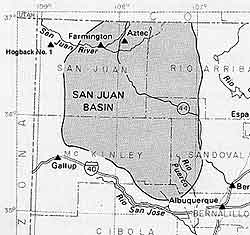
Midwest Refining Company had drilled New Mexico’s first commercial oil well on September 25, 1922, on the Navajo Indian Reservation near Shiprock.
By the 2010s, New Mexico oilfields had produced more than 5.5 billion barrels of oil.
The Hogback No. 1 well was a modest producer at 375 barrels per day, but Midwest drilled 11 additional wells to establish the Hogback oilfield as a major producer of the San Juan Basin. Two years later, a pipeline to Farmington was completed, and oil was shipped by rail to Salt Lake City, Utah, for refining.
But discoveries in southeastern New Mexico later overshadowed the San Juan Basin’s oil and natural gas possibilities when Permian Basin wells made New Mexico the third largest producing state.
Discovering the Hobbs Oilfield
Following oil discoveries in the Scarborough field of Winkler County, Texas, exploration for oil moved north and began in Hobbs in 1927, according to a noted local historian. The Midwest Refining Company, which would later become Amoco, drilled the Hobbs discovery well in a farmer’s remote pasture.
Midwest Refining drilled its wildcat well using a cable-tool rig, which proved a challenge from the start. Disaster struck at a depth of 1,500 feet when exhaust from the Franklin 85 engine ignited the engine house. Fire quickly consumed the wooden derrick.
“Men with less vision would have given up, but not the drillers of Midwest,” proclaimed local historian Paige W. Christiansen in 1989.

“A steel derrick from Amarillo, Texas, was set in place, the engine was rebuilt by local mechanics, and the cable tools were ‘fished’ from the hole,” Christiansen noted in The Story of Oil in New Mexico (learn more about recovering lost downhole tools in Fishing in Petroleum Wells).
After encountering the first signs of oil at 4,065 feet in June, the well was drilled to 4,330 feet to increase production, according to the Midland Reporter-Telegram article. “Having penetrated all the oil-bearing beds, Midwest’s State No. 1, the discovery well of the future Hobbs oil pool, was completed (November 28), producing 700 barrels of oil per day on state land leased by the Will Terry ranch.”
Drilling Boom
Production from the Hobbs oilfield soon drew crowds of investors and encouraged further exploration, quickly transforming the town from “sand, mesquite, bear grass, and jackrabbits” to the fastest-growing town in the United States, according to the 1930 census.
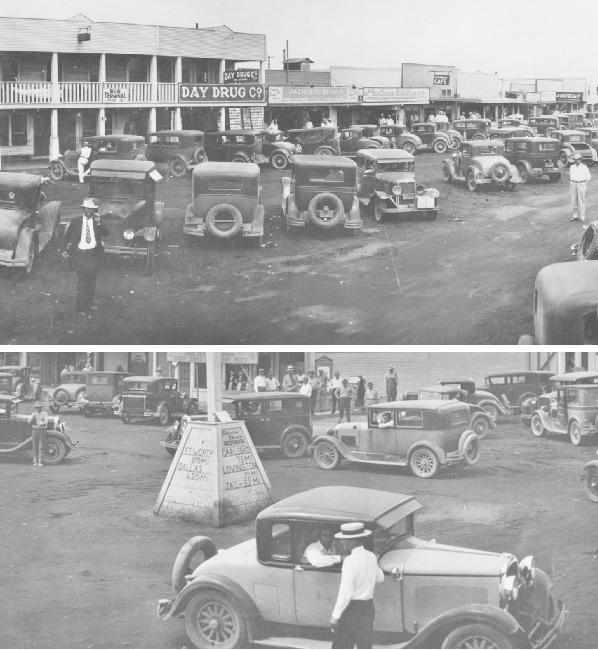
Views of Main Street in Hobbs, which in 1930 had two movie theaters; a brick hotel — the Harden; two post offices; several taverns, dance halls, and roller rinks; 19 pool halls; 34 drug stores; 53 barbershops; and 50 oilfield supply companies. Photos courtesy Permian Basin Petroleum Museum, Midland, Texas.
A second oil boom occurred in January 1930 when Humble Oil Company of Texas drilled a well three miles northwest of Hobbs that began producing a spectacular 9,500 barrels of oil a day. Humble Oil also introduced a new drilling technology to New Mexico oilfields — the rotary rig. As production grew, oil tank batteries were built and pipelines laid to transport both oil and natural gas.
However, problems for transporting the petroleum to markets continued to grow (also see Million Barrel Museum). Relief came when the first train, operated by Texas & New Mexico Railways, arrived in Hobbs in April 1930.
The Midwest State No. 1 well has been described by New Mexico geologists as “the most important single discovery of oil in New Mexico’s history.”
Noting the marker commemorating the strike, the Hobbs Daily News-Sun reported in 1976 that “this historic well still produces quietly near the intersection of Grimes Street and Stanolind Road in Hobbs, with most passersby unaware of the furor its gestation and birth created nearly half a century ago.”
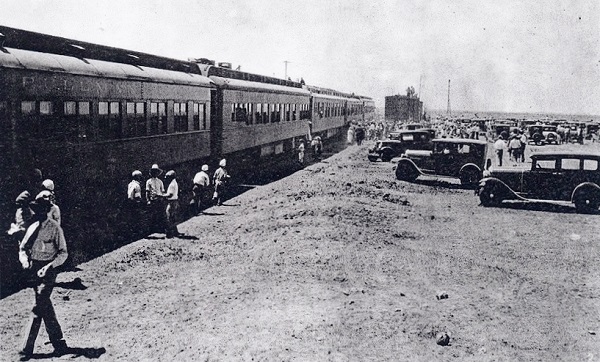
The Texas & New Mexico Railway, which incorporated after oil discoveries in the Permian Basin, in 1930 completed a short-line railroad operating in southeastern New Mexico. Hobbs residents flocked to the train when it arrived on April 19, 1930. Photo courtesy HobbsHistory.com
New Mexico has been a major producer of oil and natural gas since hydrocarbons were first discovered in the early 1920s,” according to the New Mexico Bureau of Geology and Mineral Resources.
Natural Gas
Discoveries in the Permian Basin of southeastern New Mexico would overshadow the San Juan Basin’s oil and natural gas possibilities. The Midwest State No. 1’s production ended in 2002, but the state remains a major petroleum producer.
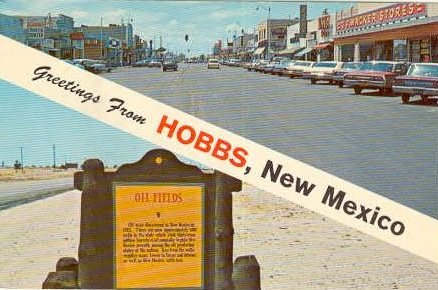
An oilfield discovery in the southeastern corner of New Mexico brought exploration companies and prosperity to Hobbs.
Ten counties have produced oil or natural gas, according to the New Mexico Oil and Gas Association. Pipelines extend for more than 25,000 miles — exceeding the combined mileage of the state’s railroads and highways. In 2016, New Mexico produced 145 million barrels of oil and 1.27 trillion cubic feet of natural gas.
The state’s annual oil production more than doubled between 2013 and 2018, making it the third-largest oil-producing state, according to the U.S. Energy Information Administration (EIA). New Mexico in 2018 had produced more than 5.5 billion barrels of oil since its 1922 Hogback No. 1 well. The state’s crude oil production accounted for 13.3 percent of the total U.S. output in 2022.
The “Biggest Little Museum in the West,” the Lea County Museum in Lovington, New Mexico, features petroleum history exhibits and equipment, including a 1946 Aeronca Champ airplane, a type of aircraft used in the industry to check pipelines.
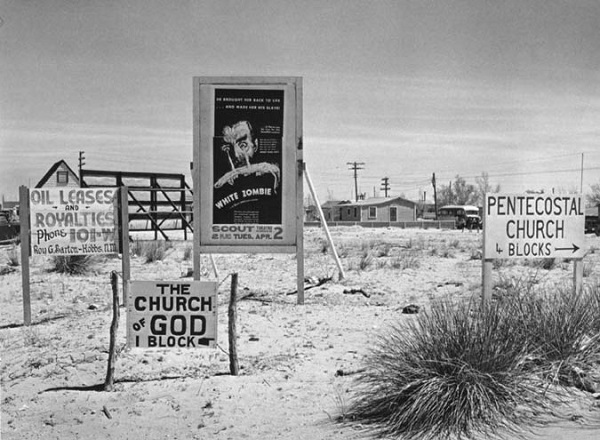
The 1930s work of photographer Russell Lee for the Farm Security Administration preserves a visual record of Hobbs and its famous oilfield.
New Mexico also is a key U.S. source of uranium, as Stella Dysart learned in 1955; after spending decades drilling for oil, one of her “dusters” made her a very wealthy woman. Learn more in Mrs. Dysart’s Uranium Well.
Photographer Russell Lee
The Library of Congress (LOC) American Memory collection includes 1930s photographs of Hobbs taken by Russell Lee and others for the Farm Security Administration. Lee primarily photographed activity in Oklahoma oilfields, but he visited Hobbs several years after the oilfield’s first oil strike, documenting life in the historic New Mexico boom town.
Lee was the most prolific photographer of the Great Depression, according to Neely Tucker of the LOC Office of Communications.

“But while Lee’s work is widely known, his story has remained more elusive,” Tucker noted in 2001, when a new biography published in association with the library helped establish Lee “as one of the most influential documentary photographers in American history.”
More New Mexico petroleum history can be found in Farmington, including the exhibit “From Dinosaurs to Drill Bits” at the Farmington Museum.
_______________________
Recommended Reading: The story of oil in New Mexico – Scenic trips to the geologic past (1989); Petroleum Empire of the Southwest: Era of Advancement, from the Depression to Present (1977); Oil in West Texas and New Mexico
_______________________
The American Oil & Gas Historical Society (AOGHS) preserves U.S. petroleum history. Please become an AOGHS annual supporter and help maintain this energy education website and expand historical research. For more information, contact bawells@aoghs.org. © 2025 Bruce A. Wells. All rights reserved.
Citation Information – Article Title: “First New Mexico Oil Wells.” Authors: B.A. Wells and K.L. Wells. Website Name: American Oil & Gas Historical Society. URL: https://aoghs.org/petroleum-pioneers/hobbs-new-mexico-oil-discovery. Last Updated: November 1, 2025. Original Published Date: April 29, 2013.