April 7, 1902 – Spindletop Boom brings The Texas Company –
Joseph “Buckskin Joe” Cullinan and Arnold Schlaet established The Texas Company in Beaumont to transport and refine oil from Spindletop Hill, a giant oilfield discovered in January 1901. The new company constructed a kerosene refinery in Port Arthur — and discovered an oilfield at Sour Lake Springs, where its Fee No. 3 well produced 5,000 barrels of oil a day in 1903.
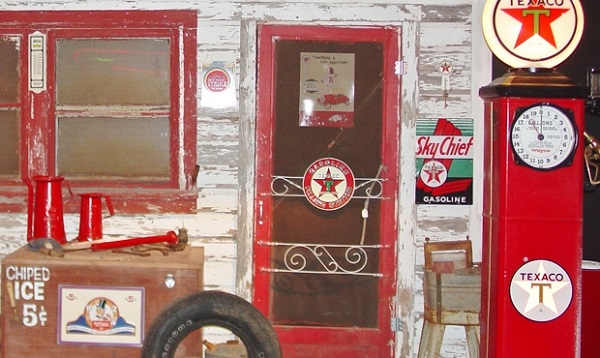
The National Route 66 Museum in Elk City, Oklahoma, preserves the heritage of Texaco, the first petroleum company to market products in all 50 states. Photo by Bruce Wells.
The Texas Company telegraph address at its New York office was “Texaco,” a name soon adopted for its petroleum products. In 1909 a red star with a green capital “T” was trademarked, and by 1928 the Texaco brand operated more than 4,000 service stations nationwide. The Texas Company, which officially renamed itself Texaco in 1959, was acquired by Chevron in 2001.
Learn more in Sour Lake produces Texaco.
April 7, 1966 – Cold War Accident boosts Offshore Technology
A robotic technology soon adopted by the offshore petroleum industry was first used to retrieve an atomic bomb. America’s first cable-controlled underwater research vehicle (CURV) attached cables to recover the weapon lost in the Mediterranean Sea.
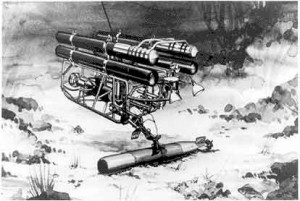
The U.S. Navy in 1966 used its CURV (Cable-Controlled Underwater Recovery Vehicle) to recover a lost nuclear bomb in the Mediterranean.
The 70-kiloton hydrogen bomb, which had been lost when a B-52 crashed off the coast of Spain in January, was safely hoisted from a depth of 2,850 feet.
“It was located and fished up by the most fabulous array of underwater machines ever assembled,” proclaimed Popular Science magazine. During the Cold War, the Navy developed deep-sea technologies that the offshore petroleum industry would adopt and continue to advance.
Learn more in ROV – Swimming Socket Wrench.
April 8, 1929 – Sinclair vs. United States
The Supreme Court unanimously upheld a lower court ruling that Congress had the right to investigate Sinclair Oil founder Harry Sinclair’s personal dealings with Secretary of the Interior Albert Fall regarding the leasing of federal oil reserves. In 1922, Fall had leased land in the Teapot Dome oilfield (Navy Reserve No. 3) to the Mammoth Oil Company, a Sinclair subsidiary. He also leased land in California’s Elk Hills reserve to Edward Doheny, the 1892 discoverer of the Los Angeles Field.
After several trials, proceedings concluded with Doheny being acquitted of conspiracy and Fall convicted of accepting bribes and serving nine months in prison, notes the Federal Judicial Center. He was the first cabinet official to go to prison. Sinclair was acquitted of conspiracy but convicted of contempt of Congress and served six and a half months in prison in 1929.
April 9, 1914 – Ohio Cities Gas Company founded
Beman Dawes and Fletcher Heath organized the Ohio Cities Gas Company in Columbus, Ohio, before building an oil refinery in West Virginia. Ohio Cities Gas acquired Pennsylvania-based Pure Oil Company in 1917 and adopted that name three years later. Pure Oil was founded in Pittsburgh in 1895 by independent oil producers, refiners, and pipeline operators to counter the market dominance of Standard Oil Company.
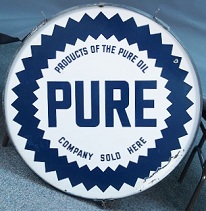
Ohio Cities Gas Company became Pure Oil in 1917.
By producing, refining, and selling its products, Pure Oil became the second vertically integrated petroleum company after Standard Oil. Headquartered in an iconic Chicago skyscraper it built in 1926, the company joined the 100 largest U.S. industrial corporations. It was acquired in 1965 by Union Oil Company of California, now a division of Chevron.

April 11, 2016 — 100th Anniversary of Ventura Avenue Oilfield
The city of Ventura, California, celebrated 100 years of production from its oilfield, which was still producing 14,000 barrels of oil a day and 7.8 billion cubic feet of natural gas. “It’s unusual for an oilfield to celebrate a century of operations,” noted the president of Arena, the operating company, which in 2026 merged for approximately $2.1 billion with California Resources Corporation (CRC), operator of the THUMS offshore islands.
By the 1920s, Ventura County led California in oil production, thanks to discoveries at Ventura, Sulphur Mountain, Rancho Ojai, Rancho Sespe, and Rancho Santa Paula. “Asphaltum” collected at Sulphur Mountain was refined in homemade stills as early as 1854, according to the History of Oil Development in Ventura County.
April 9, 1966 – Birthday of Tula’s Golden Driller
A 76-foot statue of an oilfield worker today known as “The Golden Driller” made its debut at the International Petroleum Exposition in Tulsa, Oklahoma. After several refurbishments, the 22-ton statue would contain 2.5 miles of rods and mesh with tons of plaster and concrete — withstanding winds up to 200 mph. A smaller version of Tulsa’s iconic roughneck originally appeared at the 1953 petroleum exposition as a promotion for the Mid-Continent Supply Company of Fort Worth, Texas.
April 10, 1866 – Densmore Brothers patent Railroad Tank Car
James and Amos Densmore of Meadville, Pennsylvania, received a patent for their “Improved Car for Transporting Petroleum,” developed a year earlier in the northwestern Pennsylvania oil regions. Their patent illustrated a simple but sturdy design for securing two reenforced containers on a typical railroad car.
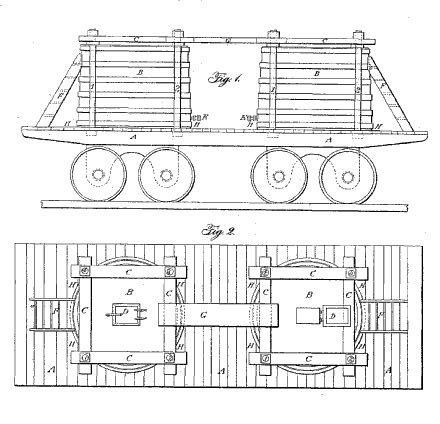
The Densmore dual tank car briefly revolutionized the bulk transportation of oil to market. Hundreds of the twin-tank railroad cars were in use by 1866.
Although the Densmore cars were an improvement, they would be replaced by the more practical single, horizontal tank. After leaving the business, Amos Densmore in 1875 invented a new way for arranging “type writing machines” so commonly used letters would not collide — the “Q-W-E-R-T-Y” keyboard. James Densmore’s continued success in oilfields helped finance the start of the Densmore Typewriter Company.
Learn more in Densmore Brothers invent First Oil Tank Car.
April 11, 1957 – Independent Producer William Skelly dies
William Grove Skelly (1878 -1957) died in Tulsa after a long career as an independent producer he began as a 15-year-old tool dresser in early Pennsylvania oilfields. Prior to World War I, he found success in the El Dorado field outside Wichita, Kansas. Skelly incorporated Skelly Oil Company in Tulsa in 1919.
In 1923, Skelly organized the first International Petroleum Exposition while serving as president of the Tulsa Chamber of Commerce. Skelly in 1947 helped establish KWGS, Tulsa’s first FM radio station and one of the earliest educational stations in the nation.
_______________________
Recommended Reading: The Texaco Story: The First Fifty Years, 1902-1952


_______________________
The American Oil & Gas Historical Society (AOGHS) preserves U.S. petroleum history. Please support this energy education website, our monthly email newsletter, This Week in Oil and Gas History News, and help expand historical research. Contact bawells@aoghs.org. Copyright © 2026 Bruce A. Wells. All rights reserved.