Preserving a family’s oilfield production prototype and THUMS Islands memorabilia.
Rodney Shively hopes to preserve the oilfield legacies of his grandfather and great-grandfather. After researching details of a May 5, 1953, patent they were awarded from the U.S. Patent Office (no. 2,637,528), he is looking for a permanent home for his family’s prototype oilfield production device.
Shively, who worked as a research scientist in the biotechnology and pharmaceutical industries for nearly 40 years, has been investigating his grandfathers’ careers in the petroleum industry. Other family artifacts include memorabilia from THUMS, a late-1960s consortium of petroleum companies that constructed five oilfield production islands off Long Beach, California.
“Nearly a decade ago I inherited a few mid-twentieth-century oil technology artifacts from my grandfathers,” Shively explains. The most unique is the prototype of the patented self-adjusting carrier bar for oilfield pump jacks designed by his grandparents.
Shively hopes a U.S. petroleum museum, technology museum, or historical organization will be interested in preserving the prototype “Carrier Rod for Polish Rods” described in the July 1949 patent application.
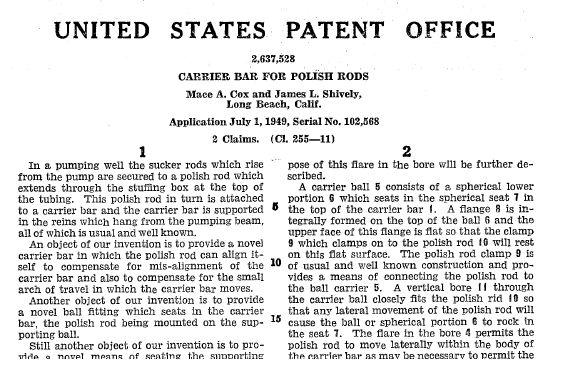
The oilfield production technology patent was awarded to Rodney Shively’s great-grandfather and grandfather on May 5, 1953.
More Shively family oilfield items encompass a 1960s promotional tray depicting the THUMS production facility at Long Beach, “landscaped and lighted oil island.” Other family items also relate to the trailblazing offshore islands. Five petroleum companies — Texaco, Humble, Union, Mobil, and Shell — built four artificial islands that remain among the most innovative, artfully camouflaged facilities worldwide. (see THUMS — California’s Hidden Oil Islands).
Self-Adjusting Carrier Bar
An object of our invention is to provide a novel carrier bar in which the polish rod can align itself to compensate for misalignment of the carrier bar and also to compensate for the small arch of travel in which the carrier bar moves. — Mace A. Cox and James L. Shively
Shively hopes his 28-pound, self-adjusting carrier bar for pumping unit sucker rods will be of interest to museum curators. His grandfather and great-grandfather received their 1953 patent for an innovative design, possibly the first prototype universal joint carrier bar.
“As a little boy in the 1960s and 1970s, when I visited my grandfather’s home, this item was always on display,” Shively explains. “My father inherited it and the other items when my grandfather passed a quarter century ago. They then passed to me when my father passed a decade back. I have no further family to pass this collection of oilfield artifacts on to.”
Shively wants to preserve the prototype — along with other oilfield items — and is willing to donate the collection to a museum. “These items represent mid-twentieth-century oilfield inventiveness, ingenuity, and work,” he says. “It is my hope that these items will be reminders to future generations of the era’s petroleum technology.”

Patented in 1953, the prototype universal joint carrier bar was designed to reduce linear and rotational stress between the rod and jack head, reducing breakage. Photos courtesy Rodney Shively.
Years ago, his grandfather explained to him that carrier bars had been an early part of oilfield production technology, but earlier designs were prone to stress breakage. Broken carrier bars meant wells would spend downtime for repair — and oil not being pumped.

“This new carrier bar was designed to reduce the movement linear and rotational stress between the siphon rod and jack head, reducing breakage and downtime,” Shively reports. “In viewing the image of the prototype carrier bar backside, at the lower end along the center vertical ridge, there is a visible ‘C & S’ as part of the unit. These letters stand for the last names of inventors Mace A. Cox and James L. Shively, my grandfathers.”
Shively adds that the improved carrier bar had a small part in providing a more reliable supply of crude oil following World War II. “The post-war decades were a time when the U.S. interstate expanded and suburban sprawl was beginning,” he notes. “Shipping and air travel also began expansion in these decades with a more reliable supply of crude oil.”
THUMS Memorabilia
Shively in December 2025 reached out to the American Oil & Gas Historical Society (AOGHS) for help finding a museum home for his family’s oilfield artifacts. He hopes directors or docents will contact him for more details about the carrier bar prototype — or any of his family’s petroleum history artifacts.
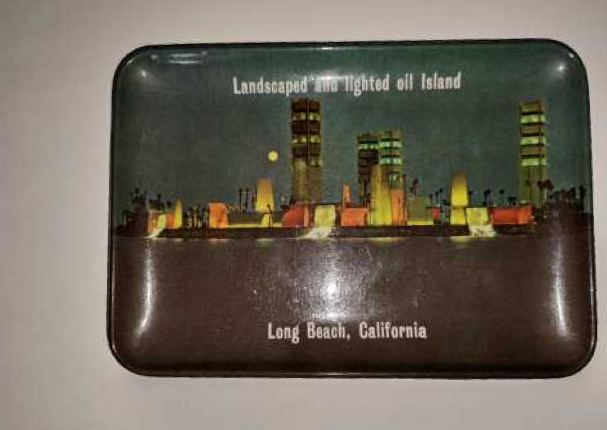
From the Shively family collection: a late-1960s “knickknack tray” with Disney-inspired disguised derricks of the THUMS Oil Islands off Long Beach, California.
“A late-1960s knickknack tray promoting the THUMS Oil Islands off the coast of Long Beach, California. On the bottom side there is a number P67, the assumption is this might be a reference to the year of production and/or manufacture, 1967.”

Worker overalls with the THUMS Long Beach logo for the four offshore production islands, which produce oil from California’s Wilmington field, the fourth-largest oilfield in the United States in 2017.

Employee badge of the Long Beach Oil Development Company, where Rodney Shively’s grandfather worked in 1946. He thinks the “66” may refer to the company being located near the end of Route 66.
Long Beach Oil Company Overalls — As part of his job with the city of Long Beach, managing oil derrick operations on THUMS, my grandfather routinely needed to visit the THUMS Oil Island facilities. On those visits, he would need to wear these overalls over his business suit.
Long Beach Oil Company Badge — The Long Beach Oil Development Company badge is old and was included in my grandfather’s items, indicating some relationship or personal prominence,” he observes. The badge has a screw pin on the back for attaching to a hard hat or clothing.
“Though my grandfather’s relationship to this company was unknown originally, I had heard stories he worked in the oilfields in the late 1940s and 1950s. Serendipitously, an old document was discovered showing my grandfather worked for the Long Beach Oil Development Company in 1946,” Shively reports. “The badge center number may be 66 as a logo homage to Route 66 and the petroleum needs for cars and trucks,”
A web search revealed the Long Beach Oil Development Company was filed as a business entity in Carson City, Nevada, on January 10, 1939.

Today living in Washington, Rodney Shively hopes the AOGHS American Oil Families website article will help promote his effort to preserve his grandparents’ petroleum legacies. He would be happy to discuss these items and their possible addition to a museum’s collection — or preservation by a state or county historical society or similar organizations. To learn more, email him at Rshively01@outlook.com.
“Are you aware of any need at an oil industry technology history museum to expand collections with items such as these listed?” he concludes. “When I pass, I believe all these items should be left to be displayed for everyone, not lost to history.”
_______________________
The American Oil & Gas Historical Society (AOGHS) preserves U.S. petroleum history. Please become an annual AOGHS supporter and help maintain this energy education website and expand historical research. For more information, contact bawells@aoghs.org. Copyright © 2026 Bruce A. Wells. All rights reserved.
Citation Information – Article Title: “Preserving Shively Family Oil Artifacts.” Authors: B.A. Wells and K.L. Wells. Website Name: American Oil & Gas Historical Society. URL: https://aoghs.org/oil-almanac/shivley-family-oil-artifacts. Last Updated: February 5, 2026. Original Published Date: February 5, 2026.