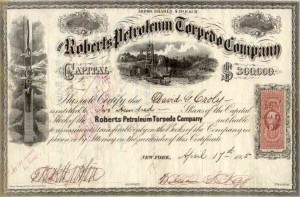
Established in 1865, The Roberts Petroleum Torpedo Company would have a lengthy a monopoly on all types of torpedoes used in the petroleum industry. The company stock certificate is worth almost $300 to collectors.

“I found an old oil company stock certificate in my grandmother’s attic. Is it worth anything?”

Unfortunately, unless it is a rare collectible, few certificates have commercial value today. Although the society’s budget prevents researching most requests regarding individual company histories, a society volunteer may have information.

You are invited to post questions about your certificate in the comments section at the bottom of  our Stock Certificate Q&A page. In time, this sharing of comments could help produce useful research sources.

Scripophily – the collection of antique stocks and bonds – is growing more popular. “Certificates are valued for their vignettes, which often depict bygone industries and times, and their historical significance,” notes on collector. “Many interesting certificates can still be acquired at modest cost.”

America's first oil company -- the Pennsylvania Rock Oil Company of New York -- incorporated on December 30, 1854, in Albany.

The historical society often recommends contacting several commercial sites, including Scripophily.com – a provider of authentic stock certificates, autographs, and old company stock research services.

Scripophily has been collecting and selling certificates since 1990. The company will research old certificates for about $40.

The link below leads to part of our collection of stock certificate inquiries and responses.

Stock Certificate Q&A Forum

—————————————————–

Is My Old Oil Stock Worth Anything?

Can you tell me anything about this old petroleum company…and its stock certificate?

The historical society cannot research all requests regarding individual company histories and the potential value of stock certificates; however, a site visitor or a society volunteer may have information. To share knowledge and previous research experience, you are invited to submit your query in the Stock Certificate Q&A Forum section.

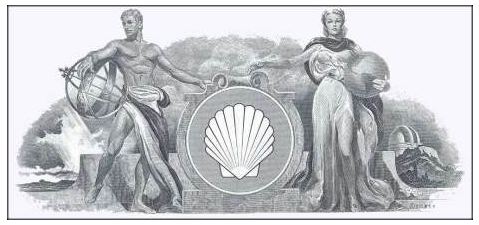
This vignette is from a Shell Oil Company engraved certificate printed by the Security-Columbian Banknote Company and issued in 1977. The complete document includes an ornate border -- and has the printed signatures of the company’s president and secretary. The certificate's value to collectors is about $40.

Because the following is a summary (and includes information for articles), the society seeks companies interested in sponsoring additional research. For certificate collector research, there also is Scripophily — a fee-based website:

• Did the company fail?
• Is it in business under a new name?
• Was it acquired by another company?
• How do I contact the current company?
• Does the certificate have collector value?

—————————————————————

The following research was sponsored by the Texas Alliance of Energy Producers, Wichita Falls.

——————————————————————-

Updated April 2012

Question

I have an oil certificate that is for Texas-Rotan Oil Company (Fort Worth, TX) that is from Feb. 1920. I cannot find anything on this company. Any help would be great.

Answer

Your Texas-Rotan Oil Company may have been created to gamble on the success of the much larger Texas Company’s wildcat explorations in Fisher County, Texas. (The Texas Company later became Texaco – now a part of Chevron.) Such a major oil company is capitalized sufficiently to absorb substantial losses if drilling efforts produce only dry holes.

When a major oil company’s geological research prompts them to drill in a previously unproductive area, it is sure to draw entrepreneurs and investors hoping to find successful lease opportunities nearby.  In 1918-1919 the Texas Company drilled four dry holes in southwest Fisher County before moving its exploration rigs to the vicinity of Rotan.  The Texas Railroad Commission (RRC) maintains maps RRC’s Public GIS

Map Viewer that show drilling around Rotan, but neither the Texas Company nor the Texas-Rotan Company found oil.  The county’s first commercial oil discovery (the D. W. Stephens No. 1 – drilled by the Texas Company) would not come until 1928, but that well produced for 66-years.  The RRC map shows many dry holes and later, many productive wells, but the Texas-Rotan Oil Company does not appear to have shared in that success.

Question

I came across a certificate for Tapo Oil Company.  The certificate says the company was incorporated in California in 1900 and is dated September 1960.  Does anyone have information on what became of this company?

Answer

Tapo Oil Company was formed in April 27, 1900 with capital of $500,000.  President was S. C. Graham and Secretary was C. H. McKevett.  The company was based in Santa Paula and drilled three shallow dry holes (~700 feet) on Rancho Tapo north of Simi Valley, California, in 1901-1902.   California records the wells as abandoned prior to 1913.

The president of Tapo Oil Company, S. C. Graham, was a Pennsylvania-born oilman and had several years experience with the Hardesty & Steweart Oil Company – which would become Union Oil.  Graham and McKevett had also founded the Graham-Loftus Oil Company in 1898 and found success in Orange County, California.  One Graham-Loftus well is reported to have produced 700 barrels a day.  Union Oil Co. was the principle buyer of all the oil produced.

S. C. Graham remained active in the oil business after the failure of Tapo Oil Company and served as president of the Grador Oil Company, formed August 16, 1908, capitalized at $250,000 and dissolved in 1922.  Graham also served as President of the Placentia Oil Co. (formed 1914) and the Gilroy Oil Co. of Los Angeles, which drilled six unsuccessful wells in Santa Clara county…

Response

Thank you for the information.  The original stock certificate we found is dated September 14, 1960 and signed by Milton M Teague, President.  It does indicate that the company was incorporated in California on April 27, 1900 but with capital stock of $1,000,000.  Do you think it could be the same company?  I appreciate your insight and assistance.

Question

Hi, I was hoping you could help me find out about a old stock That was my grandmas. It is from a Company called Southwest Oil Corporation. It is out of Delaware and dated Dec. 10, 1954.

Answer

Southwest Oil Corporation was more into the music business than into oil. The company drilled two dry holes near Portland in Sumner County, Kansas between October 1955 and January 1956. No oil was found and by February, the wells were abandoned.

It appears that the company abandoned the oil business as well because on May 8, 1961, Southwest Oil became a wholly owned subsidiary of Melo-Sonics, which had been established as a Delaware corporation in 1953 and was involved in distribution of background music, tape repeaters and related items. Southwest Oil Corporation was renamed Melo-Sonics and subsequently joined with Whippany Electronics Inc., in the manufacture of portable electronic organs popular with rock bands.

Vintage Whippany and Melo-Sonic equipment can be seen online but by 1996, the trademark had expired and the company dissolved.  In 2003, about 32,000 obsolete Melo-Sonics Non-Transferable Securities Certificates were authorized for destruction by the Depository Trust & Clearing Corporation.

Question

Hello. We have recently discovered two stock certificates registered in the state of California. One is for the New Richmond Land Company incorporated on February 4, 1909, and this certificate appears to be for 5,000 shares. The corner of the certificates shows “Shares: 83,343.” It is signed by George S. Wall as Secretary on August 27, 1926.

The second is a certificate dated December 6, 1965 for 13 shares of the Bay Shore Land Co., signed by a Robert L. Chambers (secretary) and a gentleman with the last name of Bagley (president).

How would be go about finding whether these certificates have any value or not, or at least get a little history on the companies. My husband inherited these two certificates in the mid-1990s. Thanks.

Answer

Here’s what you can learn from your stock certificate’s appearance. Is it Canceled or Uncanceled?  Canceled — Stock certificates that are perforated or otherwise canceled have no value as a marketable securities because the original shareowner named on the certificate surrendered the certificate to a transfer agent during a change of ownership (sale, trade, acquisition, merger, etc.).

Like other obsolete stock certificates, they no longer reflect partial ownership in a company.  Uncanceled — If for whatever reason the shareholder named on the certificate failed to surrender it during a change of ownership, the stock shares would have nonetheless been canceled on the books and any remaining value turned over to the Unclaimed Property Division of the owner’s state. Some uncanceled stock certificates are in this category.

Other Uncanceled — Uncanceled stock certificates can also be the remains of aspiring companies that issued stock to raise capital but subsequently went bankrupt. New oil and gas ventures could easily fail amidst dry holes or other oilfield hazards and leave investors holding uncanceled valueless paper shares. Like other obsolete stock certificates, these are also evocative and popular with scripophily collectors who value their often intricate artwork and history.

Question

Any information out there on “The Texas Oil Producers Company” incorporated in Delaware that was selling shares in the early 1920,s. VP of the company was Webster Bishofs? alotment of shares were managed by Robert S Strauss & Co. in 1922.

Answer

In 1918, forty-three miles northwest of Beaumont, Texas in eastern Liberty County, the Hull oilfield was discovered, sparking rapid growth of the town.  Under the supervision of a man named “Bud” Cole, the Texas Producers Oil Company drilled two dry holes in the Hull oilfield in 1919-1920.

The early days of the oil business involved frequent scrambles to new oilfields when such a discovery announced the presence of oil.  Entrepreneurs, investors, landsmen, and speculators were drawn to the boom but dry holes and bankruptcies were necessarily part of the landscape.  The Delaware Department of State’s Division of Corporations online entity search reports that out Texas Producers Oil Company was formed in September, 1917, but little else.

The Texas Railroad Commission retains drilling records and may have information on the Texas Producers Oil Company operations in Texas circa 1920.  Historical Oil and Gas Records (Central Records) at (512) 463-6882.

Question

I have come across certificate No. 3386 for 400 shares of Petroleum Production Company of America from October 1920 and I was wondering what happened to the company. It was countersigned and registered by Security Transfer and Registrar Co. Can anyone provide any insight?  Thank You.

Answer

A February 25, 1918, reference announces that R. B. (Robert Bradford) Marshall of East St. Louis, Illinois; Anna Thurstrup of Chicago, and Marion Luce, of Oak Park, Illinois, had applied to incorporate the Petroleum Production Company of America in Delaware with the purpose of acquiring and developing petroleum properties. Capitalization was only $500,000. That company soon disappears – which is not uncommon for the highly speculative business of finding oil with an undercapitalized venture.

The company’s founders included Marion Luce who was a Chicago socialite and a principal investor in a number of companies of the era: 1916 – The United Battery Company (capital stock of $3 million); 1917 – Aristo Company of America (manufacturer of wall and interior decorations capitalized at $1 million); 1918 – The Ideal Laboratories Company (manufacturer of “Lura Toilet Preparations” capitalized at $2 million); and in 1921- Utility Battery Company of America, capitalized at $5 million.

Another of the Petroleum Company of America’s founders was Robert Bradford Marshall who after graduating in 1888 from Columbian (now George Washington) University joined the United States Geological Survey and became its Chief Geographer by 1918. Despite what seems to be adequately funded and qualified founders, the Petroleum Production Company of America does not appear to have prospered, nor do any of Marion Luce’s investments.

Question

My father’s estate holds sinking fund debenture gold bonds for the Midcontinent Producers & Refiners Corporation dated 1921. Also stock in the Cleveland Wyoming Oil Company of Delaware.Were these companies ever merged into another entity and do they have any value today except as an antique?

Answer

My understanding is that a Midcontinent Producers & Refiners Corporation “sinking fund debenture” would have provided periodic repayments from corporate assets and earnings set aside for such designated debentures and long-term debts, but beyond brief mention of filing on August 23, 1920, and a stock certificate image, there is a dearth of information on this company.

In the Torchlight Dome of Wyoming’s Bighorn Basin between November 1914 and October 1915, there were 20 successful oil and gas wells drilled, but the Cleveland Wyoming Oil Co. drilled their first (No. 1) oil well 1.5 miles further west than any other producing well, to an unknown depth and without success.

The company’s No. 2 well was drilled more than 400-feet deep, but apparently also came up dry. On March 15, Cleveland-Wyoming Oil Company spudded a well in Section 22, T-51-N, R-93-W, and finished at 900-feet on April 10, 1915, but the well soon filled with water, It also showed a thin “oil scum,” the source of which was questionable.

In addition, Cleveland-Wyoming Oil Company drilled a 700-foot well on the west flank of the Big Horn Mountains on the Cherry anticline, but again found no oil. Such a string of dry holes would have stressed any company, regardless of capitalization, so it is most likely that this company also failed. Securities from many such oil companies nonetheless retain value to collectors because of their unique histories and artful stock certificates. A map of the Basin, Wyoming, shows the Torchlight Dome.

Question

I’m trying to find out any information I can about Overland Oil, Inc., which was issuing stock in Colorado in 1955. I’ve Googled it — as well as the issuing bank — but come up (mostly) empty. I have attached the certificate and would appreciate any insights anyone can offer.

Answer

Overland Oil, Inc. (901 Morton St., Denver, CO) was first established with Winfield Morton as president, followed by Elmer F.E. Schmidt and John O. Hayden. Board members included Andrew T. Sweet, formerly of the U.S. Bureau of Mines.

In June 1953, in order to raise capital for “general corporation purposes,” the company offered 600,000 new common stock shares to current stockholders for 40 cents per share on a l-for-2 basis.In December, the company offered an additional 300,000 shares to the public for 20-cents per share. By 1955, the company was involved in a process for extracting uranium from ore, but was declared defunct on October 10, 1962, for nonpayment of taxes.

Reply

Thank you for your interesting, detailed response! My father probably held on to the certificate as a lesson in bad investments. I appreciate your sharing your information.

Question

I am sending photos of the stock share for the Centralized Oil & Gas Company. My Father purchased it in 1919. If there is any other information on the company, its history, etc. I would appreciate your input. – Jess

Answer

The Centralized Oil & Gas Company operated in Gotebo, Kiowa County, Oklahoma, and was still in business as late as 1922, when it appeared in the American Oil Directoryalong with Fair Play Oil & Gas Company and Gotebo Oil & Refining Company.

Like many other oil regions at the time, entrepreneurs who could quickly secure leases on properties proximate to producing fields improved their chances of drilling a successful well. Issuing stock was a primary tool to raise money. Sometimes sufficient capital could be raised to actually drill a well — but the Oklahoma Corporate Commission records no such success for the Centralized Oil & Gas Company.

I hope you find some of this helpful. The historical society will keep on the lookout for more information about your certificate — as we continue to research and write about America’s exploration and production heritage.

Question

I was wondering if Pongratz Petroleum Company still exists? I have an old stock from my grandmother from 1939 and was just wondering. – Sherry

Answer

If your stock certificate for the Pongratz Petroleum Company names Gus Pongratz as an officer of the company, it is likely the same individual previously associated with a failed California Independent Oil Organization.

On February 24, 1934, “California Independent Oil Organization” leased 560 acres in Crow Indian tribal land in Big Horn County, Montana. Gus Pongratz operated the lease until operations ceased in April, 1936.

California Department of Conservation (Division of Oil, Gas, and Geothermal Resources) maps show the Pongratz Petroleum Company as once having several wells in Los Angeles with Newmark No. 1, Newmark No. 2, Martin No. 1, Dutch No. 1, and Schelnik No. 1 marked “plugged and abandoned.”

The Gus Pongratz Dorsey 1-A is marked “plugged and abandoned-dry hole.” Sheri, I hope you find some of this helpful. The historical society will keep on the lookout for more information about your certificate — as we continue to research and write about America’s exploration and production heritage.

Question

I was wondering if you could please tell me if you know anything about Doughboy Oil Company? Could you give me someone to contact who does know of the history of this company?

I was told a story about this company and want to do some research as to the facts. Thank you in advance for all of your help.

Answer

The promotional map and stock certificate may be indicative of an unsuccessful effort to raise sufficient capital for oil exploration since it appears no Doughboy Oil Company wells were ever drilled. The stock certificate indicates that for all of the company’s lease blocks, a deed “is recorded in the Deed Records in the County Clerk’s office in every county in which we have acreage.”

The 120-acre Doughboy lease areas shown around Fredonia, Kansas, are near Benedict Junction, which is readily identifiable on Wilson County topographic maps.

The Doughboy leases were indeed recorded, although the company president, W.R. Pruitt, is as elusive as his company. “Lease Assignments” came from the Wilson County (Kansas) Registrar of Deeds. Each of these documents transferred ownership of mineral rights on specified acreage to the Doughboy Oil Company — “for and inconsideration of One Dollar” (and other valuable considerations).

The property descriptions for Section 9, Township 28 Range 15E, of Wilson County correspond to the indications on your map and the topographic map’s markings. Speculators rushed purchase oil leases when there were known producing wells in an area although it was often difficult to find sufficient backers, secure the leases, drill wells, and be lucky enough to find oil.

Today, even with the most modern technology, one out of five wells is a “dry hole.” The Petroleum History Institute reports that between 1916 and 1917 in Kansas, only twelve of 1,500 oil companies showed profits.

Doughboy may well have experienced the same fate in 1919. More detailed research into Doughboy’s Wilson County lease properties’ subsequent history are held at the Wilson County Registrar of Deeds, 615 Madison, Fredonia KS 66736-1396.

Question

Hello, I am writing in hopes that your office can assist my family in locating The Phenix Oil and Gas Company. I’m not sure if this company was based out of Colorado or Wyoming.

The documents we have both states listed on it – so it’s a bit confusing and the documents are dated September 1902. If you could possibly help, we would greatly appreciate it. Thank you kindly, (certificate attached) – Demetria

Answer

The Phenix Oil & Gas Company was incorporated in Cheyenne, Wyoming, Laramie County on January 29, 1902. The business operated from Cheyenne with a nine-member board of directors: A. Entwistle; Nicholas Herival (President); George Williams; J. A. Teagarden; C. B. Frantz; J. A. Naylor; E. N. Cook; C. L. Stewart; and J. A. Gillfillan. An earlier Phenix Oil Company was formed in Oklahoma by Edwin Foster — and the historic Indian Territory Illuminating Oil Company — later the Cities Service Oil Company.

During the turbulent year of Phenix Oil & Gas Company’s incorporation, the New York Times reported Wyoming’s oil excitement — and the entrepreneurs who quickly secured leases on properties anywhere near producing fields to improve their chances of drilling a successful well. Many drilled dry holes. Issuing stock raised investment money, but there were many new, competing companies seeking the same drilling capital. Sometimes sufficient capital could be raised to drill a well. However, it does not appear that your Phenix Oil & Gas Company successfully drilled and survived.

The story of Wyoming’s petroleum pioneers, first oil discoveries — and the litigation that followed over placer claims — can be found in the historical society’s “Petroleum Pioneers of Wyoming” article.

Question

I am sending you a scanned copy of a certificate. As you can hopefully see from the scanned image, it is the Hale Petroleum Company, incorporated in Delaware. It was issued in Kansas City, Missouri, on November 26, 1917.

The seal has a date of 1917. It appears the president’s signature reads J. H. Atwood and the secretary is Burr S. Stottle (?). I hope this helps you find some info for me. Thank you again – Holly

Answer

This Hale Petroleum Company from 1917 is not related to today’s Hale Petroleum Company of Columbus, Kansas. It also has no relation to the Standard Oil-affiliated Frank Hale Oil Company in Louisiana. In a 1918 text published by the Kansas City Testing Laboratory, Hale Petroleum is identified as having a refinery in Wichita, Kansas, and pipelines to Wichita from nearby El Dorado — site of Kansas Oil Museum.

Interestingly, a Hale Petroleum is identified as part of Sterling Oil & Refining Company. Sterling Oil was created by Ross Shaw Sterling, the founder and president of the Humble Oil and Refining Company, which eventually became the Exxon, now ExxonMobil. In the 1920s, he sold his interests in Humble, although he served as president of Sterling Oil & Refining Company until 1946.

The historical society will keep on the lookout for more information about your certificate — as we continue to research and write about America’s exploration and production heritage.

Question

I am a collector of vintage securities. One item has attracted my attention for some time, but I’ve not been able to find out anything about it. It is quite unusual in that it is the onlycertificate I have, out of perhaps 1500, from the period 1880-1930 or so, that has identifiable female officers. That, and the fact that it is from frontier Wyoming would suggest that the story behind it could be quite interesting. The certificate is rare — it is absent from the scripophily databases, and I’ve not seen another in my collecting over the past.

Answer

Women’s National Oil & Development Company (Womens Oil) was in the time of Wyoming’s big oil boom, which began with No. 1 Salt Creek well in October 1908 that opened Salt Creek as one of the most significant fields in the Rocky Mountains and inspired many entrepreneurs.

The post-World War I surge in demand brought even more exploration, but the Women’s National Oil & Development Company didn’t leave much behind — you may be able to find additional information through the Wyoming State Archives’ holdings of inactive corporation files from the Wyoming Secretary of State.

Question

I want to find two very old stocks from my grandfather. I am sending you copies from both of those stocks. I would appreciate it if you help me. — Vili

Answer

Federal Oil and Gas Company was a West Virginia exploration and production company with offices in Akron, Ohio, that reported property valuation of $5,000 in the 1917 Annual Report to the Tax Commission of Ohio (Athens County). It was still active in 1919, purchasing 80 acres in Wayne County for $180,000.

The 1919 National Gas Association of America’s 14th meeting lists Federal Oil and Gas Company as located at 517 Second National Bank Building in Akron with E. B. Gill as Treasurer and General Manager. E. B. Gill’s signature appears on your certificate.

A separate Federal Oil and Gas Company organized in January 1908 under a Delaware charter. Beginning with a 4,000-acre lease near Nowata, Oklahoma, with 105 producing wells, this Federal Oil and Gas Company added properties from the Osage Indian Reservation and other companies. By 1911, the company held 12,000 acres with 217 producing oil and natural gas wells.

Question

Recently I came across my grandfather’s strong box; in it you could imagine there was everything in it from soup to nuts. I found an old envelope with stocks from the Buffalo-Texas Oil Company, Electra, Texas. The stocks are dated 1919, 1920, and 1921. Does anyone remember this company or its history?

Any information would be great. Buffalo-Texas Oil Company’s main office was in Buffalo, New York, not Buffalo, Texas. I can just imagine my grandfather back in 1919 at age 18 buying this stock thinking just as we all do to make some money to have for his own or to take care of his family.

At that time my grandfather worked in the shipping department of a little known company called International Motor Car Company which later became Mack Truck. My grandfather retired in 1961 as supervisor, and passed on in 1975. He was a fantastic person to know. From time to time I receive e-mails from people thinking that the Buffalo-Texas Oil Company is now a part of Mobile Oil — just as my grandfather thought this could be the ticket for the entire family. Oh well, that’s why we dream and sometimes dreams do come true.

A newspaper ad promotes the Buffalo-Texas Oil Company's Wichita County, Texas, prospects.

I found a lot of information on the history of oil, how it was a very big industry, but that it had taken a nose dive in the mid-1920s. I found that people collect old stock certificates. The stock certificate from the Buffalo-Texas Oil Company is worth about $150, but I would never sell them because they are a part of my family’s history. — Joe

Answer

Thanks for your e-mail and the touching story about your father. The Buffalo-Texas Oil Company folded by 1928 with a final offer of 1/2 cent per share. Although your certificate cites capital stock of $3,000,000 in 1923, there are no records of any wells being drilled — the stock issue may well have been an unsuccessful effort to raise sufficient venture capital to purchase leases and proceed with exploration.

An oil boom had begun when the giant Ranger oilfield was discovered near Electra on April 1, 1911. As a result, the following years saw intense competition for leases as the drilling prospects became harder to come by.

The 1919 date corresponds with a huge post-WW I surge in demand for petroleum and a rush to profit from Ranger, part of the famed Mid-Continent field, which contains hundreds of oilfields reaching from Kansas, Oklahoma, and Texas into parts of Louisiana and Missouri.

The Mid-Continent field has a long history of oil discoveries and the business booms and busts associated with such discoveries. As early as 1913, North Texas fields like Burkburnett and Electra were producing 46 percent of all the oil in Texas.

Refineries began to appear in Wichita Falls in 1915. That year, Wichita County reported 1,025 producing wells. On July 28, 1918, the Fowler No. 1 well in Burkburnett came in at 3,000 barrels per day — triggering another boom. Newspapers reported that within a few weeks of Fowler No. 1, there were more than 200 wells inside the Burkburnett city limits and more than 60 companies had been formed to exploit the new discovery. Entrepreneurs and investors were always drawn into the fray but dry holes and bankruptcies were necessarily part of the landscape. Bank deposits increased by 400 percent in 1919, and oil-related industries increased dramatically.

Your certificate represents a fascinating petroleum history of the region. Electra today hosts an annual celebration for its Clayco No. 1 Well (2011 is the centennial of the discovery) and the Academy Award-winning 1940 movie “Boom Town” with Spencer Tracy and Clark Gable is based on the story of Burkburnett’s oilfield.

——————————————————–

Editor’s Note — For learning the value of your old oil stock, sites like Scripophily.com — a provider of collectible certificates, autographs and research services — offer helpful services. Scripophily has been collecting certificates since 1990 and will research your certificate for a fee.

Have a question? You are invited to submit your query in our Stock Certificate Q&A forum section – where everyone can share their research.