January 7, 1864 – Oilfield Discovery at Pithole Creek –
The once-famous Pithole Creek
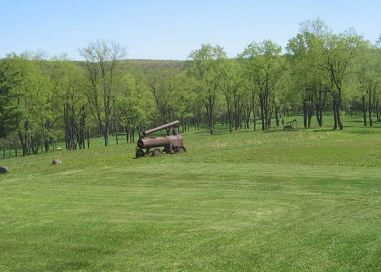
Pithole City history is preserved at Pennsylvania Oil Creek State Park. Photo by Bruce Wells.
Adding to the boom were Civil War veterans eager to invest in the new industry. Newspaper stories added to the oil fever — as did the Legend of “Coal Oil Johnny.” Tourists today visit Oil Creek State Park and its education center on the grassy expanse that was once Pithole.
January 7, 1905 – Humble Oilfield Discovery rivals Spindletop
C.E. Barrett discovered the Humble oilfield in Harris County, Texas, with his Beatty No. 2 well, which brought another Texas drilling boom four years after Spindletop launched the modern petroleum industry. Barrett’s well produced 8,500 barrels of oil per day from a depth of 1,012 feet.
The population of Humble jumped from 700 to 20,000 within months as production reached almost 16 million barrels of oil, the largest in Texas at the time. The field directly led to the 1911 founding of the Humble Oil Company by a group that included Ross Sterling, a future governor of Texas.
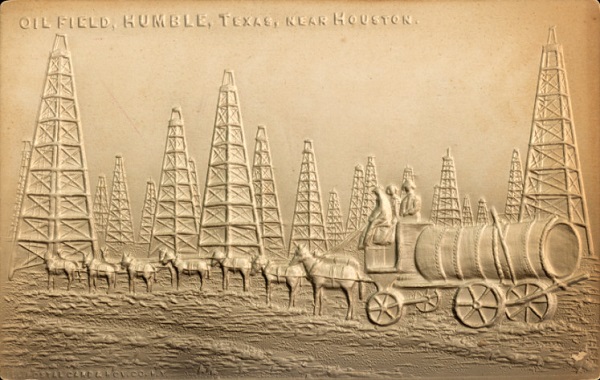
Embossed, circa 1915 Postal Card & Novelty postcard, courtesy University of Houston Digital Library.
“Production from several strata here exceeded the total for fabulous Spindletop by 1946,” notes a local historic marker. “Known as the greatest salt dome field, Humble still produces, and the town for which it was named continues to thrive.” Another giant oilfield discovery in 1903 at nearby Sour Lake helped establish the Texaco Company.
Humble Oil, renamed Humble Oil and Refining Company in 1917, consolidated operations with Standard Oil of New Jersey two years later, eventually leading to ExxonMobil.

January 7, 1957 – Michigan Dairy Farmer finds Giant Oilfield
After two years of drilling, a wildcat well on Ferne Houseknecht’s Michigan dairy farm discovered the state’s largest oilfield. The 3,576-foot-deep well produced from the Black River formation of the Trenton zone.
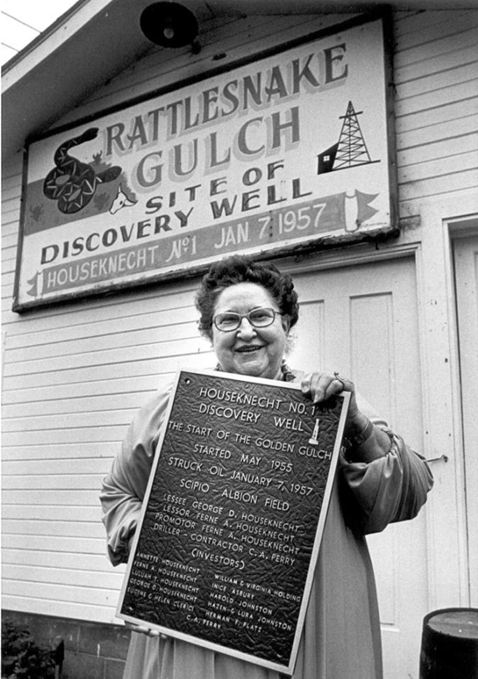
After 20 months of on-again, off-again drilling, Ferne Houseknecht’s well revealed a giant oilfield in the southern Michigan basin.
The Houseknecht No. 1 discovery well at Rattlesnake Gulch revealed a producing region 29 miles long and more than one mile wide. It prompted a drilling boom that led to production of 150 million barrels of oil and 250 billion cubic feet of natural gas from the giant Albion-Scipio field in the southern Michigan basin.
“The story of the discovery well of Michigan’s only ‘giant’ oilfield, using the worldwide definition of having produced more than 100 million barrels of oil from a single contiguous reservoir, is the stuff of dreams,” noted Michigan historian Jack Westbrook
Learn more in Michigan’s “Golden Gulch” of Oil.
January 7, 1913 – “Cracking” Patent improves Refining
William Burton of the Standard Oil Company’s Whiting, Indiana, refinery received a patent for a process that doubled the amount of gasoline produced from each barrel of oil refined. Burton’s invention came as gasoline demand was rapidly growing with the popularity of automobiles. His thermal cracking concept was an important refining advancement, although the process would be superseded by catalytic cracking in 1937.
January 8, 1903 – Sour Lake discovery leads to Texaco
Founded a year earlier in Beaumont, Texas, the Texas Company struck oil with its Fee No. 3 well, which flowed at 5,000 barrels a day, securing the company’s success in petroleum exploration, production, transportation, and refining.
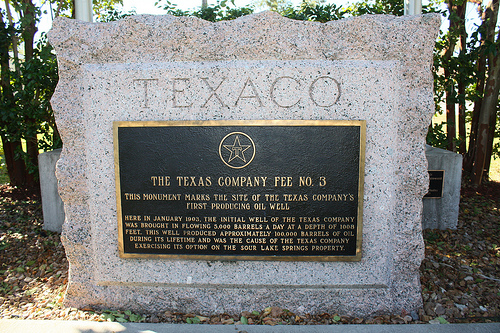
A monument marks the site where the Fee No. 3 well flowed at 5,000 barrels of oil a day in 1903, helping the Texas Company become Texaco.
“After gambling its future on the site’s drilling rights, the discovery during a heavy downpour near Sour Lake’s mineral springs turned the company into a major oil producer overnight, validating the risk-taking insight of company co-founder J.S. Cullinan and the ability of driller Walter Sharp,” explained a Texaco historian. The Sour Lake field — and wells drilled in the Humble oilfield two years later — led to the Texas Company becoming Texaco (acquired by Chevron in 2001).
Learn more in Sour Lake produces Texaco.

January 10, 1870 – Rockefeller incorporates Standard Oil Company
John D. Rockefeller and five partners incorporated the Standard Oil Company in Cleveland, Ohio. The new oil and refining venture immediately focused on efficiency and growth. Instead of buying barrels, the company bought tracts of oak timber, hauled the dried timber to Cleveland on its own wagons, and built its own 42-gallon oil barrels.
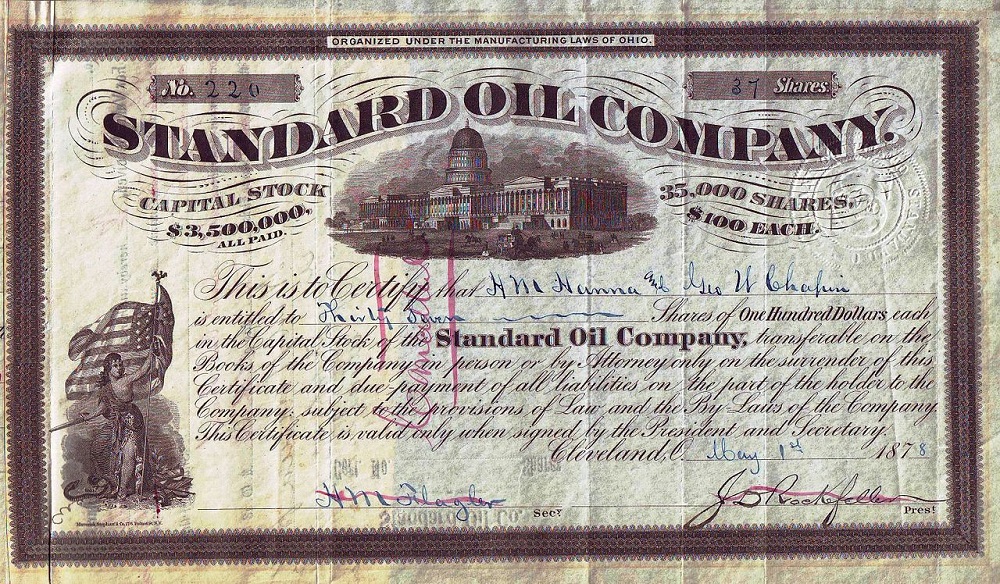
A stock certificate issued in 1878 for Standard Oil Company, which would become Standard Oil of Ohio (Sohio) following the 1911 breakup of John D. Rockefeller’s oil monopolies.
Standard Oil’s cost per wooden barrel dropped from $3 to less than $1.50 as the company improved refining methods to extract more kerosene per barrel of oil (there was no market for gasoline). By purchasing properties through subsidiaries, dominating railroads, and using local price-cutting, Standard Oil captured 90 percent of America’s refining capacity.
January 10, 1901 – Spindletop launches the Modern Petroleum Industry
The modern U.S. oil and natural gas industry began on a small hill in southeastern Texas when a wildcat well erupted near Beaumont. The Spindletop field, which yielded 3.59 million barrels of oil by the end of 1901, would produce more oil in one day than all the rest of the world’s oilfields combined.
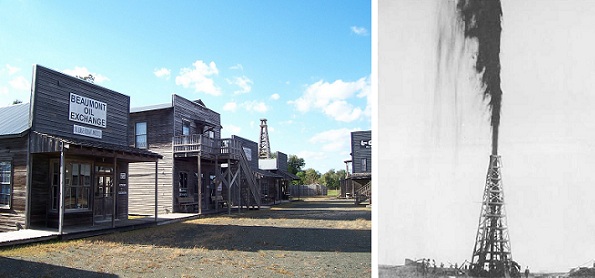
The Spindletop-Gladys City Boomtown Museum in Beaumont, Texas, opened in 1976 to educate visitors about the importance of the 1901 “Lucas Gusher.”
The “Lucas Gusher” and other nearby discoveries changed American transportation by providing abundant oil for cheap gasoline. The drilling boom would bring hope to a region devastated just a few months earlier by the Galveston Hurricane, still the deadliest in U.S. history. Petroleum production from the well’s geologic salt dome had been predicted by Patillo Higgins, a self-taught geologist and Sunday school teacher.
Learn more in Spindletop launches Modern Petroleum Industry.
January 10, 1919 – Elk Hills Oilfield discovered in California
Standard Oil of California discovered the Elk Hills field in Kern County, and the San Joaquin Valley soon ranked among the most productive oilfields in the country. It became embroiled in the 1920s Teapot Dome lease scandals and yielded its billionth barrel of oil in 1992. Visit the petroleum exhibits of the Kern County Museum in Bakersfield and at the West Kern Oil Museum in Taft.
January 10, 1921 – Oil Boom arrives in Arkansas
“Suddenly, with a deafening roar, a thick black column of gas and oil and water shot out of the well,” noted one observer in 1921 when the Busey-Armstrong No. 1 well struck oil near El Dorado, Arkansas. H.L. Hunt would soon arrive from Texas (with $50 he had borrowed) and join lease traders and speculators at the Garrett Hotel — where fortunes were soon made and lost. “Union County’s dream of oil had come true,” reported the local paper. The giant Arkansas field would lead U.S. oil output in 1925 with production reaching 70 million barrels.
Learn more in First Arkansas Oil Wells.
January 11, 1926 – “Ace” Borger discovers Oil in North Texas
Following early 1920s Gulf Oil Company oil and natural gas discoveries in Carson County of the Texas Panhandle, Dixon Creek Oil and Refining Company completed a wildcat well in southern Hutchinson County. Drilled by A.P. “Ace” Borger of Tulsa, Oklahoma, on a 240-acre lease, the Smith No. 1 well flowed at 10,000 barrels of oil per day. By September, the field was producing more than 165,000 barrels of oil a day.
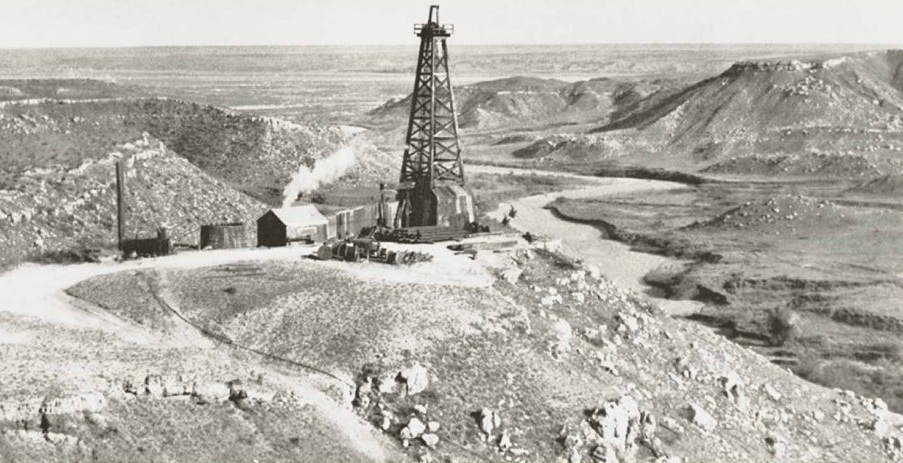
Cable-tool drilling in the Texas Panhandle’s Hutchinson County led to a 1926 oilfield discovery at Dixon Creek Canyon, where the town of Borger would soon be born. Photo courtesy Hutchinson County Historical Museum.
After establishing his Borger Townsite Company, Borger laid out streets and sold lots for the town, which grew to 15,000 residents in 90 days. When the oilfield produced large amounts of natural gas, the town named its minor league baseball team the Borger Gassers. The team left the league in 1955 (owners blamed air-conditioning and television for reducing attendance).
Dedicated in 1977, the Hutchinson County Boom Town Museum in Borger celebrates “Oil Boom Heritage” every March.
_______________________
Recommended Reading: Myth, Legend, Reality: Edwin Laurentine Drake and the Early Oil Industry (2009); Humble, Images of America


_______________________
The American Oil & Gas Historical Society (AOGHS) preserves U.S. petroleum history. Please become an AOGHS annual supporter and help maintain this energy education website and expand historical research. For more information, contact bawells@aoghs.org. Copyright © 2026 Bruce A. Wells. All rights reserved.