February 09, 1953 – TIME features “Fire Beater” Myron Kinley –
Myron M. Kinley — born in 1896 in Santa Barbara, California, the son of an oil well shooter — was featured in a TIME magazine article about a blowout and fire on a drilling platform 14 miles off the coast of Louisiana. “The oilmen knew what to do. They put in a hurry call to the world’s most famous oil-fire fighter,” the article noted.
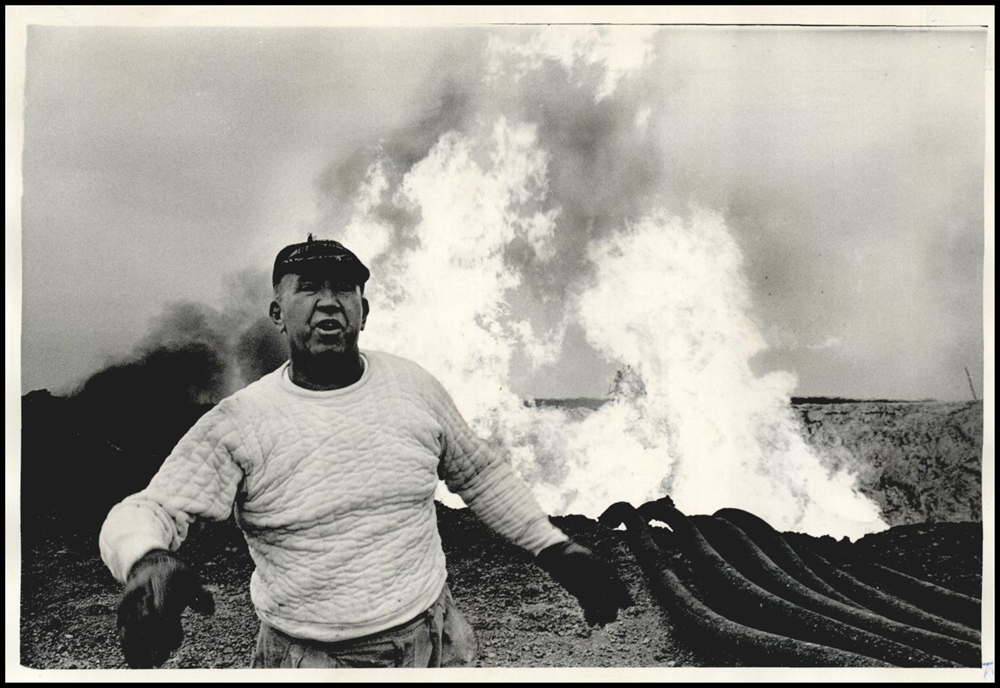
A 1965 Daily Oklahoman photo with Myron Kinley demonstrating “the courage and coolness under fire that won him fame and fortune during an almost legendary 40-year career of fighting oil well fires throughout the world.” Photo by Frank Granger courtesy Oklahoma Historical Society.
Kinley developed many oil well firefighting tools and techniques — and trained many others in their use, including Red Adair, “Boots” Hansen and “Coots” Mathews (Boots & Coots). Any company in the oilfield firefighting business today can trace its roots to Myron Kinley, who died at home in Chickasha, Oklahoma, in 1978.
February 9, 2013 – First Well drilled on Mars
Images transmitted from NASA’s robotic rover Curiosity confirmed it successfully drilled on the Martian surface, accomplishing “history’s first ever drilling and sampling into a pristine alien rock on the surface of another planet in our solar system,” according to Universe Today.
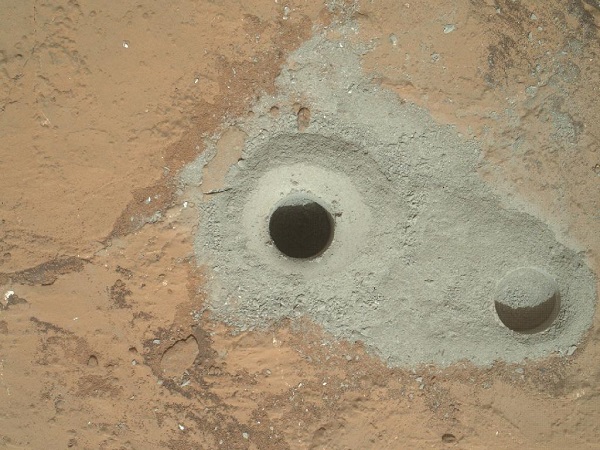
Mars rover Curiosity tested its rotary-percussion bit by drilling a shallow hole (at right) before completing the first well on another planet. Photo courtesy NASA.
While exploring the Red Planet’s Yellowknife Bay Basin, Curiosity paused to drill for the first time, making a hole .63 inches wide and 2.5 inches deep. A rotary-percussion drill bit at the end of a seven-foot robotic arm penetrated a “red slab of fine-grained sedimentary rock with hydrated mineral veins of calcium sulfate.”
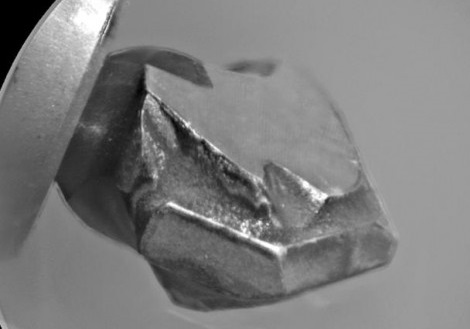
The “rotary-percussion” bit of Curiosity measured .6 of an inch wide. Photo courtesy NASA/JPL.
Images beamed from the site included a drill test next to the historic borehole. After completing Mars No. 1 (unofficial name), the one-ton rover drilled many others using its slow, “low-percussion” technique. Learn about terrestrial drilling methods in Making Hole – Drilling Technology.
February 10, 1910 – Discovery of Giant California Oilfield
Honolulu Oil Corporation discovered the Buena Vista oilfield in Kern County, California. The well, originally known as “Honolulu’s Great Gasser,” drilled deep into oil-producing sands for production of 3,500 barrels of oil a day. Steam injection operations helped the field produce “heavy” (high viscosity) oil from depths near 4,000 feet.
In 1912, as the Navy began converting its warship boilers from coal to oil (see Petroleum & Sea Power), the San Joaquin Valley oilfield was designated Naval Petroleum Reserve No. 2. The Department of Energy leased 90 percent of the 30,000-acre Buena Vista reserves to private oil companies in 2020.
February 10, 1917 – Petroleum Geologists Organize in Tulsa
About 90 geologists gathered in Oklahoma to form an association where “only reputable and recognized petroleum geologists are admitted.” They met at Henry Kendall College, now Tulsa University, to establish the Southwestern Association of Petroleum Geologists, today’s American Association of Petroleum Geologists (AAPG).
AAPG began in Oklahoma as the Southwestern Association of Petroleum Geologists.
Adopting its current name in 1918, AAPG also launched its peer-reviewed scientific journal, the Bulletin. By 1920, industry trade magazines were praising the association’s professionalism and success in combating “unscrupulous and inadequately prepared men who are attempting to do geological work.”
AAPG in 1945 formed a committee to assist the Boy Scouts of America with a geology merit badge and the AAPG Foundation supports a Distinguished Lecture program. The association’s 2025 membership has reached almost 40,000 members, including 8,000 students, in 129 countries. Learn more in AAPG – Geology Pros since 1917.
February 10, 1956 – Frank Lloyd Wright’s “Prairie Skyscraper”
Harold C. Price Sr., founder of the pipeline construction company H.C. Price, dedicated his headquarters building in Bartlesville, Oklahoma. The 19-story concrete and copper office tower remains the only skyscraper designed by architect Frank Lloyd Wright.
Established in 1921, H.C. Price specialized in field welding oil storage tanks and electric welding of pipelines. The company helped construct the “Big Inch” pipelines during WWII and built large sections of the 800-mile Trans-Alaska Pipeline.
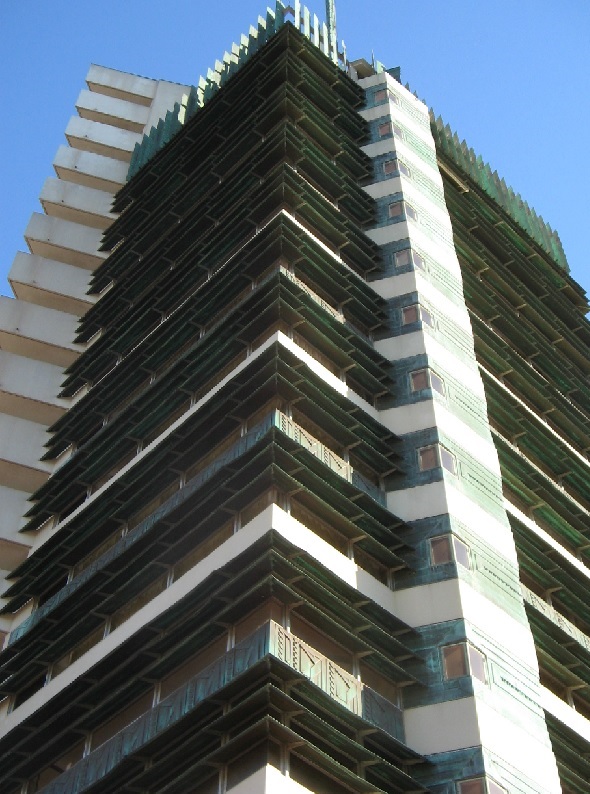
Once a pipeline company headquarters, the Price Tower in Bartlesville, Oklahoma, was listed on the National Register of Historic Places in 1974. Photo by Bruce Wells.
Wright — who in 1954 designed the Price family residence in Phoenix, Arizona — created the Bartlesville “Prairie Skyscraper” in four quadrants, “based on the geometry of a 30-60-90 degree double parallelogram module” with one quadrant for apartments and three for offices, according to the current occupant, Price Tower Arts Center. The National Register of Historic Places added the former pipeline company headquarters building in 1974.
February 12, 1954 – First Nevada Oil Well
After hundreds of dry holes (the first drilled near Reno in 1907), Nevada became a petroleum-producing state. Shell Oil Company’s second test of its Eagle Springs No. 1 well in Nye County produced commercial amounts of oil. The routine test revealed petroleum production from depths between 6,450 feet and 6,730 feet.
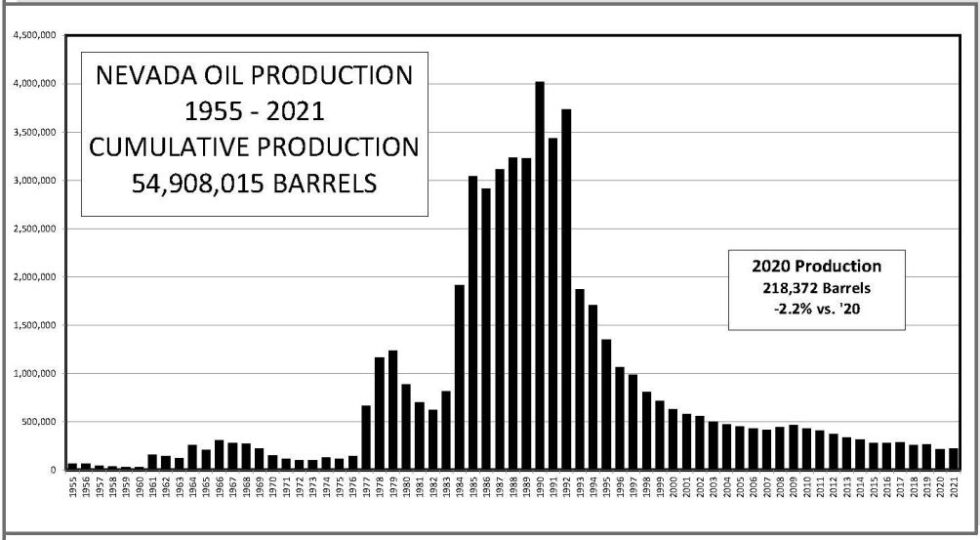
Nevada’s annual oil production peaked in 1990 at about 4 million barrels of oil. The state produced about 175,000 barrels of oil in 2024. Chart courtesy Nevada Division of Minerals.
The Eagle Springs oilfield eventually produced 3.8 million barrels of oil. It took 20 more years to find Nevada’s second oilfield took two more decades. In 1976, the Northwest Exploration Company completed its Trap Spring No. 1 well in Railroad Valley, five miles west of the Eagle Springs oilfield. Learn more in First Nevada Oil Well.
February 12, 1987 – Texaco Fine upheld for Getty Oil Takeover Attempt
A Texas court upheld a 1985 decision against Texaco for having initiated an illegal takeover of Getty Oil after Pennzoil had made a bid for the company. By the end of the year, the companies settled their historic $10.3 billion legal battle for $3 billion when Pennzoil agreed to drop its demand for interest. The compromise was vital for Texaco emerging from bankruptcy, a haven it had sought to stop Pennzoil from enforcing the largest court judgment ever awarded at the time, according to the Los Angeles Times.

February 13, 1924 – Forest Oil adopts Yellow Dog Logo
Forest Oil Company, founded in 1916 as an oilfield service company by Forest Dorn and his father Clayton, adopted a logo featuring the two-wicked “yellow dog” oilfield lantern. The logo included a keystone shape to symbolize the state of Pennsylvania, where Forest Oil pioneered water-flooding methods to improve production from the 85,000-acre Bradford oilfield.
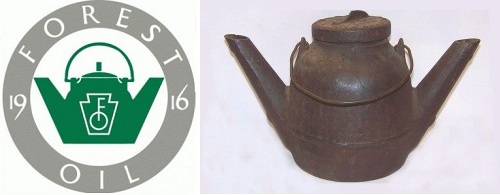
Forest Oil Company adopted the “yellow dog” lantern logo in 1924. eight years after being founded in Bradford, Pennsylvania,
Forest Oil Company‘s oilfield water-injection technology, later adopted throughout the petroleum industry, helped keep America’s first billion-dollar oilfield producing to the present day. Patented in 1870, the popular derrick lamp’s name was said to come from the two burning wicks resembling a dog’s eyes glowing at night.
February 13, 1977 – Texas Ranger “El Lobo Solo” dies
“El Lobo Solo” — The Lone Wolf — Texas Ranger Manuel T. Gonzaullas died at age 85 in Dallas. During much of the 1920s and 1930s, he had earned a reputation as a strict law enforcer in booming oil towns.
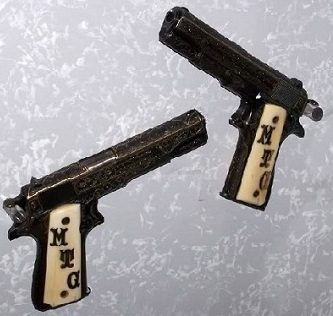
Texas Ranger Manuel Gonzaullas’ .45 “working pistols” featured his initials and the trigger guards cut away.
When Kilgore became “the most lawless town in Texas” after the discovery of the East Texas oilfield in 1930, Gonzaullas was chosen to tame it. “Crime may expect no quarter in Kilgore,” the Texas Ranger once declared. He rode a black stallion named Tony and sported a pair of 1911 .45 Colts with his initials on the handles.
“He was a soft-spoken man, and his trigger finger was slightly bent,” noted independent producer Watson W. Wise in 1985. “He always told me it was geared to that .45 of his.” Learn more in Manuel “Lone Wolf” Gonzaullas, Texas Ranger.
February 15, 1982 – Deadly Atlantic Storm sinks Drilling Platform
With rogue waves reaching as high as 65 feet during an Atlantic cyclone, offshore drilling platform Ocean Ranger sank on the Grand Banks of Newfoundland, Canada, killing all 84 on board. At the time, the world’s largest semi-submersible platform, the Ocean Ranger, had been drilling a third well in the Hibernia oilfield for Mobil Oil of Canada.
The deadly weather system also engulfed a Soviet container ship 65 miles east of the platform, resulting in the loss of 32 crew members. A 1983 Coast Guard Marine Casualty Report about Ocean Ranger led to improved emergency procedures, lifesaving equipment, and manning standards for Mobile Offshore Drilling Unit (MODU) operations.

_______________________
Recommended Reading: Trek of the Oil Finders: A History of Exploration for Petroleum (1975); Mars Rover Curiosity: An Inside Account from Curiosity’s Chief Engineer


_______________________
The American Oil & Gas Historical Society (AOGHS) preserves U.S. petroleum history. Become an annual supporter to help maintain this energy education website, a monthly newsletter, this week in oil and gas history, and expand historical research. Please contact bawells@aoghs.org. Copyright © 2026 Bruce A. Wells. All rights reserved.