December 1, 1865 – Lady Macbeth arrives in Famed Boom Town –
Shakespearean tragedienne Miss Eloise Bridges starred as Lady Macbeth in Pithole, Pennsylvania — America’s first famously notorious oil boom town. A January 1865 oilfield discovery had launched the drilling frenzy that created Pithole, which within a year had 57 hotels, a daily newspaper, and the third busiest post office in Pennsylvania.
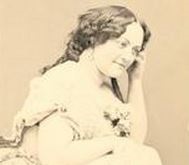
Star of the stage in boomtown Pithole, Pennsylvania, Eloise Bridges, circa 1865.
Bridges appeared at Murphy’s Theater, the biggest building in a town of more than 30,000 teamsters, coopers, lease traders, roughnecks, and merchants. Three stories high, the building included 1,100 seats, a 40-foot stage, an orchestra, and chandelier lighting by Tiffany.
Bridges was the acclaimed darling of the Pithole stage. Eight months after she departed for new engagements in Ohio, Pithole’s oil ran out; the most famous U.S. boomtown collapsed into empty streets and abandoned buildings. Today, visitors can walk the grassy streets of the historic ghost town.
Learn more in Oil Boom at Pithole Creek.
December 1, 1901 – Indian Territory Illuminating Oil Company
With almost 1.5 million acres of Osage Indian Reservation under a 10-year lease expiring in 1906, Henry V. Foster organized the Indian Territory Illuminating Oil Company by combining the Phoenix Oil Company and Osage Oil Company. The lease provided the Osage with a 10 percent royalty on oil produced and $50 per year for each natural gas well (see Million Dollar Elm).
Although debt would drive the Indian Territory Illuminating Oil Company into receivership, the company emerged thanks to partnering with Theodore Barnsdall, who helped Foster complete 361 wells by the end of 1904. Barnsdall’s interests were sold to a Cities Service Company subsidiary for $40 million in 1912. Henry Foster discovered the Oklahoma City oilfield on December 4, 1928.

December 1, 1913 – First U.S. Drive-In Service Station
Gulf Refining Company opened America’s first drive-in service station at the corner of Baum Boulevard and St. Clair Street in Pittsburgh, Pennsylvania, and sold “Good Gulf Gasoline” for 27 cents per gallon.
Unlike earlier curbside gasoline filling stations, the purposefully designed pagoda-style brick facility offered air, water, crankcase service, and tire and tube installation. A manager and four attendants stood nearby. The service station’s lighted marquee provided shelter.
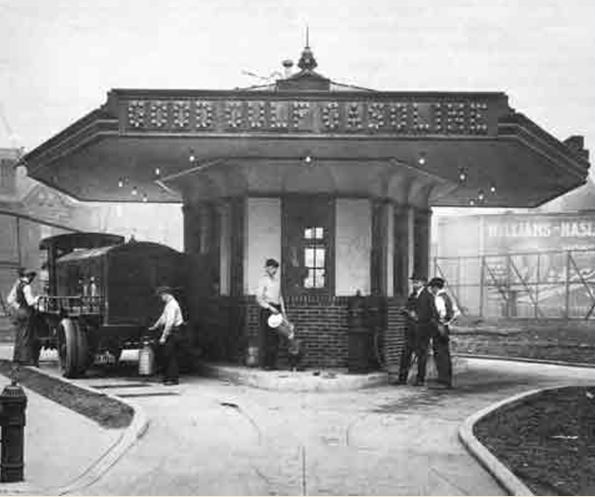
Gulf Refining Company opened the first service station (above) in 1913 on “automobile row,” Baum Boulevard in Pittsburgh. Photo courtesy Gulf Oil Historical Society.
“On its first Saturday, Gulf’s new service station pumped 350 gallons of gasoline,” notes the Pennsylvania Historical and Museum Commission. A July 2000 historical marker adds, “Prior to the construction of the first Gulf station in Pittsburgh and the countless filling stations that followed throughout the United States, automobile drivers pulled into almost any old general or hardware store, or even blacksmith shops in order to fill up their tanks.”
When the Pittsburgh station opened in 1913, Baum Boulevard already was known as “automobile row” because of dealerships located along the roadway. In addition to gas, the Gulf station sold the first U.S. commercial road maps.
Learn more in First Gas Pump and Service Station.
December 1, 1960 – Lucy’s Broadway Oil Musical
Lucille Ball debuted in “Wildcat” — her first and last foray onto Broadway. Critics loved Lucy but hated the show. She played the penniless “Wildcat Jackson,” scrambling to find an oil gusher in a dusty Texas border town, circa 1912.
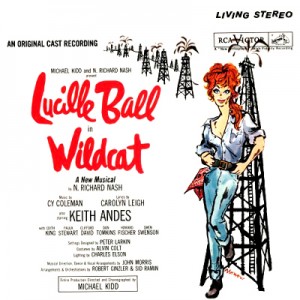
Oil gushers featured on the album cover of the 1960 Broadway musical “Wildcat.”
“Wildcat went prospecting for Broadway oil but drilled a dry hole,” proclaimed a New York Times critic. Although some audiences appreciated a rare oil patch musical, after 171 performances, the show closed.
December 2, 1942 – Roosevelt creates Petroleum Administration for War
President Franklin D. Roosevelt established the Petroleum Administration for War “for the successful prosecution of the war and other essential purposes.” The executive order came after oil and natural gas industry leaders met with Interior Secretary Harold L. Ickes, head of the newly created Office of Petroleum Coordinator for National Defense, which established five districts for managing gasoline rationing.
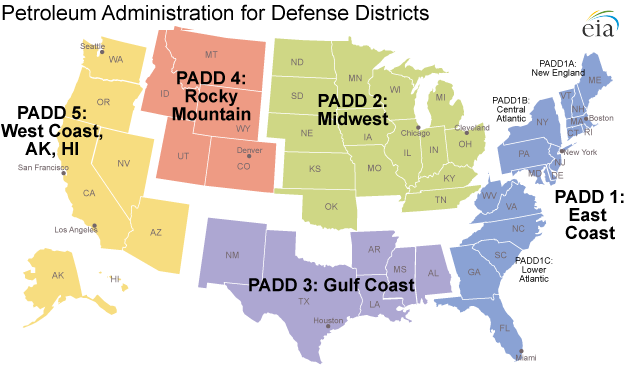
Established to assist gasoline rationing during World War II, five Petroleum Administration for Defense Districts (PADDs) have remained in use. Map courtesy Energy Information Administration (EIA).
Although Roosevelt ended the Petroleum Administration for War in May 1946, Congress passed the Defense Production Act of 1950, with the Petroleum Administration for Defense using the same five regions as the Petroleum Administration for Defense Districts (PADDs).
“While the PADD system might seem a bit archaic, studying the movements of petroleum products between the PADD regions is useful for understanding how these markets are segmented in the United States,” notes the College of Earth and Mineral Sciences at Penn State University.
December 2, 2001 – Enron files for Bankruptcy
Enron Corporation, once the world’s largest energy-trading company, filed for Chapter 11 bankruptcy protection, beginning one of the largest corporate scandals in U.S. history. The Houston-based company had reached a market value of almost $70 billion before it collapsed, causing thousands of employees to lose their jobs and more than $2 billion in pensions.
In 2006, former Enron Chairman Kenneth Lay and former Chief Operating Officer Jeffrey Skilling were convicted in federal district court of multiple counts of securities and wire fraud. New state and federal accounting regulations resulted from the financial scandal.

December 2, 1970 – President Nixon establishes EPA
Eleven months after the 1969 offshore platform oil spill at Santa Barbara, California, President Richard M. Nixon established the U.S. Environmental Protection Agency to consolidate the federal government’s environmental responsibilities under one agency.

The new agency combined “a variety of federal research, monitoring, standard-setting, and enforcement activities to ensure environmental protection” with Assistant Attorney General William Ruckelshaus serving as the first administrator.
Environmental initiatives included the improvement of water treatment facilities; creation of national air quality standards; guidelines to lower motor vehicle emissions; a proposed tax on lead additives in gasoline; cleanup of federal facilities; and tightening of safeguards on the seaborne transportation of oil, according to an EPA history.
December 4, 1928 – Reflection Seismography reveals Oilfield
Following tests in the early 1920s, reflection seismic technology was first used to find oil when Amerada Petroleum Corporation drilled a well into the Viola limestone formation near Seminole, Oklahoma.
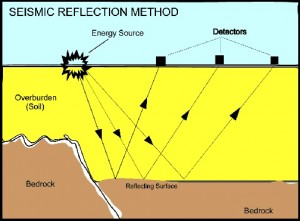
Seismic reflections help identify geologic formations, here reflecting from the top of bedrock to detectors on the surface. Image courtesy Geologic Resources.
The Amerada Petroleum well was the world’s first oil discovery in a geological structure that had been identified by reflection survey. Others soon followed as the technology revealed dozens of mid-continent oilfields.
Conducted by Amerada Petroleum subsidiary Geophysical Research, the new exploration method resulted from experiments by an academic team led by Professor John C. Karcher of the University of Oklahoma. Reflection seismography — seismic surveying — applied techniques from weapons research. During World War I, Allied scientists developed portable equipment that used seismic reflections to locate sources of enemy artillery fire.
Learn more in Exploring Seismic Waves.
December 4, 1928 – Oklahoma City Oilfield discovered
Henry V. Foster’s Indian Territory Illuminating Oil Company and his Foster Petroleum Corporation completed the Oklahoma City No. 1 well, revealing the Oklahoma City oilfield. Drilled just south of the city limits, the 6,335-foot-deep well produced 110,000 barrels of oil in its first 27 days, causing a rush of development that quickly extended the field northward toward the capitol building.
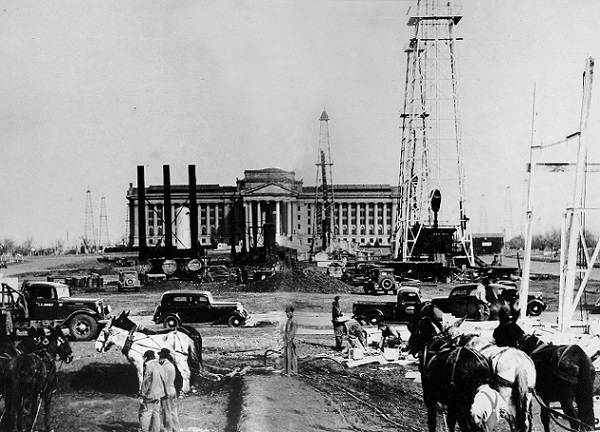
The Oklahoma City oilfield would bring stability to the economy of Oklahoma during the Great Depression. Photo courtesy Library of Congress.
Drilling reached the city limits in May 1930, prompting the city council to pass ordinances limiting drilling to the southeast and allowing only one well per city block. With 870 producing wells completed by 1932, the field’s production peaked at 67 million barrels of oil. “From such a beginning the sprawling Oklahoma City oil and natural gas field will become one of the world’s major oil-producing areas,” notes a 1980 state historical marker.
Already known as Oklahoma’s King of the Wildcatters, Thomas Slick completed many wells in the giant oilfield. When the highly pressurized Wilcox sands produced another gusher in 1930, the column of oil made worldwide headlines as the “Wild Mary Sudik.”
December 7, 1905 – Helium discovered in Natural Gas
University of Kansas professors Hamilton Cady and David McFarland revealed the importance of natural gas for producing helium when they discovered the rare gas in a well 45 miles southeast of Wichita. Two years earlier, the Gas, Oil and Developing Company had drilled the well at Dexter, which produced “a howling gasser” from a depth of just 560 feet.
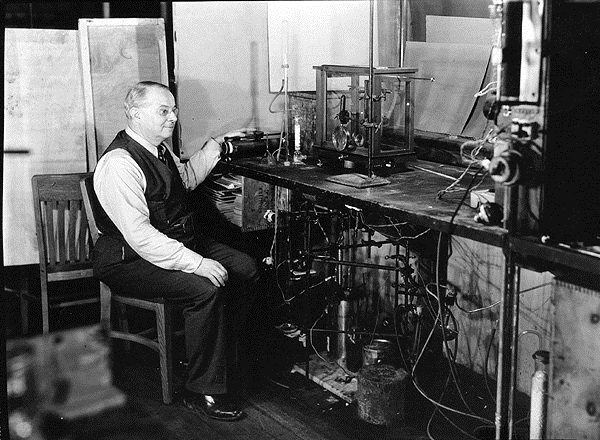
University of Kansas Professor Hamilton Cady in 1905 discovered helium could be extracted from natural gas, thanks to a well at Dexter. Helium was considered a key strategic resource at the time. Photo courtesy American Chemical Society.
The town envisioned a future attracting new industries — until it was found the gas would not burn. Experiments revealed helium associated with natural gas, causing scientists to predict helium would no longer be rare, but “a common element, existing in goodly quantity for uses that are yet to be found for it.”
The Dexter “Gas That Wouldn’t Burn” led to more scientific advances and a multi-million dollar industry, according to the American Chemical Society, which in 2000 designated the “Discovery of Helium in Natural Gas at the University of Kansas” a National Historic Chemical Landmark.
Learn more in Kansas “Wind Gas” Well.
_______________________
Recommended Reading: Cherry Run Valley: Plumer, Pithole, and Oil City, Pennsylvania, Images of America


_______________________
The American Oil & Gas Historical Society (AOGHS) preserves U.S. petroleum history. Please become an AOGHS annual supporter and help maintain this energy education website and expand historical research. For more information, contact bawells@aoghs.org. Copyright © 2025 Bruce A. Wells. All rights reserved.