

September 14, 1871 – President Grant visits Pennsylvania Oil Regions –
President Ulysses S. Grant and his family arrived at Titusville, Pennsylvania, on a special train. The 18th president thanked residents for the reception and noted it was his first visit to the oil regions, adding, “I am aware that this section of the country furnished its full share of men and means for suppression of the rebellion, and your efforts in the discovery and production of petroleum aided materially in supplying the sinews of war, as a medium of foreign exchange, taking the place of cotton.”
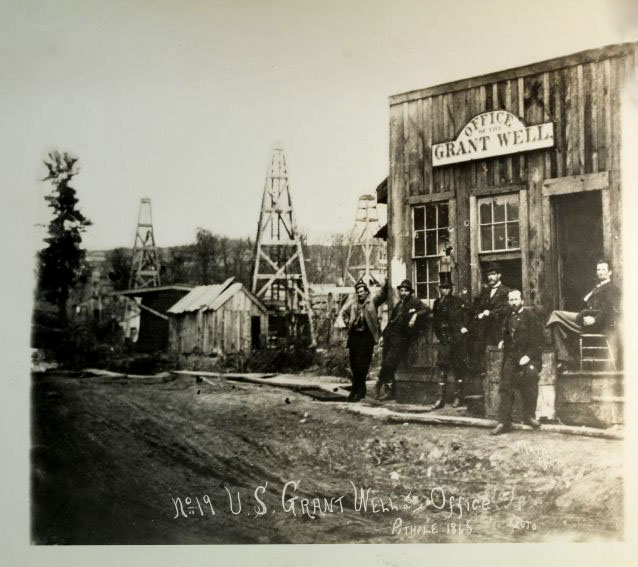
At Pithole, Pennsylvania, an 1865 photograph shows the No. 19 Grant well (and office), presumably named after the Union Army’s top general, according to the Oil Region Library Association.
According to “Hidden Heritage” of the Oil Region Library Association, “Grant spoke to oil producers at the Oil Exchange, enjoyed lunch at the Duncan House and then headed via train to Reno, where he stopped to witness a gushing oil well.” President Grant observed the scene with “silent astonishment,” noted the local newspaper.
President Grant’s oil regions trip included visits to Petroleum Centre, Oil City, Franklin, and Pittsburgh. In 1876, seeking to improve roads in the nation’s capital, he directed that Pennsylvania Avenue be paved (see Asphalt Paves the Way).
September 14, 1929 – West Texas Well sets Record
A West Texas well struck oil at a depth of 1,070 feet and produced an astounding 204,672 barrels of oil a day — the nation’s most productive single well up until that time. The Yates 30-A initially produced 8,528 barrels of oil per hour, according to the Handbook of Texas Online. The Pecos County well was drilled just a few hundred yards from the 1926 discovery well of the giant Yates field.
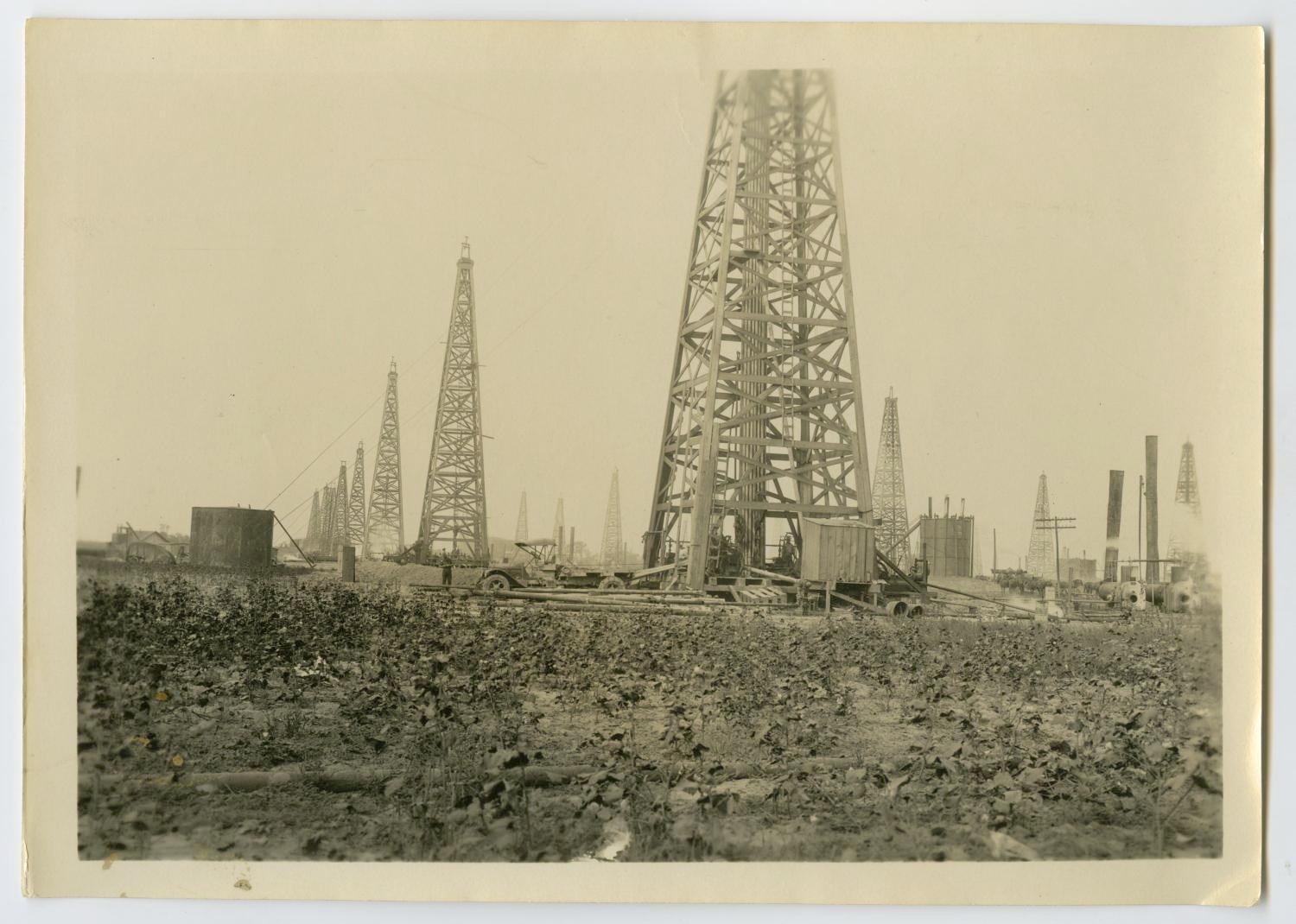
Circa 1920s photo of rows of Texas wooden derricks by oilfield photographer J.R. Rogers, who opened a studio in Cisco in 1921. Photo courtesy Dublin Historical Museum via The Portal to Texas History.
First discovered in 1920, the Permian Basin’s massive size had been confirmed in 1923 by the Santa Rita No. 1 well. Pecos County alone covers more than 4,700 square miles. The 1929 Yates 30-A well, operated by Transcontinental Oil Company and Mid-Kansas Oil and Gas Company (at the time a subsidiary of Ohio Oil Company), brought an economic boom to Midland and Odessa.
“The Yates field, among the largest ever found in the United States, has been in continuous production for 85 years and has been exploited by a list of oil companies, some of them no longer in existence,” noted the Houston Chronicle in 2011. The Yates oilfield produced its one-billionth barrel of oil in 1985.
September 14, 1960 – OPEC founded in Baghdad
The Organization of the Petroleum Exporting Countries (OPEC) was created at the Baghdad Conference by Iran, Iraq, Kuwait, Saudi Arabia, and Venezuela (later joined by nine other countries). Headquartered in Vienna, Austria, since 1965, OPEC’s stated objectives were to “coordinate and unify petroleum policies among member countries in order to secure fair and stable prices for petroleum producers; an efficient, economic and regular supply of petroleum to consuming nations; and a fair return on capital to those investing in the industry.”


September 15, 1886 – Trenton Field brings Indiana Gas Boom
The Eaton Mining & Gas Company, recently established by George W. Carter and a group of investors, discovered a giant natural gas field near Portland, Indiana, at a depth of 922 feet. They had been encouraged by earlier discoveries, including the January “Great Karg Well” in Ohio. The Indiana well revealed what proved to be the Trenton Limestone.
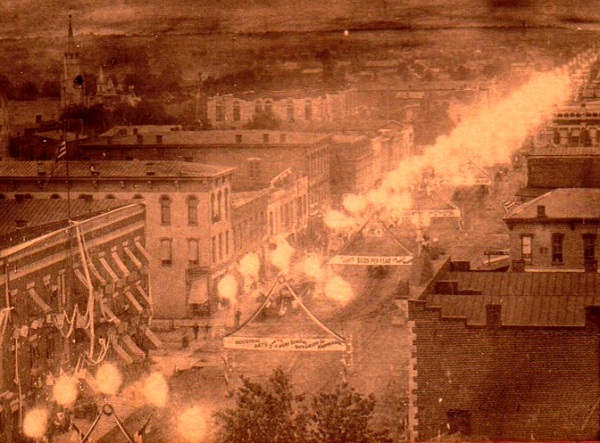
Cities in Indiana and Ohio erected “flambeaux” arches to attract new industries. Indiana banned them in 1891, an early effort to legislate conservation. Photo of Findlay, Ohio, during its 1888 Gas Jubilee courtesy Hancock Historical Museum.
Thanks to the Trenton Formation stretching more than 5,100 square miles across 17 counties, Indiana soon became the world’s largest natural gas producer. Within three years of the discovery, more than 200 companies were drilling, distributing, and selling natural gas. Learn more in Indiana Natural Gas Boom.
September 15, 1903 – Improved Portable Drilling Machine Patented
Seth Powers of Stanberry, Missouri, received a patent for his “Combined Well Boring and Rock Drilling Machine.” The wheel-mounted, cable-tool framework — used primarily for water wells but capable of finding oil — included a derrick, steam engine, and boring augers.
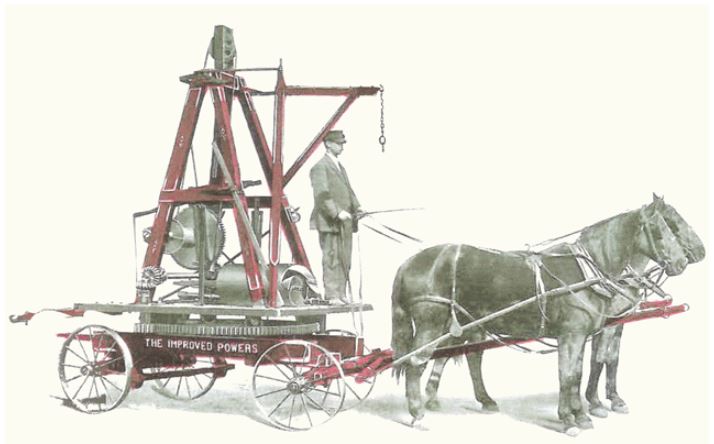
Seth Powers manufactured a portable drilling rig for boring deeper wells. Image courtesy Superstition Mountain Museum.
Lisle Manufacturing Company promoted the improved technology as a “One-Man Machine” for boring deep wells. By World War I, the company offered a complete line of portable drilling machines, which could bore up to 1,000 feet deep with the gasoline-powered model.
The Superstition Mountain Lost Dutchman Museum east of Phoenix, Arizona, preserves an original 1903 version of the Improved Powers Well Boring Machine.
September 16, 1908 – Carriage Maker incorporates General Motors
William Crapo “Billy” Durant, co-owner of America’s largest manufacturer of horse-drawn carriages, founded General Motors Holding Company in Flint, Michigan. The Durant-Dort Carriage Company, which had taken control of Buick Motor Company, would soon acquire Olds Motor Works of Detroit.
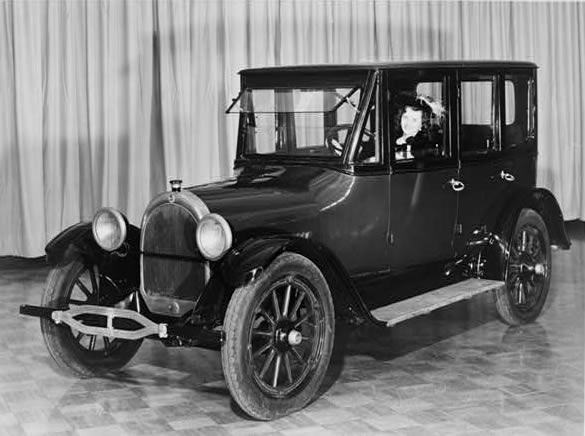
General Motors sold its 1,000,000th car in 1919, an Oldsmobile 37-B model. Photo courtesy Library of Congress.
Within two years, Durant’s General Motors purchased dozens of auto manufacturing companies, including Cadillac and Oakland Motor Car (Pontiac). Durant attempted to acquire Ford Motor Company, but his bankers denied a “buy-out loan” of $9.5 million.
Durant was ousted from GM for overextending the company’s finances but returned in 1918 after arranging a reverse merger with Chevrolet Motor Car Company, which he had founded with Louis and Arthur Chevrolet in 1911, a decade after the first U.S. auto show. In 1955, GM became the first American company to make more than $1 billion in a single year.

September 17, 2021 – Celebrating a Giant Pennsylvania Oilfield
Bradford, Pennsylvania, celebrated the 150th anniversary of the discovery of “America’s first billion-dollar oilfield” and the 50th anniversary of the opening of the Penn-Brad Oil Museum. “We look forward to the future, but we celebrate the wealth of our history,” noted the Chamber of Commerce.
Pennsylvanians celebrated anniversaries of the nation’s first billion-dollar oilfield and the oil museum that opened 100 years later to preserve its history.
The Allegheny National Forest Visitors Bureau released a brief promotional video about the museum and Bradford, once the “high-grade oil metropolis of the world.” One decade after its 1871 discovery, the Bradford field alone produced more than 80 percent of all oil used in the United States — and 70 percent of the world’s production.
September 18, 1855 – First U.S. Oil Company reorganizes
In need of more capital, George Bissell and partner Jonathan Eveleth reorganized their New York-based Pennsylvania Rock Oil Company, the first U.S. petroleum exploration company, into the Seneca Oil Company of New Haven, Connecticut. They continued to seek investors for drilling a well to produce oil that could be refined into kerosene.
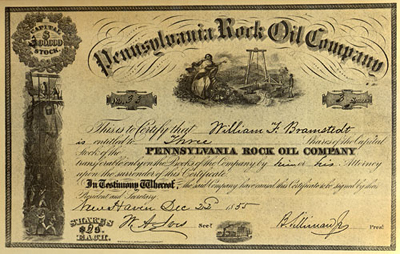
America’s first oil company, Pennsylvania Rock Oil Company, reorganized as Seneca Oil Company of New Haven, Connecticut in 1858, one year before drilling the first U.S. commercial oil well.
The Pennsylvania Rock Oil Company had been established in 1854 to drill a well near Titusville (see George Bissell’s Oil Seeps). The reincorporated business entered New York City’s capital markets, which had shown little interest in drilling for oil, seen as too speculative.
Seneca Oil hired former railroad conductor Edwin L. Drake, who overcame financial and technical obstacles to complete the first U.S. oil well in August 1859.

September 18, 1948 – Oil discovered in Utah
J.L. “Mike” Dougan, president of the Equity Oil Company, completed Utah’s first significant oil well. Dougan’s small company outcompeted larger and better-financed exploration companies, including Standard Oil of California (Socal), Pure Oil, Continental, and Union Oil. His Uinta Basin oilfield discovery launched a deep-drilling boom in Utah.
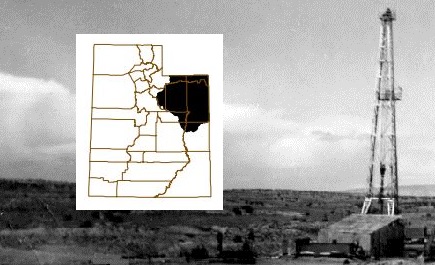
Begun in 1948 in the giant Uinta Basin, Utah’s petroleum industry continues today thanks to reserves of coalbed methane gas.
Unlike earlier attempts, Dougan drilled beyond the typical depth of up to 2,000 feet. His Ashley Valley No. 1 well, 10 miles southeast of Vernal, produced 300 barrels of oil a day from about 4,000 feet.
Uinta Basin production soon averaged almost one million barrels of oil a year from 30 wells. As drilling technologies advanced, companies began drilling to 8,000 feet and deeper. Learn more in First Utah Oil Wells.
September 19, 1902 – Katalla Oilfield Discovered in Alaska Territory
Tom White, known as “The Sourdough Driller,” discovered the first oilfield in Alaska Territory at Katalla, about 50 miles southeast of Cordova. Drilled near coal mines for the Alaska Petroleum and Coal Company, “the gusher took everything away with it, rising nearly 200 feet before it could be capped,” reported the New York Times in a special dispatch from Valdez.


Drilled with cable tools in the early 1900s, Alaska Territory’s early oil wells proved production was possible — but difficult and costly to transport. Photo courtesy University of Alaska Fairbanks Archives.
Lacking petroleum industry infrastructure, production from the Katalla oilfield led to the construction of Alaska Territory’s first refinery, which burned down on Christmas Eve in 1933. With the post office closed by 1938, Katalla became a ghost town. Learn more in First Alaska Oil Wells.
_______________________
Recommended Reading: Myth, Legend, Reality: Edwin Laurentine Drake and the Early Oil Industry


_______________________
The American Oil & Gas Historical Society (AOGHS) preserves U.S. petroleum history. Please support this website, subscribe to the free, monthly email newsletter This Week in Oil and Gas History News, and help expand our historical research. Contact bawells@aoghs.org. Copyright © 2026 Bruce A. Wells. All rights reserved.