

October 5, 1886 – Dresser patents Pipe Coupler –
Solomon R. Dresser (1842-1911) of Bradford, Pennsylvania, received a U.S. patent for his “new and useful improvements in pipe-couplings.” The design created a secure connection between pipes needed for oil and natural gas production in the giant Bradford oilfield.
“The main feature of my invention is to provide in the coupling a recess for a rubber or other elastic packing and then to furnish and adapt means to compress such packing by means of the force or power in the inside of the pipes and force the packing into all the apertures of the joint, thus securing a perfectly tight joint,” explained the founder of S.R. Dresser Manufacturing Company in his 1885 application for Patent No. 359,421.
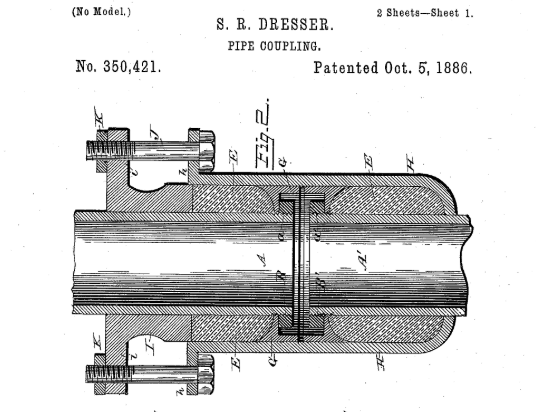
Pipeline coupling enhancements improved the reliability of transmissions, later supporting the growth of the natural gas industry by reducing service interruptions. Dresser earlier patented a rubber “packer” for controlling downhole pressure, sealing the gap between the well and the pipe for pumping the oil.
October 5, 1915 – Science of Petroleum Geology reveals Oilfield
Using the new earth science of petroleum geology for finding oil led to the discovery of the giant Mid-Continent field in central Kansas. Drilled by Wichita Natural Gas Company, a subsidiary of Cities Service Company, the well revealed the 34-square-mile El Dorado oilfield.
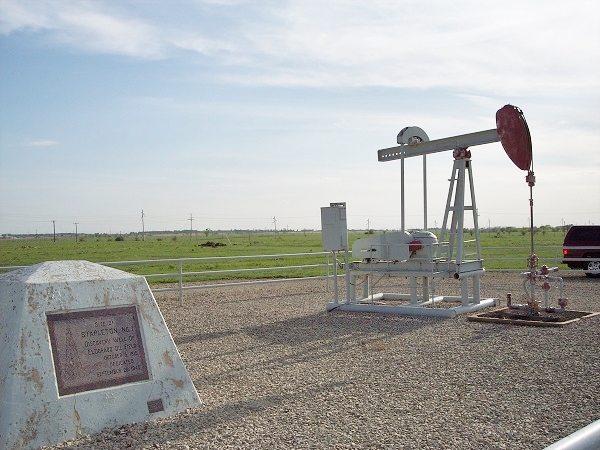
A historic marker erected in 1940 at the Stapleton No. 1 well commemorates the October 5, 1915, scientifically discovered oilfield at El Dorado, Kansas. By 1919, Butler County had more than 1,800 producing oil wells. Photo by Bruce Wells.
“Pioneers named El Dorado, Kansas, in 1857 for the beauty of the site and the promise of future riches, but not until 58 years later was black rather than mythical yellow gold discovered when the Stapleton No. 1 oil well came in on October 5, 1915,” explained geologist Lawrence Skelton in 1997.
The Stapleton No. 1 well east of Wichita initially found oil at a depth of 600 feet before being deepened to 2,500 feet to produce 110 barrels of oil a day from the Wilcox sands. Natural gas discoveries one year earlier at nearby Augusta had prompted El Dorado civic leaders to seek their own geological study of Mid-Continent fields.
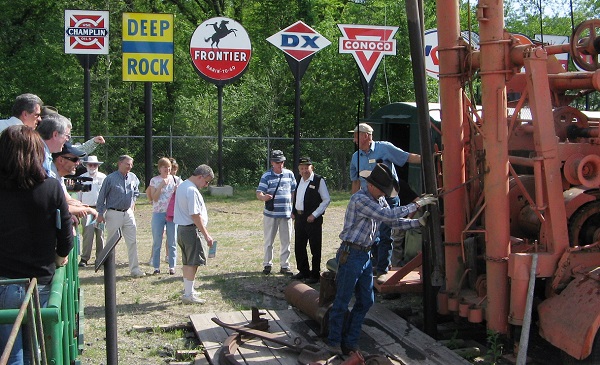
The Butler County Historical Society’s Kansas Oil Museum, among the largest museums in Kansas, includes an energy education center, oilfield equipment demonstrations, and a recreated oil boom town. Photo by Bruce Wells.
The Kansas Oil Museum preserves the state’s petroleum heritage with historic oilfield equipment displayed on 10 acres east of the city. Museum exhibits describe how lessons from the El Dorado field helped launch petroleum geology as a profession while establishing El Dorado as a center for refining.
Learn more in the Kansas Oil Boom.
October 5, 1958 – Permian Basin Water Park opens for One Day
A water park inside a Depression-era experimental concrete oil tank opened to the public in West Texas. The day’s festivities at Monahans attracted swimmers, boaters, anglers, and even water skiers to the massive, manmade lake — before leaks at the seams forced it to close the next day.
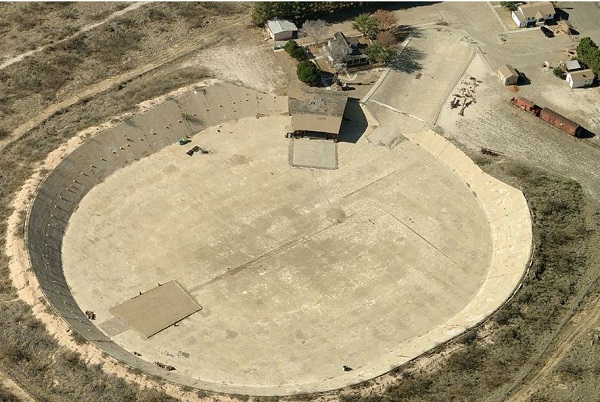
The Million Barrel Museum’s site was originally built to store Permian Basin oil and included pillars supporting a domed redwood roof. For scale, note the railroad car and caboose exhibit at upper right. Photo courtesy Top of Texas Gazette.
A local couple had attempted to find a good use for the 525-foot by 422-foot “million barrel reservoir” once covered by a redwood dome roof. The concrete tank had been completed in 1928 by Shell Oil due to a lack of pipelines for Permian Basin oil. Shell stopped using the tank because the company could not prevent oil from leaking at the seams.
Learn more in Million Barrel Museum.
October 6, 1886 – Natural Gas fuels Glass Manufacturing
A 900-foot-deep natural gas well in a cornfield near Kokomo, Indiana, led to the establishment of the Indiana Natural Gas Company, and in 1888, the Opalescent Glass Works, which has been in continuous operation since. The state’s first natural gas well was completed in 1867, seeking oil reserves (see Indiana Natural Gas Boom).
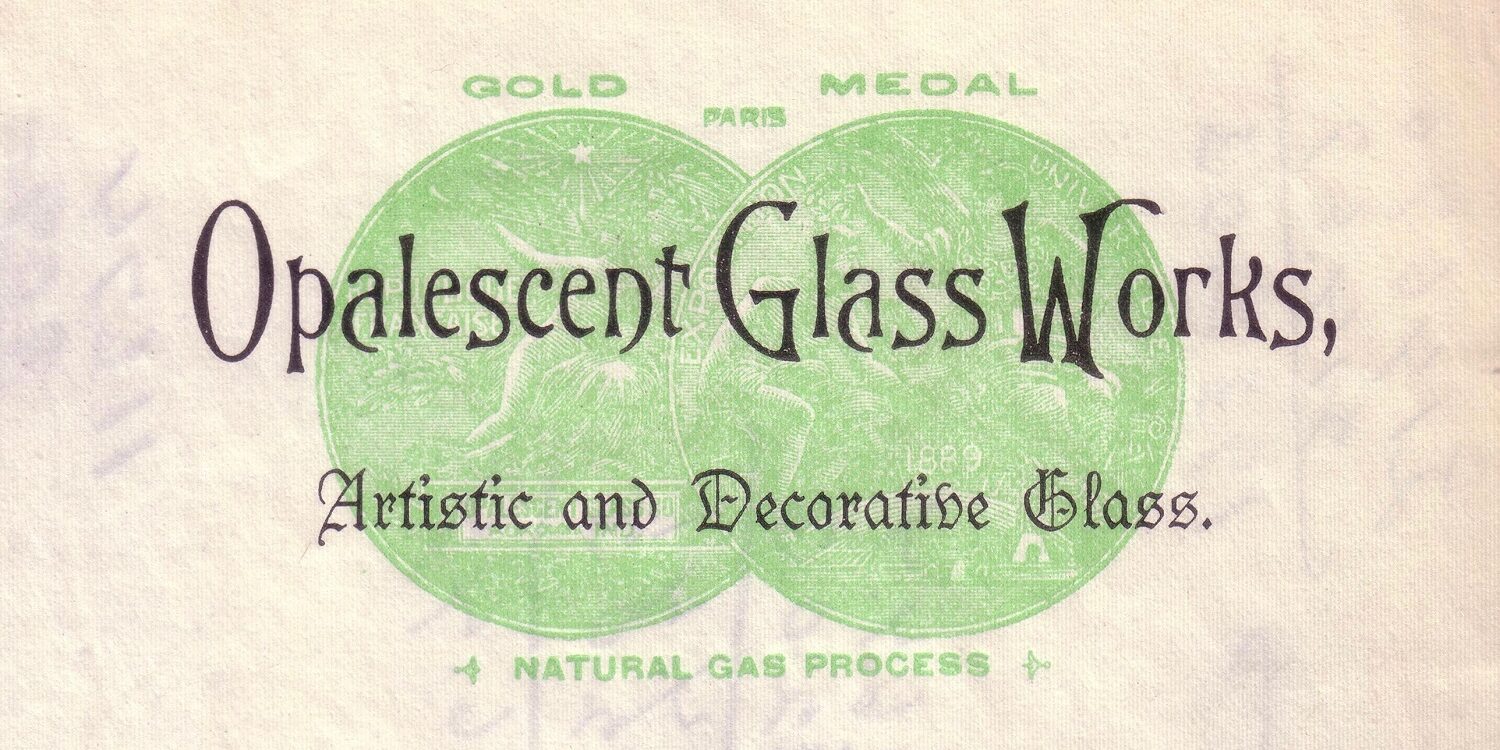
Opalescent Glass Works won a gold medal at the 1889 Exposition Universelle in Paris for its “natural gas process” glass. Photo courtesy Kokomo Opalescent Glass.
Opalescent Glass Works, today Kokomo Opalescent Glass, almost went bankrupt when natural gas supplies dwindled, but in 1893 it recovered by selling electric insulators to Edison General Electric Company — and thousands of pounds of stained glass to Tiffany Studios in New York City.
October 6, 1957 – Society of Petroleum Engineers established
The first board of directors meeting of the Society of Petroleum Engineers (SPE) established the professional society in an expansion of the American Institute of Mining, Metallurgical and Petroleum Engineers (AIME), which had created a Petroleum Division in 1922.

The American Institute of Mining Engineers established a Petroleum Division in 1922 that led to the Society of Petroleum Engineers.
AIME began in 1871, when a small group of Pennsylvania mining engineers sought to “preserve their collective knowledge and experiences for the benefit of future engineers.” SPE has grown into an independent, nonprofit global society with 132,000 members in 146 countries.
October 7, 1859 – First U.S. Oil Well catches Fire
The wooden derrick and engine house of America’s first oil well erupted in flames along Oil Creek at Titusville, Pennsylvania. The well had been completed the previous August by Edwin L. Drake for George Bissell and the Seneca Oil Company of New Haven, Connecticut. Working with driller William “Uncle Billy” Smith, Drake used steam-powered cable-tool technology.
The first U.S. oil well fire began when Uncle Billy inspected a vat of oil with an open lamp. When the lamp’s flame set gases alight, the conflagration consumed the derrick, the stored oil, and the driller’s home. Drake and Seneca Oil Company would quickly rebuild at the already famous well site.
Learn more in First Oil Well Fire.
October 7, 2014 – 200th Anniversary of Ohio Oil Discovery
The Noble County Historical Society of Caldwell, Ohio, hosted a 200th anniversary festival and park dedication celebrating a brine well drilled with a spring pole that produced oil. The 1814 well can be found at Thorla McKee Park, named for Silas Thorla and Robert McKee, the entrepreneurs who established the local salt works, according to Dave Baker in “Early Marietta.”
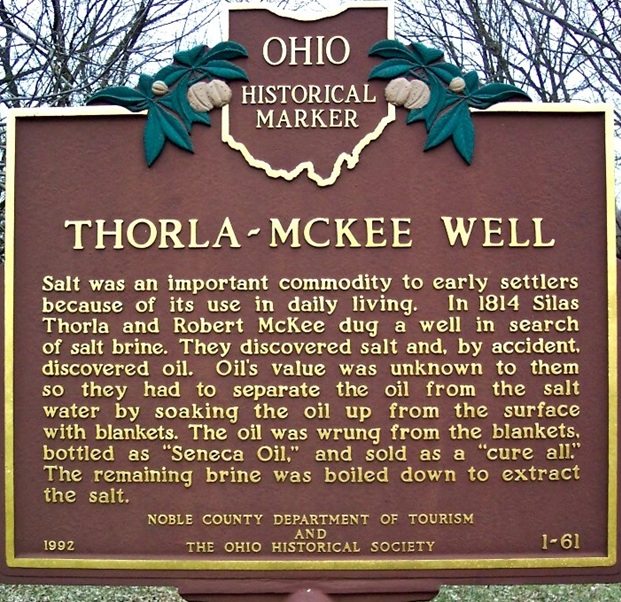
The Ohio Historical Society in 1992 dedicated a marker near the well.
Baker reported the wellsite included the remains of its original sycamore log casing beneath a replica spring pole. Thoria and McKee separated oil from salt water by soaking it up with blankets before bottling it to sell as a medicinal potion. The remaining brine was boiled to extract the salt. Ohio’s first well drilled exclusively for oil was completed near Macksburg in 1860.
October 8, 1915 – Elk Basin oilfield discovered in Wyoming
An exploratory well drilled in a remote Wyoming valley opened the giant Elk Basin oilfield. Completed by the Midwest Refining Company near the Montana border, the wildcat well produced 150 barrels of high-grade “light oil” a day. The oil needed little refining to provide quality lubricants.

“Gusher coming in, south rim of the Elk Basin field, 1917.” Photo courtesy American Heritage Center, University of Wyoming.
Geologist George Ketchum first recognized the potential of the basin as a source of oil deposits. Ketchum had explored the remote area in 1906 with C.A. Fisher while farming near Cowley, Wyoming. The Elk Basin extended from Carbon County, Montana, into northeastern Park County, Wyoming.
Fisher was the first geologist to map sections of the Bighorn Basin southeast of Cody, Wyoming, where oil seeps had been found as early as 1883. The Wyoming oilfield discovery in unproven territory attracted new ventures like Elk Basin United Oil Company, investors, and oilfield service companies.
Learn more in First Wyoming Oil Wells.
October 8, 1923 – First International Petroleum Exposition and Congress
Five thousand visitors attended the rainy opening day of the first International Petroleum Exposition and Congress in downtown Tulsa, an event that would return for almost six decades.
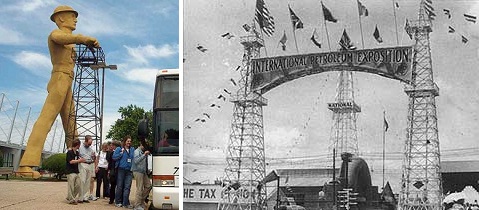
Although still a tourist attraction, the 76-foot-tall Golden Driller arrived decades after Tulsa’s first International Petroleum Exposition in 1923.
With annual attendance growing to more than 120,000, Mid-Continent Supply Company of Fort Worth introduced the original Golden Driller of Tulsa at the expo in 1953. Economic shocks beginning with the 1973 OPEC oil embargo depressed the industry, and after 57 years, the International Petroleum Exposition ended in 1979.
October 9, 1999 – Converted Offshore Platform launches Rocket
Sea Launch, a Boeing-led consortium of companies from the United States, Russia, Ukraine, and Norway, launched its first commercial rocket using the Ocean Odyssey, a modified semi-submersible drilling platform. After a demonstration flight in March, a Russian Zenit-3SL rocket carried a DirecTV satellite to geostationary orbit.
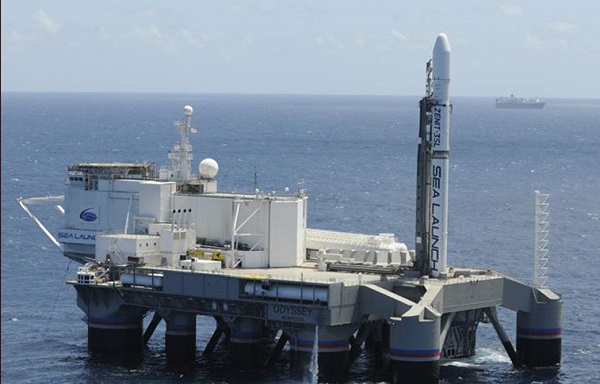
Ocean Odyssey, a modified semi-submersible drilling platform, became the world’s first floating equatorial launch pad in 1999. Photo courtesy Sea Launch.
In 1988, the former drilling platform had been used by Atlantic Richfield Company (ARCO) for North Sea explorations. The Ocean Odyssey made 36 more rocket launches until 2014, when the consortium ended after Russia illegally annexed Ukraine’s Crimean peninsula.
Although SpaceX in 2023 abandoned its plans to convert two oil rigs into launch platforms, in July 2026, the Bureau of Ocean Energy Management (BOEM) began seeking input on how to utilize existing offshore infrastructure for space activities, a “First Step to Explore Potential for Outer Continental Shelf Space Launch & Recovery.”
Learn more in Offshore Rocket Launcher.


October 10, 1865 – Oil Pipeline constructed in Pennsylvania
A two-inch iron pipeline began transporting oil five miles through hilly terrain from a well at booming Pithole, Pennsylvania, to the Miller Farm Railroad Station at Oil Creek. With their livelihoods threatened, teamsters attempted to sabotage the pipeline until armed guards intervened. A second oil pipeline would begin operating in December.
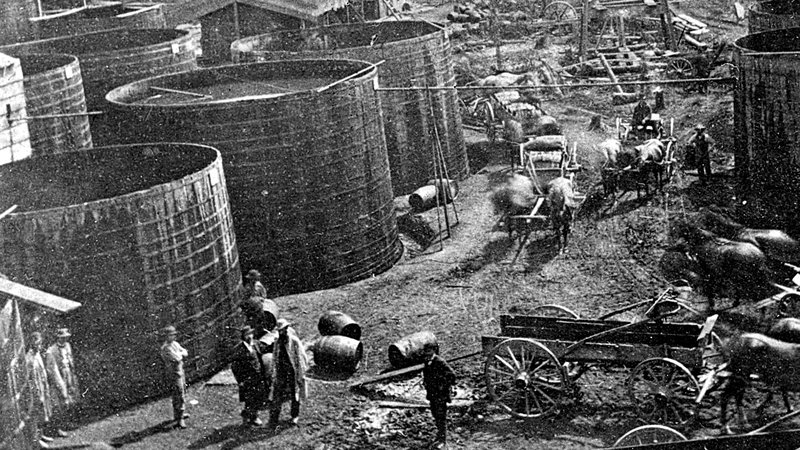
Oil tanks at Pithole, Pennsylvania, where Samuel Van Syckel built a five-mile pipeline in 1865. Photo courtesy Drake Well Museum.
Built by Samuel Van Syckel, who had formed the Oil Transportation Association, the pipeline used 15-foot welded joints. Three 10-horsepower Reed and Cogswell steam pumps pushed the oil at a rate of 81 barrels per hour. With up to 2,000 barrels of oil arriving daily at the terminal, more storage tanks were soon added. The pipeline transported the equivalent of 300 teamster wagons working for 10 hours.
“The day that the Van Syckel pipeline began to run oil a revolution began in the business,” proclaimed Ida Tarbell in her 1904 History of the Standard Oil Company. “After the Drake well, it is the most important event in the history of the Oil Regions.”
_______________________
Recommended Reading: The Fire in the Rock: A history of the oil and gas industry in Kansas, 1855-1976


_______________________
The American Oil & Gas Historical Society (AOGHS) preserves U.S. petroleum history. Please support this energy education website, subscribe to the free monthly newsletter, This Week in Oil and Gas History News, and help expand historical research. Contact bawells@aoghs.org. Copyright © 2026 Bruce A. Wells. All rights reserved.