

September 7, 1917 – Oilfield Legacy of Texas Governor Hogg –
After drilling 20 “dry holes,” the Tyndall-Wyoming Oil Company completed the No. 1 Hogg well 50 miles south of Houston. Within four months, a second well was producing about 600 barrels a day. The discoveries ended a succession of attempts dating back to 1901, when former Texas Governor James “Big Jim” Hogg paid $30,000 for the lease.
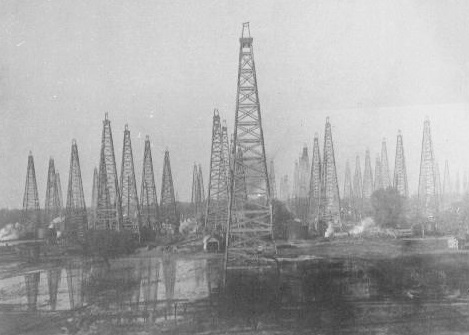
Discovered southwest of Houston in September 1917, the 20-square-mile West Columbia oilfield produced more than 119,000 barrels of oil by 1918.
Gov. Hogg died 11 years before the Tyndall-Wyoming Oil discovered the giant West Columbia oilfield. Fortunately for his family, the Texas governor stipulated in his will that the mineral rights should not be sold for at least 15 years after his death. He also helped launch the Texas Company (Texaco).
Learn more in Governor Hogg’s Texas Oil Wells.
September 7, 1923 – California Oilfield discovered at Dominguez Hills
Maj. Frederick Russell Burnham discovered oil in Dominguez Hills, an unincorporated area of Los Angeles County, California. His well produced about 1,200 barrels of oil a day from a depth of about 4,000 feet. Maj. Burnham, a decorated soldier in both the U.S. and British armies, was once known as “King of the Scouts.”
The Burnham Exploration Company and partner Union Oil Company of California opened the Dominguez Hills oilfield, “a two-square-mile, two-mile-deep stack of eight producing zones.”
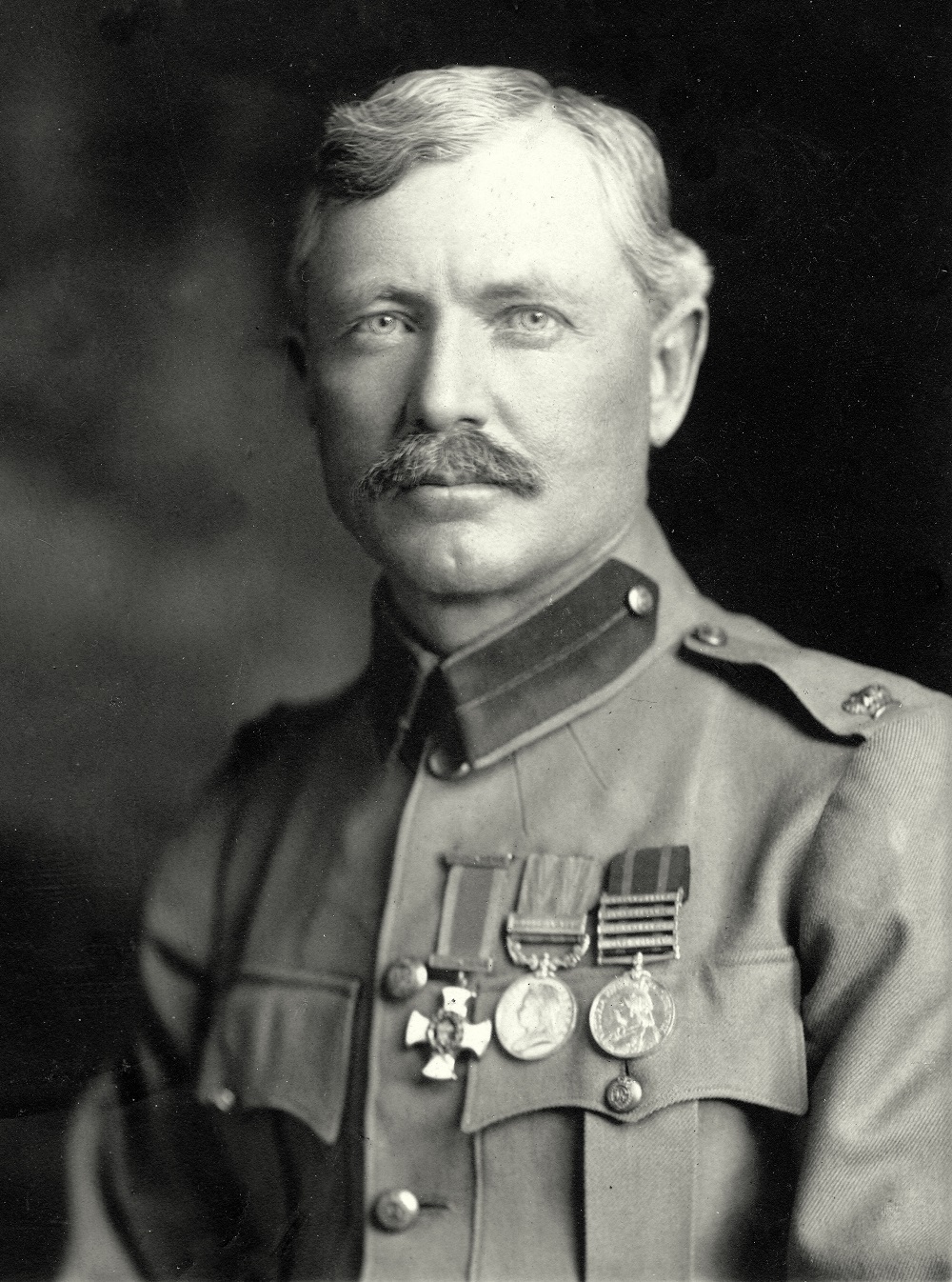
Discoverer of the Dominguez Hills oilfield, Maj. Frederick Burnham, in British Army uniform, 1901.
The region was named for a Spanish soldier who in 1784 received a land grant for grazing cattle. “But family fortunes truly took off with discovery of oil in the 1920s, first in the Torrance area and then, most resoundingly, on Dominguez Hill itself,” explained a California State University historian in 2007. By 1933, Maj. Burnham’s petroleum exploration venture and Union Oil had paid more than $10 million to stockholders.
Learn more California history in First California Oil Wells and Discovering Los Angeles Oilfields.
September 8, 1891 – Patent issued for “Flexible Driving Shafts”
The modern concept of horizontal drilling may have begun with 19th-century patents by John Smalley Campbell of London. After receiving a British patent for his “useful improvements in flexible driving shafts or cables” in 1889, Campbell received a U.S. patent (no. 459,152) for his drilling method.
While Campbell described his directional drilling patent as ideal for dental engines, “the patent also carefully covered use of his flexible shafts at much larger and heavier physical scales,” reported geologist and oil historian Stephen M. Testa in a 2015 article for Pacific Petroleum Geology. “The modern concept of non-straight line, relatively short-radius drilling dates back at least to September 8, 1891,” Testa added. Directional drilling pioneer H. John Eastman in 1933 applied the technology to save the Conroe oilfield.
September 9, 1855 – Birthday of Spindletop Discoverer
Anthony Francis Lucas was born in Split, Croatia, as Antonio Francesco Luchich, the son of a wealthy shipbuilder. Receiving an engineering degree by age 20, he was commissioned a second lieutenant in the Imperial Navy of Austria-Hungary. After visiting an uncle in Michigan in 1879, he began working as a mechanical and mining engineer before becoming a naturalized citizen in 1885, when he changed his name.
In 1899, Lucas visited Texas, where he and Pattillo Higgins studied the geology of a hill south of Beaumont — the future site of the Spindletop discovery that launched the modern petroleum industry. “This mound attracted my attention on account of the contour, which indicated possibilities for an incipient dome below,” Lucas later explained, according to Giant Under the Hill, A History of the Spindletop Oil Discovery at Beaumont, Texas, in 1901.

September 10, 1969 – Second Nuclear Fracturing Test
A 40-kiloton nuclear device was detonated about eight miles southeast of present-day Parachute, in Garfield County, Colorado. Project Rulison was the second of three natural-gas-reservoir stimulation tests that were part of Operation Plowshare, a government program to study uses of nuclear explosives for peaceful purposes. The first nuclear fracturing test, Project Gasbuggy, detonated a 29-kiloton device in a New Mexico well in December 1967. The third unconventional test to increase production was Project Rio Blanco, a 1973 detonation in a Rio Blanco County, Colorado, natural gas well.
September 11, 1960 – Houston Oilers feature Derricks on Helmets
The first game of the new American Football League’s Houston Oilers featured a helmet with oil derricks. The design was selected by owner Bud Adams, whose father, Kenneth “Boots” Adams, succeeded Frank Phillips in 1930 as president of Phillips Petroleum Company until retiring in 1968.
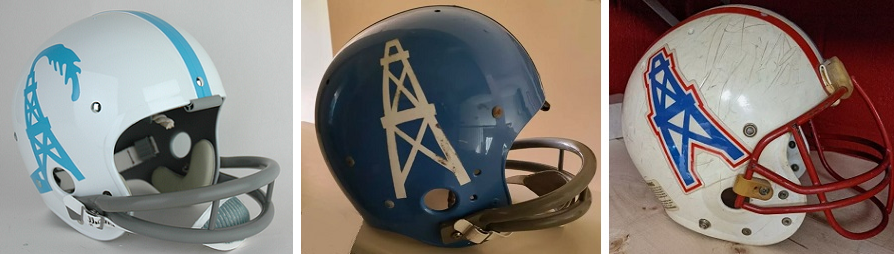
Houston Oilers helmet logos included a gusher (used only in advertising), a white derrick (1960-1965), and the last (1966-1998) used until the franchise moved to Nashville. Photos courtesy Helmet Hut.
Adams and Lamar Hunt, founder of the Dallas Texans franchise (today the Kansas City Chiefs), established the new league in 1959. Hunt’s father, independent producer Haroldson “H.L.” Hunt Jr., had found success in Arkansas oilfields and the giant East Texas field. A prototype Oilers helmet logo included the derricks gushing oil, “A reminder to the roots of the Oilers beginnings in Houston,” notes Helmut Hut.
September 11, 1866 – Distilling Kerosene in Vacuum leads to Mobil Oil
Carpenter and inventor Matthew Ewing patented a new method for distilling kerosene in a vacuum to produce lubricants. His innovation would lead to Mobil Oil. Three weeks after receiving his patent, Ewing and partner Hiram Everest founded the Vacuum Oil Company in Rochester, New York. Their first product was “Ewing’s Patent Vacuum Oil,” a leather conditioner.
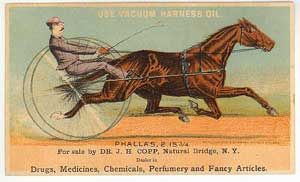
Circa 1870 ad for “Ewing’s Patent Vacuum Oil” for preserving leather harnesses before it became a steam-engine lubricant.
After Ewing left the partnership, Everest improved the refining process and distributed the lubricant in square containers previously used for canned oysters. In 1880, Everest sold a 75 percent interest in Vacuum Oil to the Standard Oil Company. Vacuum Oil became an industry pioneer of lubricant products, including Gargoyle Steam Cylinder Oil, before evolving into Socony Mobil in 1955, then Mobil Oil before becoming ExxonMobil in 1999.
Learn more in Mobil’s High-Flying Trademark.
September 12, 1866 – First Texas Oil Well
The Texas petroleum industry began when Lyne Taliaferro Barret’s Melrose Petroleum Oil Company completed a well east of Nacogdoches, producing 10 barrels of oil per day.
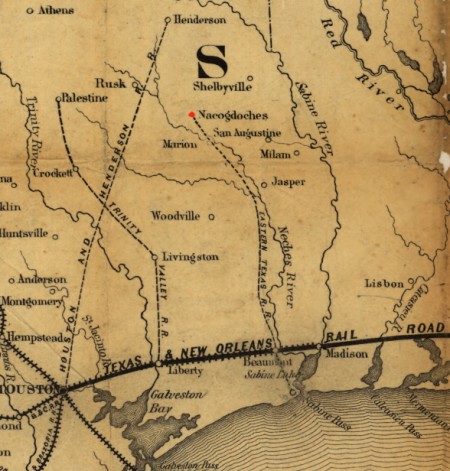
Lyne Taliaferro Barret in 1859 leased 280 acres east of Nacogdoches, Texas, to drill in an area known for oil seeps.
The Confederate Army veteran’s No. 1 Isaac C. Skillern well, drilled in an area known as Oil Springs, found the newly prized resource at a depth of 106 feet. The well’s modest oil production and limited access to markets led to the failure of Melrose Petroleum Oil Company.
The oilfield Barret discovered lay dormant for nearly two decades until exploration continued near his well. With oil production then lasting into the 1950s, the Nacogdoches field became the oldest oilfield in the Lone Star State.
Learn more in First Texas Oil Well.
September 13, 1899 – First U.S. Pedestrian killed by Auto
An electric-powered cab struck and killed a pedestrian in New York City. “Here at West 74th Street and Central Park West, Henry H. Bliss dismounted from a streetcar and was struck and knocked unconscious by an automobile on the evening of September 13, 1899,” notes a historical marker placed by a safety awareness organization on the centennial of Bliss’ death. The cab driver was arrested, but charges were later dropped.
September 13, 1975 – President dedicates Petroleum Museum
Fifty-one years ago, President Gerald R. Ford addressed 400 guests attending the opening ceremony for the Permian Basin Petroleum Museum, Library and Hall of Fame in Midland, Texas. After touring the museum, he was presented with “Dressing the Bit,” a 15-inch bronze sculpture of two cable-tool workers.

President Gerald Ford spoke at the Petroleum Museum’s 1975 opening in Midland, Texas. Photo courtesy Petroleum Museum.
The museum, which received an $18 million renovation in 2016, maintains more than 60,000 square feet of space for geological, technical, and cultural exhibits. Outdoor equipment displays include rigs, pumping units, and other oilfield machinery.
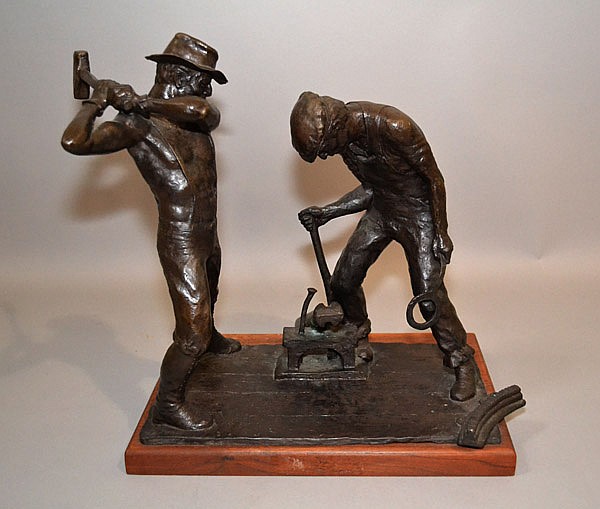
“Dressing the Bit,” by Lincoln Fox was presented to President Ford. Photo courtesy Gerald R. Ford Presidential Museum.
Energy education programs include K-6 robotics courses, an engineering lab, traveling trunks, and family science nights. The Permian Basin Petroleum Museum also preserves the world’s largest collection of Chaparral racing cars.


September 13, 1957 – First Hawaiian Refinery
Standard Oil of California announced it would build the Territory of Hawaii’s first and only oil refinery, eight miles west of Pearl Harbor. According to a 1959 Popular Mechanics article, Standard Oil originally planned to import petroleum from the Middle East “by means of an unusual undersea submarine cable.”
In 2016, Chevron in sold the facility to Island Energy Services LLC. Par Hawaii currently operates the refinery in the Honolulu port area of Oahu, processing about 94,000 barrels of crude oil a day.
_______________________
Recommended Reading: California State University, Dominguez Hills (2010); Drilling Technology in Nontechnical Language


_______________________
The American Oil & Gas Historical Society (AOGHS) preserves U.S. petroleum history. Please support this website, subscribe to the free, monthly email newsletter This Week in Oil and Gas History News, and help expand our historical research. Contact bawells@aoghs.org. Copyright © 2026 Bruce A. Wells. All rights reserved.