

August 24, 1892 – “Prophet of Spindletop” founds Oil Exploration Company –
Patillo Higgins, who would become known as the “Prophet of Spindletop,” founded the Gladys City Oil, Gas & Manufacturing Company and leased 2,700 acres near Beaumont, Texas. Higgins believed oil-bearing sands could be found a few miles south of town. Most earth science experts said he was wrong.
A self-taught geologist, Higgins had noticed oil and natural gas seeps at Spindletop Hill while taking his Sunday school class on picnics. He later supervised the planning of Gladys City, which he named for his favorite student.
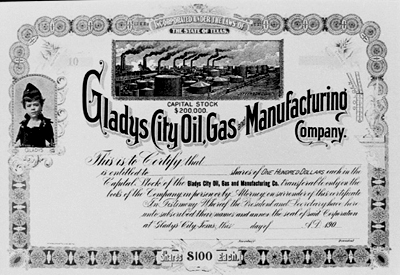
Patillo Higgins was no longer with the company he had founded when it discovered oil at Spindletop Hill in January 1901.
Although Higgins left the Gladys City venture in 1895, Anthony Lucas drilled the “Lucas Gusher” for the company in January 1901 and forever changed the petroleum industry (the oilfield produced more oil in one day than the rest of the world’s fields combined). Gulf Oil, Texaco, Mobile, and Sun Oil companies got their start thanks to Patillo Higgins’ confidence in the “Big Hill.”
Learn more in Prophet of Spindletop.
August 24, 1923 – University of Texas receives Royalty Check
The University of Texas received the first oil royalty payment ($516.53) three months after the Santa Rita No. 1 well discovered an oilfield on university-owned land in the Permian Basin. After 21 months of difficult drilling, the Texon Oil and Land Company’s well had revealed the 4.5-square-mile Big Lake field.
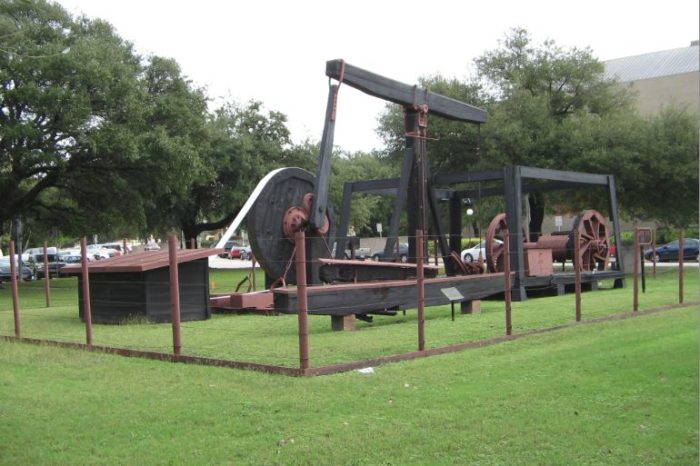
Drilling and production equipment from the Santa Rita No. 1 well displayed in 2005 near the campus library of the University of Texas, Austin. Photo by Bruce Wells.
Within three years of the Big Lake discovery, petroleum royalties endowed the university with $4 million. In 1958, the university moved the Santa Rita well’s walking beam and other equipment to the Austin campus. A student newspaper described the historic well as “one that made the difference between pine-shack classrooms and modern buildings.”
August 24, 1937 – Music Mountain Oil Discovery
No one had expected it, not even the Niagara Oil Company that drilled it, notes the Bradford Landmark Society about a 1937 gusher near Bradford, Pennsylvania, in McKean County. For the first time since the great Bradford field discovery 70 years earlier, an exploratory well on Music Mountain revealed a new oilfield (the producing formation was beneath the older Bradford sands). A local refinery, the American Refining Group, has been processing McKean County oil since 1881. The region’s high-paraffin oil remains as one of the best natural lubricants in the world.
August 26, 1926 – The Texas Company expands
After years of growth thanks to major discoveries at Spindletop and Sour Lake, the Texas Corporation was formally incorporated, acquiring all outstanding stock of the Texas Company, which was dissolved the next year.
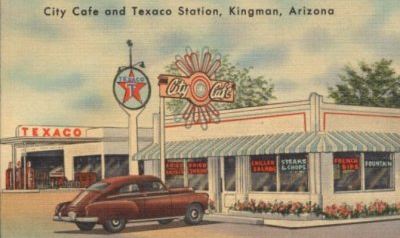
Texaco was founded in Beaumont as the Texas Company one year after the 1901 discovery of a giant oilfield at Spindletop Hill.
Moving its headquarters from Houston to New York City, the corporation became the parent company of Texas Company entities and subsidiaries, including the Texaco brand — a name derived from the original telegraph office address and officially adopted in 1959.
Learn more in Histories of Indian Refining, Havoline, and Texaco.
August 26, 2009 – Oil Refinery designated Historic Landmark
The American Chemical Society (ACS) designated the development of the first U.S. still for refining oil as a National Historic Chemical Landmark in a ceremony in Pittsburgh, Pennsylvania. The society also dedicated a plaque 100 miles north, at the Drake Well Museum in Titusville, as part of celebrations for the 150th anniversary of the U.S. petroleum industry.
ACS noted that in the 1850s, Samuel Kier constructed a one-barrel, cast-iron still and began selling distilled petroleum, which he called “carbon oil,” for $1.50 a gallon. “Kier’s refining process touched off the search for more dependable sources of crude oil, which led to the drilling of the nation’s first oil well,” noted ACS on the Pittsburgh plaque. “These two technologies — refining and drilling — made western Pennsylvania the undisputed center of the early oil industry.”
August 27, 1859 – Birth of U.S. Petroleum Industry
America’s petroleum industry began with a well drilled 69.5 feet deep in Titusville, Pennsylvania. Hired by the Seneca Oil Company of New Haven, Connecticut, former railroad conductor Edwin Laurentine
Drake drilled the first commercial U.S. oil well. The Venango County well produced 25 barrels of oil a day.
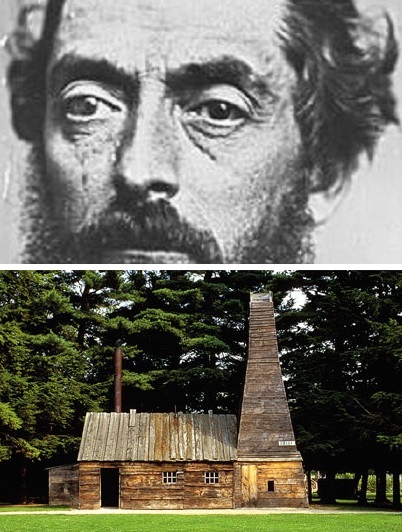
The Drake Well Museum and Park in Titusville, Pennsylvania, preserves the history of the man whose 1859 oil well forever changed the world.
Although earlier spring pole and cable-tool drillers of brine wells had found small amounts of oil — an unwanted byproduct — Drake specifically drilled for it. His investors wanted to refine the oil into kerosene for lamps and other petroleum products. Drake also pioneered new technologies, including driving an iron pipe downhole to protect the bore’s integrity from nearby Oil Creek.
After five months of financial setbacks and many drilling delays, locals began calling the well “Drake’s Folly.” To improve his reputation, Connecticut investors addressed letters to “Colonel” Edwin Drake.
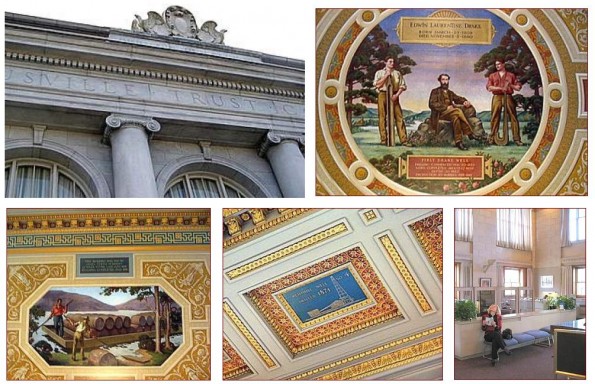
Ceiling paintings depict the early oil industry inside the Titusville Trust Building, which opened in 1919. Edwin Drake sits between men holding cable tools, an early oilfield technology. Photos by Bruce Wells.
Late in the afternoon on August 27, 1859, Drake’s driller, blacksmith “Uncle Billy” Smith, noticed oil floating at the top of the pipe. The bit had reached what would become known as the First Venango Sand. To begin pumping the oil, Drake borrowed a kitchen water pump.


August 27, 1959 – Stamp celebrates Oil Centennial
“No official act could give me greater pleasure than to dedicate this stamp commemorating the 100th anniversary of the petroleum industry,” declared U.S. Postmaster General Arthur Summerfield, who addressed a crowd gathered for the “Oil Centennial Day” in Titusville, Pennsylvania.
“The American people have great reason to be indebted to this industry,” the Postmaster General added. “It has supplied most of the power that has made the American standard of living possible.”
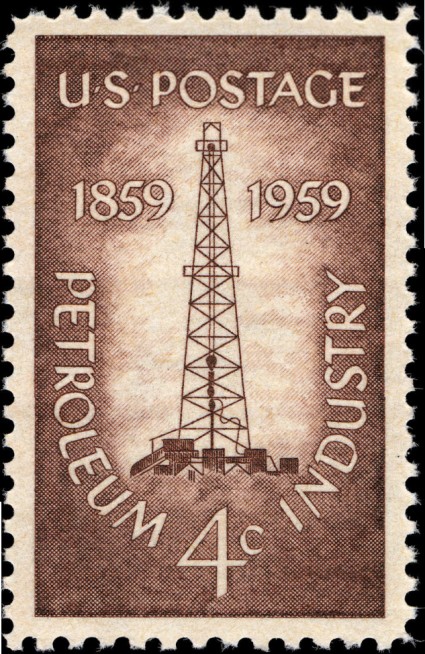
The U.S. Postal Service issued 120 million centennial oil stamps. Efforts for a 2009 anniversary stamp failed.
The U.S. Postal Service Stamp Advisory Committee in 2009 rejected requests for a stamp recognizing the 150th anniversary of the U.S. petroleum industry. The committee earlier granted 10 commemorative stamps for Kermit the Frog and nine other Muppets.
Learn more in the Centennial Oil Stamp Issue.
August 30, 1919 – Natural Gas Boom (and Bust) in Pennsylvania
The “Snake Hollow Gusher” of McKeesport, Pennsylvania, revealed a natural gas field that soon attracted hundreds of exploration companies. Drilled near the Monongahela River southeast of Pittsburgh, the discovery well produced 60 million cubic feet of gas a day. The drilling frenzy it inspired resulted in $35 million invested in a nine-square-mile area.
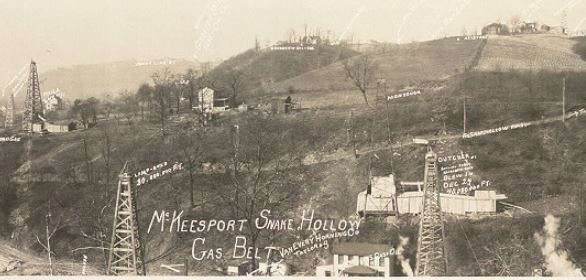
“McKeesport, Snake Hollow, Gas Belt” from a circa 1920 panorama photo courtesy Library of Congress.
“Many residents signed leases for drilling on their land,” the local newspaper reported. “They bought and sold gas company stock on street corners and in barbershops transformed into brokerage houses.”
The excitement ended in early 1921 when natural gas production declined in 180 wells, and 440 exploratory wells found no gas. The field was later described as “the scene of the Pittsburgh district’s biggest boom and loudest crash.”
Learn more in McKeesport Gas Company.

August 30, 2002 – Conoco and Phillips Petroleum become ConocoPhillips
Almost 100 years after Frank and L.E. Phillips completed their first oil well and 128 years after Continental Oil delivered its first can of kerosene in a horse-drawn wagon, Phillips Petroleum and Conoco combined to form ConocoPhillips.
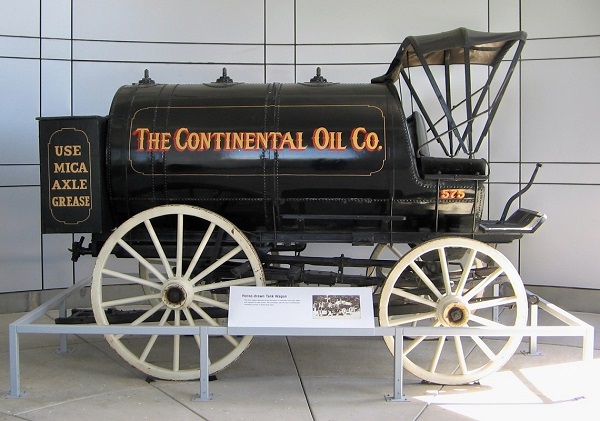
An 1880s Continental Oil Company horse-drawn tank wagon welcomes visitors to the Conoco Museum in Ponca City, Oklahoma. Photo by Bruce Wells.
Earlier petroleum companies that played key roles leading to ConocoPhillips included Transcontinental Oil & Transportation, 101 Ranch Oil, Marland Oil, and Continental Oil and Refining. As part of the 2007 celebration of Oklahoma’s centennial, ConocoPhillips opened two museums, the Conoco Museum in Ponca City and the Phillips 66 Company Museum in Bartlesville, which closed in March 2025 (see ConocoPhillips Petroleum Museums). In 2012, ConocoPhillips separated its Phillips Petroleum refining and marketing businesses, establishing Phillips 66 as an independent company.
_______________________
Recommended Reading: Spindletop: The True Story of the Oil Discovery that Changed the World (1980); Giant Under the Hill: A History of the Spindletop Oil Discovery at Beaumont, Texas, in 1901


_______________________
The American Oil & Gas Historical Society (AOGHS) preserves U.S. petroleum history. Please support this website, subscribe to the monthly email newsletter, This Week in Oil and Gas History News, and help expand our historical research. Contact bawells@aoghs.org. Copyright © 2026 Bruce A. Wells. All rights reserved.