

The U.S. government in 1974 printed but never issued 4.8 billion gasoline rationing coupons.
In response to the 1973 OPEC oil embargo, and after printing 4.8 billion emergency coupons with a portrait of George Washington, the Bureau of Engraving and Printing destroyed almost all of the 4.8 billion individual coupons it had printed by the end of 1974.
On October 17, 1973, the Organization of Petroleum Exporting Countries (OPEC) implemented what it called “oil diplomacy” and prohibited any nation that supported Israel in the Yom Kippur War from buying the cartel’s oil. The embargo shocked industrialized nations heavily reliant on petroleum with spiking gasoline prices and plummeting supplies that caused long lines at gas stations, attempts at state rationing, and a surge in siphoning thefts.
Meanwhile, the U.S. Bureau of Engraving and Printing in 1974 printed – but never issued – 4.8 billion gasoline rationing coupons. With almost all later shredded, an example survives in a special collection of petroleum and chemical industry currencies preserved in the Robert J. Bauman Collection at the Science History Institute Museum & Library in Philadelphia.
Paper money and coins make up a large majority of the materials in this collection. So far, only a small selection of paper money and a postcard have been digitized for the Science History Institute’s Digital Collections.
Printed from January 25 to February 25, 1974, it was later discovered that because the coupons used the same portrait of George Washington as the one-dollar bill, they could be used in automatic change machines. About 160,000 boxes of coupons were sealed, stored, and, with a few exceptions, shredded and buried by the end of 1974. One sheet of 16 “one unit” coupons was sent to the National Archives, and the Bureau of Engraving and Printing kept three more sheets. Almost all of the rest were destroyed. Almost all.
In 2017, Robert Bauman, president of Polymer Consulting International, donated his chemical and petroleum currency collection to a Philadelphia museum and library. In 2026, he shared with the American Oil & Gas Historical Society his insights about the little-known part of U.S. petroleum history. Bauman provided an image of his rare example.
Below is the original article Bauman submitted with his donation to the Currency of the Chemical and Petroleum Industries Collection, 1870 to 1993, Science History Institute Museum & Library:
Arab Oil Embargo Gasoline Coupon
by Robert J. Bauman, President of Polymer Consulting International
On October 17, 1973, the Arab members of the Organization of Petroleum Exporting Countries (OPEC) stopped the flow of oil to the United States in response to the United States’ support of Israel during the Yom Kippur War with Syria and Egypt. Prior to this, the United States, like other industrialized nations, had become accustomed to, and dependent on, cheap and abundant gasoline. At the time, a barrel of oil was about $4, and a gallon of gasoline cost about 35 cents.
After October 18, the price of gasoline rose immediately, and its supply became uncertain. There were long lines at service stations to buy gasoline. In some cases, service stations themselves could not acquire enough gasoline. Theft of gasoline by siphoning from vehicle fuel tanks became common. To restore order, state legislatures in those states most affected by the shortage implemented a simple form of rationing.
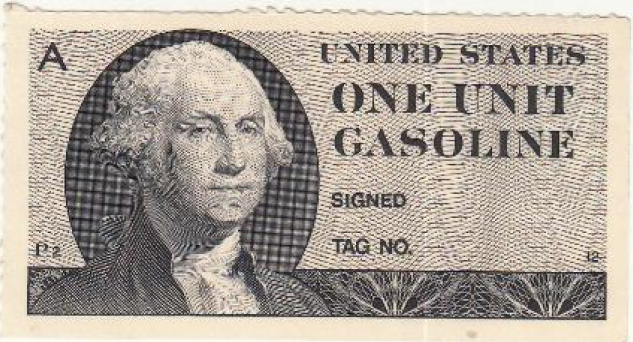
A 1974 “One Unit Gasoline” ration coupon is among more than 500 items Robert Bauman, president of Polymer Consulting International, donated to the Science History Institute Museum & Library in Philadelphia in 2017.
Drivers whose license plates had an odd number could purchase gas on the odd-numbered days of the month, and those whose plates had an even number could purchase gas on the even days of the month. This helped reduce the waiting time, but the shortage worsened as time went on. In some areas there were restrictions on the number of gallons that could be purchased.
The U.S. government then proposed nationwide gasoline rationing, as had occurred during World War II. On December 27, 1973, William E. Simon, head of the Federal Energy Office, announced that the Bureau of Engraving and Printing (BEP) would print gasoline rationing coupons. The Bureau, aware it would need assistance, signed contracts with the US Bank Note Company and the American Bank Note Company to print a portion of the coupons and furnished them with engraved dies. Printing began on January 25, 1974.
The BEP stopped their regular currency and postage stamp printing to focus on printing the coupons. Coupons were printed using intaglio plates in 96 subject sheets. They were printed, perforated, inspected, cut into 16 coupon sheets, shrink-wrapped and boxed. Three series of coupons, “A,” “B,” and “C” coupons were produced. Series “A” coupons were printed from January 25 to February 25, 1974. Series “B” coupons were printed from March 17 to March 27, 1974, and series “C” coupons were printed from February 24 to March 20, 1974.
To reduce potential counterfeiting, the same special paper used to print regular currency and the same portrait of George Washington used on the one-dollar bill, was used for the coupon. However, someone discovered that, because of the use of the same portrait of George Washington as the one-dollar bill, the coupons could be used in automatic change machines to get one dollar in coins since the portrait was the key factor for identification in these machines.
According to the records, 4.8 billion coupons were printed in less than four months—an impressive achievement. The cooperation of the Federal Reserve Board and the US Postal Service was essential as these agencies had to agree to reduce their normal demands on the Bureau for currency and postage stamps, respectively.
Since the decision to issue them was not given, the approximately 160,000 boxes (1,600 per box) were stored in Federal properties, one of which was at the army depot in Pueblo, Colorado.
The embargo ended in March 1974 when Israel began to negotiate with Syria and the Arab nations and the fighting stopped. The gasoline shortage eased and the coupons were not needed. In June 1984, the Energy Department was about to shred and bury all of the gasoline ration coupons including those stored at the Pueblo Army Depot in Pueblo, Colorado. According to former National Philatelic Collection Curator James H. Bruns, the Department of the Treasury contacted John Fleckner, chief archivist of the National Museum of American History, to ask if the Smithsonian Institution would like to keep a sample.
On September 6, a sheet of 16 coupons was provided by the Department of Energy’s Idaho office. The National Philatelic Collection became the repository of the coupons since these were initially presumed to be rationing stamps like those of World War II. Another sheet of 16 coupons was sent to the National Archives. The Bureau of Engraving and Printing kept three more of these sheets. All of the rest were destroyed.
According to one source, the destruction was awarded to a private company and, “Somehow, during transportation of the coupons, an employee managed to ‘liberate’ 32 coupons (two sheets) from a shipment and sold them to a Colorado numismatic dealer with a strong assurance that they were the only survivors.” More recently, however, additional coupons came on the market, indicating that more than 32 were “liberated.” The exact number of them is not known but they are scarce. The cost to print the coupons was estimated at $12.5 million, the storage cost was approximately $200,000 per year and the shredding cost was approximately $145,000.
Science History Institute
Robert Bauman amassed more than 13,000 banknotes and coins from global companies from 1870 to 1993, enriching his collection with postcards and medals. In 2017, he donated his collection to the Science History Institute Museum & Library, which preserves historical materials related to scientific achievements from around the world,
Although the Robert J. Bauman Collection consist of the various types of global currencies issued by chemical and petroleum companies, “paper money and coins make up a large majority of the materials in this collection,” notes the Science History Institute. “A small selection of paper money and a postcard have been digitized and can be found here.”
_______________________
The American Oil & Gas Historical Society (AOGHS) preserves U.S. petroleum history. Please support this energy education website, subscribe to the free monthly newsletter, This Week in Oil and Gas History News, and help expand historical research. Contact bawells@aoghs.org.
_______________________
Citation Information – Article Title: “Gas Ration Coupons of 1974” Authors: B.A. Wells and K.L. Wells. Article Subtitle: “Arab Oil Embargo Gasoline Coupon.” Author: Robert J. Bauman; Website Name: American Oil & Gas Historical Society. URL: https://aoghs.org/oil-almanac-gasoline-ration-coupons-of-1974. Last Updated: October 22, 2026. Original Published Date: October 24, 2026.