Petroleum product at bottom of refining process improved American mobility.
As the U.S. centennial neared, President Ulysses S. Grant directed that Pennsylvania Avenue be paved with Trinidad asphalt. By 1876, the president’s paving project covered about 54,000 square yards, according to the National Asphalt Pavement Association.
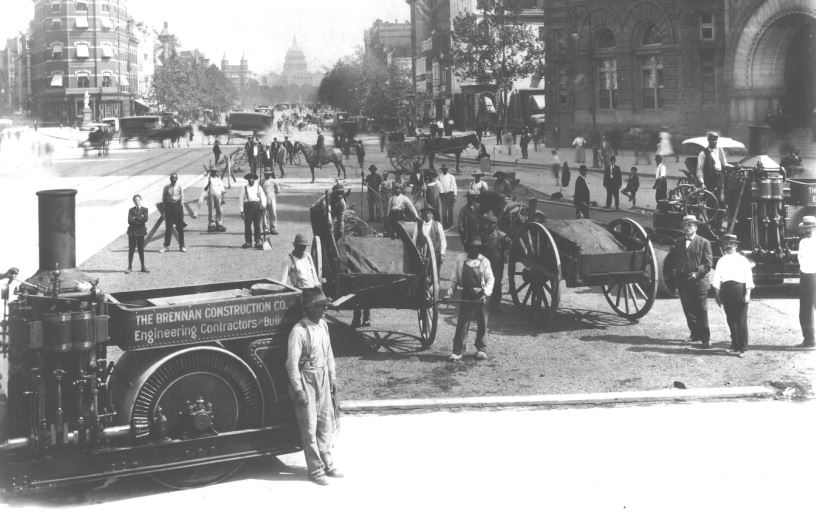
Pennsylvania Avenue was first paved in 1876-77 with bitumen imported from Trinidad. Thirty-one years later, a better asphalt derived from petroleum distillation was used to repave the famed pathway to the Capitol, above. Photo courtesy the Asphalt Institute.
“Brooms, lutes, squeegees and tampers were used in what was a highly labor intensive process. Only after the asphalt was dumped, spread, and smoothed by hand did the relatively sophisticated horse-drawn roller, and later the steam roller, move in to complete the job,” NAPA noted in its 1992 publication, A Century of Progress: The History of Hot Mix Asphalt.

On December 22, 1875, President Grant delivered to Congress the “Report of the Commissioners Created by the Act Authorizing the Repavement of Pennsylvania Avenue. ”Three decades later, the famous road to the U.S. Capitol was repaved with new and far improved asphalt made from petroleum.
Black Tops
The abundance of asphalt has made it unremarkable, yet without this residue from the petroleum refining process, bad roads may have delayed the nation’s economic progress of the 20th century.
Ninety-four percent of modern U.S. roads and streets are asphalt — variously known as blacktop, tarmac, macadam, plant mix, asphalt concrete, bituminous concrete, and hot mix asphalt.
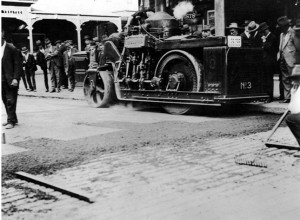
Asphalt left over from oil refining presented an improved alternative to natural bitumen. Photo courtesy the Asphalt Institute.
In North America, the asphalt industry began as early as 1595 with imports from a naturally occurring bitumen lake found on the island of Trinidad, just off the northern coast of South America.
Sir Walter Raleigh first described the Trinidad lake as a “plain” of asphalt and used it to re-caulk his ships. It was about 280 years before President Grant directed that Pennsylvania Avenue paved with the same Trinidad asphalt.
Making Asphalt
The use of petroleum asphalt, a heavy byproduct from crude oil refining, presented a readily available alternative to imported bitumen. This refining process leftover offered an economic means of dramatically improving roadways.
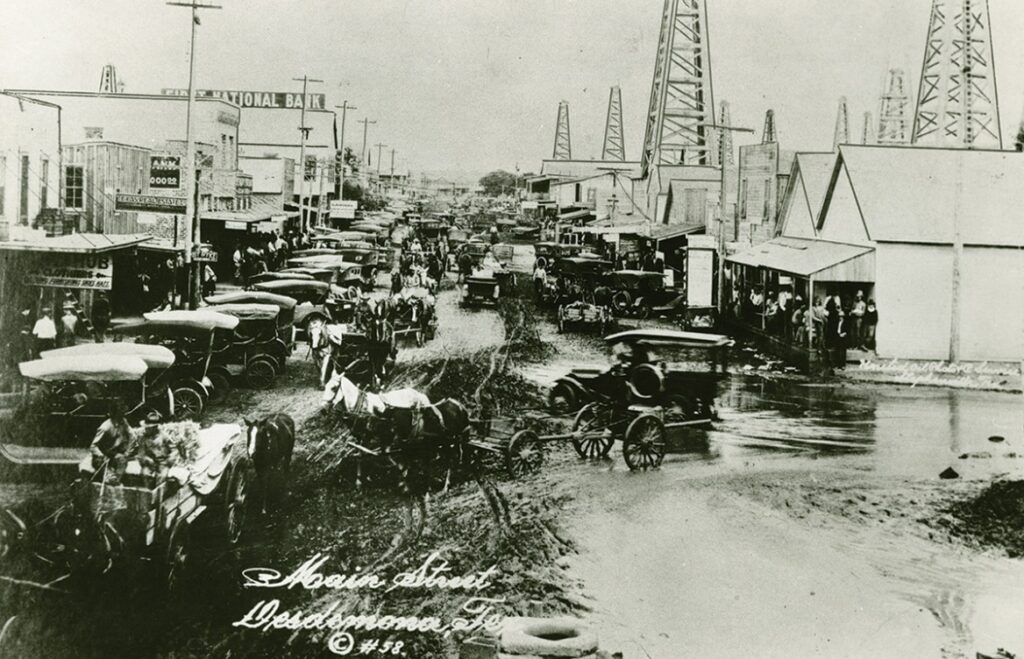
Main Street in Desdemona, Texas, at the height of the 1918 oil boom. Photo courtesy Dolph Briscoe Center for American History, University of Texas.
By 1902, the Texas Gulf Refining and Texas Refining companies produced asphalt, as did the Sun Oil Co. in Pennsylvania. The next year, Congress established a mechanical and chemical laboratory to test road materials. Within a decade, petroleum asphalt dominated the marketplace.
More than 55,000 automobiles traveled on the nation’s existing roads in 1904, and by 1910 the number of trucks and automobiles had risen to nearly 470,000, according to the Asphalt Institute’s Asphalt Magazine. Experiments began “mixing asphalt and heavy road oils with various sizes of aggregate.”
The application of “Topeka Mix” (asphalt and small stones) provided an enduring pavement for the first intercity highways.
The thousands of automobiles that began rolling off assembly lines after World War I needed more and better roads. Innovations in both producing and laying asphalt included mechanized spreaders and mixers – reducing, but never eliminating, manual labor.
Asphalt Interstates
During World War II, runway surfaces had to handle larger and heavier loads, prompting innovation in asphalt composition and paving technology. Road building became a huge industry to accommodate America’s postwar boom.
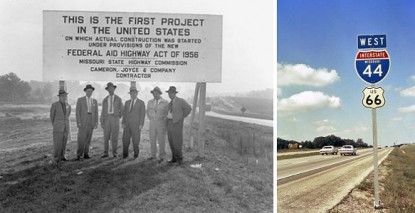
Missouri launches the U.S. interstate system after “inking a deal for work on U.S. Route 66 – now Interstate 44,” which stretches across south central Missouri and is a major corridor to the West Coast.
Responding to public demand, Congress passed the State Highway Act and allotted $51 billion to the states for road construction.
The Highway-Aid Act of 1956 provided 90 percent federal funding for a “system of interstate and defense highways” — the Eisenhower administration noted a need to efficiently evacuate major cities in the event of a nuclear attack. The act made it possible for states to afford construction of the network of national limited-access highways, which would eventually reach more than 40,000 miles.
In August 1956, Missouri became the first state to award a contract with the new interstate construction funds, “inking a deal for work on U.S. Route 66 – now Interstate 44 – in Laclede County,” noted the Missouri Department of Transportation.
“There is no question that the creation of the interstate highway system has been the most significant development in the history of transportation in the United States,” the state agency added. Advanced pavement materials now include compositions such as Open Graded Friction Course, and Stone Matrix Asphalt, better known as “Superpave.”
The Federal Highway Administration (FHA) in 2021 reported that 2,844,000 miles of U.S. roads were paved with a variety of bituminous surfaces. Promising new paving technologies have also evolved, according to FHA.
Founded in 1955, the National Asphalt Pavement Association (NAPA) in 2019 reported that of the more than 2.8 million miles of U.S. paved roads, about 94 percent were surfaced with asphalt.
Asphalt comes from the bottom of the fractional distillation process, but its contribution to America’s mobility makes it one of the petroleum industry’s most important products. Every day it passes largely unnoticed under millions of tires.
Also see America on the Move.
Asphalt Drip Experiment
Physicists in at Trinity College Dublin photographed one of the most anticipated drips in science on July 11, 2013.
“After 69 years, one of the longest-running laboratory investigations in the world has finally captured the fall of a drop of tar pitch on camera for the first time,” noted the science journal Nature a few days later.
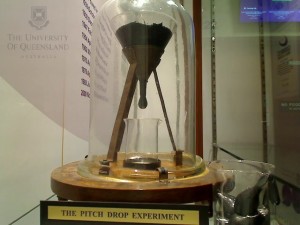
Begun in 1927, another “Pitch Drop Experiment” continues in Australia today. Photo courtesy University of Queensland.
Considered one of the longest-running laboratory investigations in the world, the pitch-drop experiment was set up in 1944 to demonstrate the high viscosity or low fluidity of pitch, a naturally occurring hydrocarbon also known as bitumen or asphalt.
Australian Drip
An even older “Pitch Drop Experiment” in Australia, which began in 1927, continues. It missed filming its latest drop in 2000 because the camera was offline, notes writer Richard Johnston. It should take seven to 13 years for a drop to form — but only a tenth of a second for it to fall.
Both experiments demonstrate the high viscosity of pitch — also known as bitumen or asphalt — a material that appears to be solid at room temperature, but is in fact flowing, albeit extremely slowly,” he explained. The Trinity College team has estimated the viscosity of the pitch in the region of two million times more viscous than honey.
The Australian experiment continues; it has been running since 1927 at the University of Queensland in Brisbane, which Guinness World Records lists as the world’s longest-running laboratory experiment.
Australia’s pitch container has yielded nine drops — with another now forming as of 2022. The ninth pitch drop fell in April 2014.
The wait for the tenth drip continues here.
_______________________
Recommended Reading: A Century of Progress: The History of Hot Mix Asphalt (1992); Down the Asphalt Path: The Automobile and the American City
_______________________
The American Oil & Gas Historical Society (AOGHS) preserves U.S. petroleum history. Become an AOGHS annual supporting member and help maintain this energy education website and expand historical research. For more information, contact bawells@aoghs.org. © 2023 Bruce A. Wells. All rights reserved.
Citation Information – Article Title: “Asphalt Paves the Way.” Authors: B.A. Wells and K.L, Wells. Website Name: American Oil & Gas Historical Society. URL: https://aoghs.org/products/asphalt-paves-the-way. Last Updated: December 16, 2023. Original Published Date: June 18, 2014.