Smithsonian Museum includes an oilfield service truck among petroleum-related exhibits.
The Smithsonian Institution’s National Museum of American History has educated millions of visitors about the history of U.S. transportation since “America on the Move” opened in November 2003 on the National Mall in Washington, D.C.
Today’s first-floor exhibits in the General Motors Hall of Transportation include the 1903 Winton (the first automobile to drive across the country), bicycles, carriages, antique automobiles, and a 1959 Chicago Transit Authority “L” mass transit car. Nearby, a A 260-ton locomotive built in 1926 is featured across from exhibits about Route 66 — the “People’s Highway.”
“America on the Move” also displays a red, 1931 Ford truck representing a typical oilfield service company.
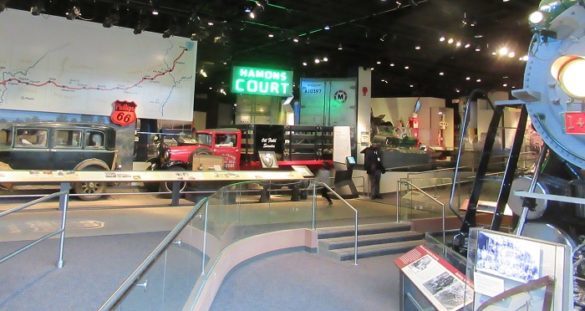
An exhibit about the history of Route 66 — commissioned in 1926 and fully paved by the late 1930s — is part of the Transportation Hall at the National Museum of American History. Photo by Bruce Wells.
The $22 million Transportation Hall encompasses 26,000 square feet and displays more than 340 historic objects. The space features 19 historic settings in chronological order, reflecting the nation’s relationship with great and small roadways.
“America on the Move replaces exhibits of road and rail transportation and civil engineering installed when the National Museum of American History opened as the Museum of History and Technology in 1964,” notes the America on the Move website.
“We would not do an exhibit about cars and trains, or even a transportation history exhibit. It would be an exhibit about transportation in American history,” the site adds.

Visitors to the Hall of Transportation learn how and why the U.S. interstate highway system began in the 1950s. Photo by Bruce Wells.
“America on the Move” features the Smithsonian’s extensive transportation collection using multimedia technology — and large displays, including a PS-4 Class steam locomotive (No. 1401) built in 1926. The exhibition educates visitors about the history of U.S. transportation infrastructure and “reveals America’s fascination with life on the road.”
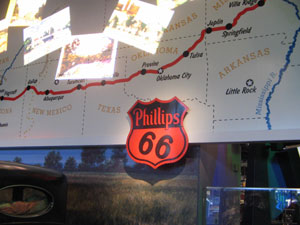
The role of “Route 66” from Chicago to Los Angeles is featured in the Smithsonian museum’s transportation hall. Photo by Bruce Wells.
The exhibit hall begins with late 19th-century transportation technologies, including steam-powered ships and trains, the building of canals, and urban development of street cars. The artifacts and custom displays progress to early internal combustion gasoline-fueled autos.
Public fascination with driving for recreation and camping at National Parks is also included in the Trams[prrtation Hall. Among the most popular collections, “America Adopts the Auto” features interactive exhibits about the massive new infrastructure required across the country (also see Asphalt paves the Way).
“Explore the way the automobile went from being a plaything of the rich to a major factor in the American transportation landscape,” notes the Smithsonian. “In this exhibit section full of objects, you can see toy cars, early license plates, engines, road markers, car-part inventions, mechanics’ tools, and gas pumps.”

To cope with the changes that “automobility” brought, the nation developed an elaborate system of law, commerce, and custom, adds the Smithsonian. Congress passed laws to rebuild roads as inventors improved production techniques. New businesses — gas stations, tire shops, and garages — sprang up to supply drivers’ needs.
In 1901, the year of the great oilfield discovery at Spindletop Hill in Texas, New York became the first state to register automobiles; by 1918, all states required license plates. Created in 1913, the Lincoln Highway Association promoted the building of a paved highway from New York to California largely supported by donations from car-related businesses.
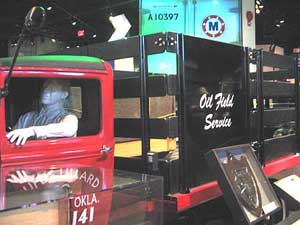
An oilfield service truck from Seminole, Oklahoma, is among the exhibits in the General Motors Hall of Transportation. Photo by Bruce Wells.
By 1930, more than half of American families owned a car — and 23 million cars were on the road. Many high schools began offering driver education classes. A large exhibit area highlights the Smithsonian’s collection, including displays showing the history of the interstate highway system and images and artifacts from Route 66.
A section about “life on the open road” notes how in the 1920s new highways began to affect people’s lives: “Some Americans used highways to migrate. Others earned a living on the road, or by its side, running businesses. Many Americans began to take to the highways for pleasure.”
Travelers often saw the highway as a symbol of independence and freedom – although they depended on the government for the roads and on businesses such as automobile and tire manufacturers, oil refiners, gas stations, and roadside restaurants.
Route 66 and Interstates
Among the exhibits are images of Route 66, which was commissioned in 1926 and fully paved by the late 1930s. A prominent Tulsa, Oklahoma, businessman — who also invested in the petroleum industry – is credited with creating the enduring (and international) popular identity of Route 66.
Cyrus Avery, a Pennsylvania native, saw the need for better roads, the exhibit notes. As chairman of the Oklahoma Highway Commission, he helped plan the system for numbered highways. His proposal for a highway from Chicago to Los Angeles along a southwestern route was approved and designated U.S. 66 in 1926.
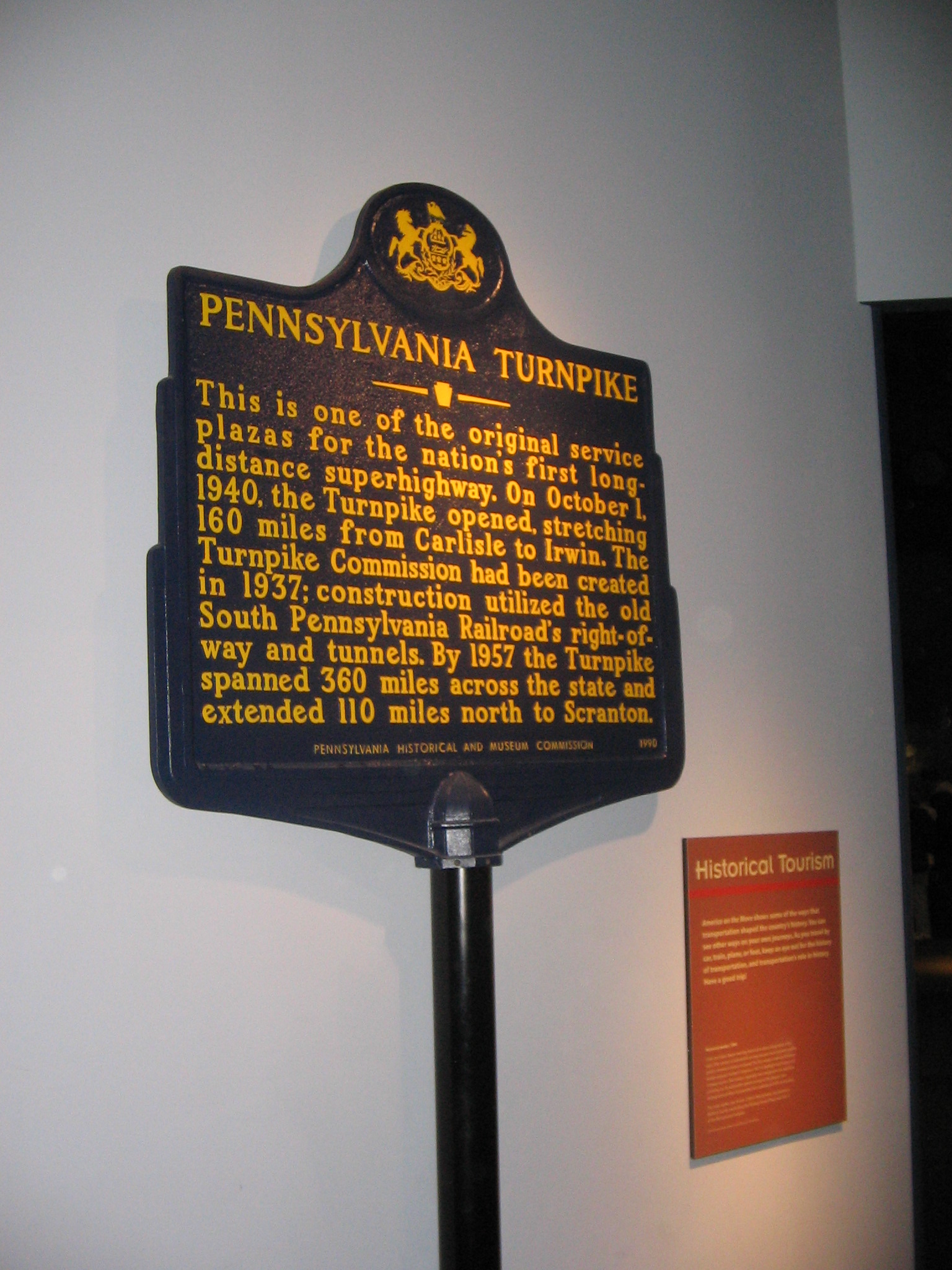
The Pennsylvania Turnpike — “the nation’s first long-distance superhighway” — opened in 1940. Photo by Bruce Wells.
Avery founded the U.S. 66 Highway Association and coined the route’s nickname, “Main Street of America.”
Another exhibit notes that after decades of debate, Congress passed the Federal Aid Highway Act in 1956 — and the interstate network was born. The 41,000-mile system was designed to reach every city with a population of more than 100,000.
When the Pennsylvania Turnpike opened in 1940, it stretched 160 miles from Carlisle to Irwin. It would more than double in length by 1957. A historical marker notes the creation of one of the earliest “service plazas,” now commonplace on all interstate highways (also see Iowa 80 Trucking Museum).

The “limited access” design of the turnpike became the model for future superhighways — the U.S. interstate system. Almost completed by the 1990s, the total cost of the nation’s interstate system reached more than $100 billion.
The Route 66 exhibit includes the red Oklahoma “oil field service” truck owned by the Rufus Lillard Company of Shawnee with this note: “The 20th-century oil industry employed increasingly large numbers of men in the oil fields: their number rose from 22,230 workers in 1902 to 93,205 in 1919.”
Even more people were employed building pipelines and working in refineries, corporate offices, and product marketing. Despite the Depression, by the mid-1930s the U.S. petroleum industry employed some one million people. Read about America’s first automobile show in 1900 in New York City’s Madison Square Garden in Cantankerous Combustion.
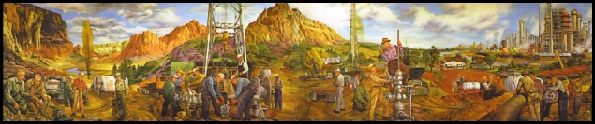
Delbert Jackson’s 56-foot mural “Panorama of Petroleum” welcomed visitors to the Smithsonian Museum of Science and Technology in 1967.
Similar to today’s “American on the Move” hall, the National Museum of American History once devoted space to the petroleum industry. On June 28, 1967, the “Hall of Petroleum” opened. It included a full-size cable-tool rig, rotary drilling rigs, pump jacks, and many other oilfield exhibits.
The Hall of Petroleum’s main entrance featured a mural by Oklahoma artist Delbert Jackson. Learn more in Smithsonian’s “Hall of Petroleum.”
_______________________
Recommended Reading: The American Highway: The History and Culture of Roads in the United States

_______________________
The American Oil & Gas Historical Society (AOGHS) preserves U.S. petroleum history. Become an AOGHS supporter and help maintain this energy education website and expand historical research. For more information, contact bawells@aoghs.org. © 2025 Bruce A. Wells.
Citation Information: Article Title: “America on the Move.” Authors: B.A. Wells and K.L. Wells. Website Name: American Oil & Gas Historical Society. URL: https://aoghs.org/transportation/america-on-the-move-smithsonian-exhibit. Last Updated: November 13, 2025. Original Published Date: January 27, 2010.