Since it earliest days, the oil and gas industry has drawn writers, photographers, painters, sculptors, movie makers…social media.
The use of energy resources has defined modern civilization. Museums, and historians, writers, and educators have preserved the heritage of the petroleum industry since the first U.S. well of 1859. Oilfield artists of all media remain important recorders and interpreters of petroleum’s worldwide influence.
For oil patch students and researchers, the American Oil & Gas Historical Society created the work-in-progress Oil in Art articles, to accompany the forums and resources page, which includes links for photography sources (especially universities and the Library of Congress), petroleum history videos, and a small AOGHS selection of books and authors.
Oilfield artists: Oil on Canvas
An icon of the Pop art movement, “Standard Station, Amarillo, Texas,” was painted in 1963 by American artist Ed Ruscha, who created a series of screen prints of the painting today in the collections of several museums, including New York City’s Museum of Modern Art.
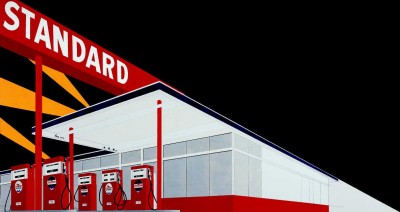
“Standard Station, Amarillo, Texas,” 1963, by Ed Ruscha. Oil on canvas. Image courtesy Hood Museum of Art from Wheelock Street, Hanover, NH.
In 2013, the Los Angeles County Museum of Art exhibited the renowned “pop artist” whose influence can be seen in graphic design, film and urban history.
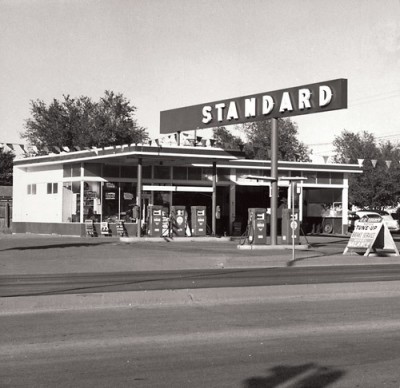
Standard Station in Amarillo, Texas, from Edward Ruscha’s “Twentysix Gasoline Stations,” 1963. Gelatin silver print.
“Ed Ruscha’s art depicts everyday objects – gas stations, street signs, billboards, commercial packaging – yet often triggers philosophical reflection about the relationship between words, things, and ideas,” noted the curator. “The word ‘standard’ is a case in point: it can be a banner or rallying point, an established level of quality, and an oil company’s brand name.”
The gasoline station is Ruscha’s most iconic image, according to New York’s Museum of Modern Art.

Ruscha began experimenting with the subject in “Twentysix Gasoline Stations” (1963), reproducing photographs taken while driving on Route 66 between Los Angeles and his hometown of Oklahoma City.
Ruscha created his 10-foot painting titled “Standard Station, Amarillo, Texas,” based on one of his photographs.
In November 1940, Edward Hopper’s painting “Gas” was first exhibited by the Whitney Museum of American Art in New York City. Art critics praised the work, suggesting the painting with the Pegasus sign anticipated the modern Pop Art movement by more than a decade.
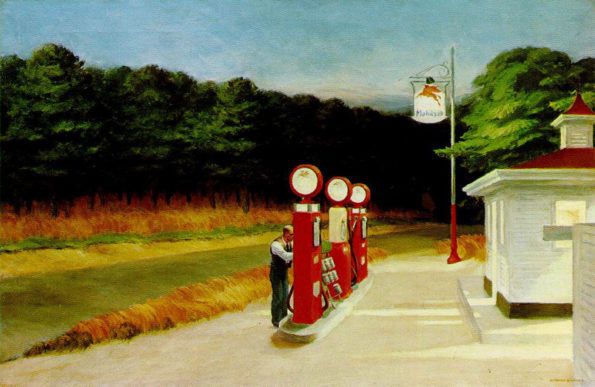
Edward Hopper (1882-1967) oil on canvas painting “Gas” of 1940 includes the flying Pegasus logo of Mobilgas. Image courtesy Museum of Modern Art, New York.
The painting is owned by the Museum of Modern Art in New York City.
Jerry Bywaters of Paris, Texas, exhibited his newly painted “Oil Field Girls” on June 1, 1940, at the Fine Arts Palace of San Francisco’s Golden Gate International Exposition. The painting of two young women in a West Texas oilfield and its companion piece, “Oil Rig Workers (Roughnecks),” would become among his best known works.
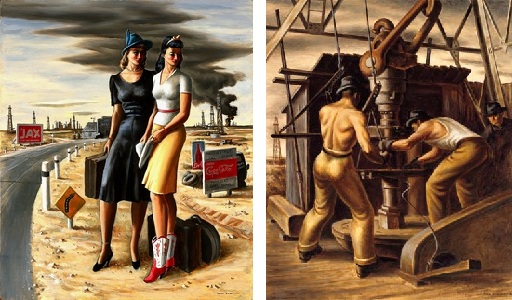
Dallas artist Jerry Bywaters painted “Oil Field Girls” in 1940 for the San Francisco Golden Gate International Exposition. He titled its companion piece “Oil Rig Workers (Roughnecks).”
The 1939 “Oil Fields of Graham” mural by Alexandre Hogue is on display in its original Texas oil patch community’s historic U.S. Postal Service building — and now a museum.
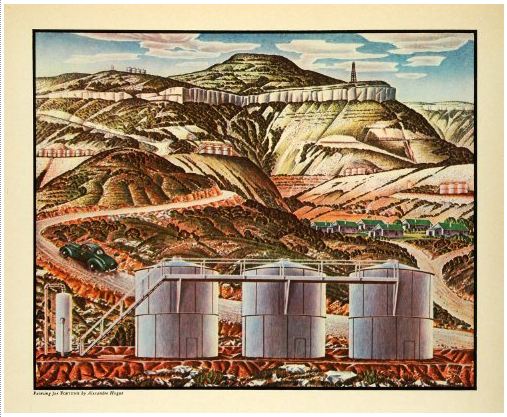
A 1937 painting by Alexandre Hogue depicts the Pecos, Texas, oilfield with storage tanks in the foreground and the green-roofed quarters for workers in the background.
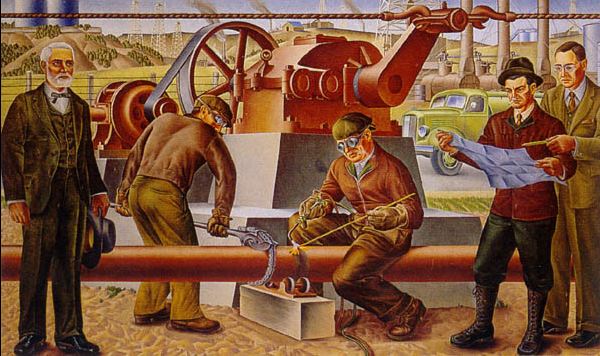
Alexandre Hogue’s “Oil Fields of Graham” (Texas) is restored and displayed at the Old Post Office Museum & Art Center, which opened in 1993.
Learn more in Oil Art of Graham, Texas.
Burning Oil Well at Night, near Rouseville, Pennsylvania
A Pennsylvania oilfield tragedy led to new safety and firefighting technologies — and a work of art.
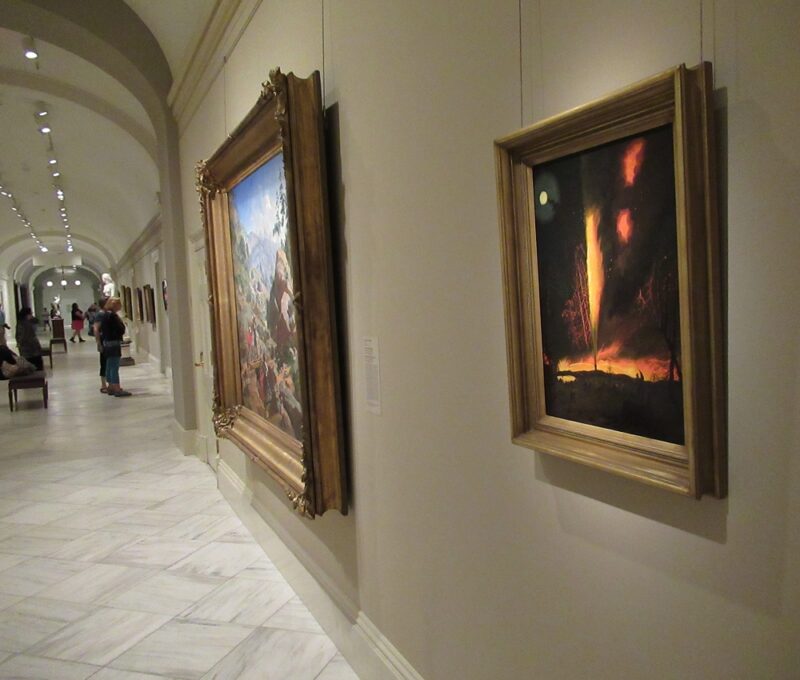
A circa 1861 oil painting, “Burning Oil Well at Night, near Rouseville, Pennsylvania,” by James Hamilton displayed in 2017 at the Smithsonian American Art Museum in Washington, D.C.
On April 17, 1861, a highly pressurized well exploded into flames on the Buchanan Farm at Rouseville, killing the well’s owner and more than a dozen bystanders.
The early oilfield tragedy was overshadowed by the greater tragedy of the Civil War, which began four days earlier. Journalist Ida Tarbell had lived in Rouseville as a child.
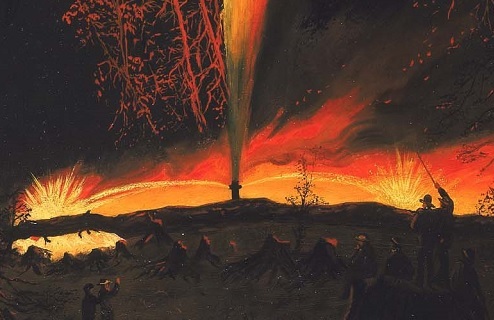
Detail from James Hamilton’s painting of the fire that killed Henry Rouse. “Burning Oil Well at Night, near Rouseville, Pennsylvania.”
At the turn of the century, Thaddeus Mortimer Fowler created popular panoramic maps of many of America’s earliest petroleum boom towns. Fowler has the greatest number of hand-drawn panoramic maps (324) in the collection of the Library of Congress.
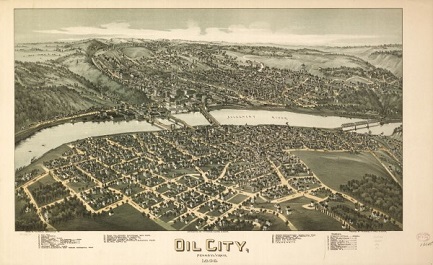
T.M. Fowler’s hand-drawn panoramic map of Oil City, Pennsylvania, in 1896. Lithographs of his cartography (done without a balloon) have fascinated people since the Victorian Age.
The cartographer created bird’s-eye views of boom towns in Pennsylvania, West Virginia, Oklahoma and Texas — his popular Oil Town “Aero Views.”
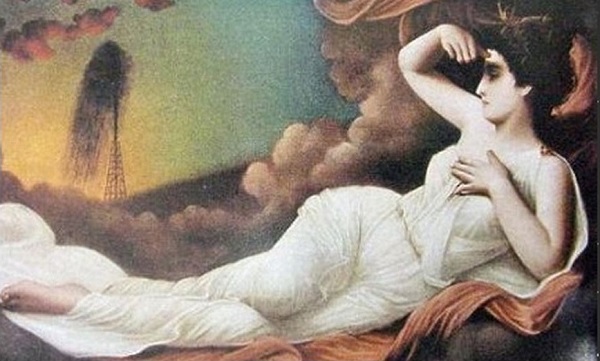
“Spindletop Viewing Her Gusher” by Aaron Arion – 1913, pastel on linen – was popular with oilmen staying at the Dixie Hotel in the Beaumont, Texas.
Black Gold of JoAnn Cowans
Oilfield artist JoAnn Cowans, a founding member of the American Oil & Gas Historical Society in 2003, has donated many artworks to community museums. She also collaborated with Loyola Marymount University Department of Archives and Small Collections on an urban archaeology project of Venice and Playa del Ray.
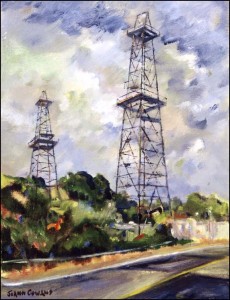
“Derricks by the Road” painting by JoAnn Cowans
By painting derricks in the 1960s, Cowans documented a history when few if any of her generation thought to do so. According to the magazine American Art Review, “Few artists, however, were devoted to the subject of the oil industry in the 1960s. Stylistically, artists were interested in the modernist concerns of abstraction and expression, rather than documentation or narrative.”
In recognition of the 2009 150th anniversary of America’s first oil discovery, this talented California painter (many of her works are in corporate, private and museum collections) published a “gallery edition coffee table book.”
Black Gold, the Artwork of JoAnn Cowans includes 42 paintings. With her canvas, paints and easel (and later, a hard hat), she captured for posterity an important part of what is today the nation’s third largest oil producing state. One-hundred years earlier, in the 1860s, the first oil derricks began appearing in California. Oil was so plentiful here that it bubbled up out of the ground. See Discovering the La Brea Tar Pits.
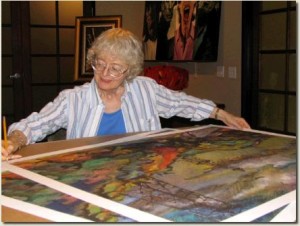
JoAnn Cowens of Fullerton, California, has been painting the state’s prolific oilfields since the 1960s. Her work preserves derricks long since removed.
Edward Doheny discovered the Los Angeles oilfield in 1892. By 1910, California produced 77 million barrels of oil. In Venice, the Ohio Oil Company completed a well in 1929 on county property just east of the city’s Grand Canal. This is where Cowans painted many derrick scenes. Her collection includes stories about California oilfields of the 1960s and more recent of paintings: Black Gold, the Artwork of JoAnn Cowans.
“Once seen, the depth and significance of her work becomes clear,” noted her publisher. “Her place in plain air painting and her own unique view helps us see the majesty of the oil tower.”
“Oil and Guts” Oilfield Mural
Artist Barbara Fritsche began painting “Oil and Guts” at the end of 2007 — just when the fictionalized movie “There Will Be Blood” was hitting theaters, she later noted. Meeting with roughnecks provided her a more in-depth petroleum industry education.
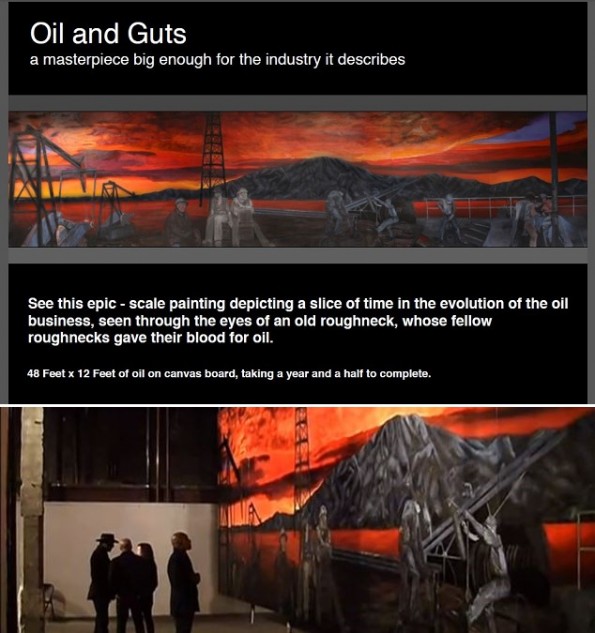
Los Angeles artist Barbara Fritsche’s mural – which some say resemble the Buena Vista oilfields – acknowledges “the blue collar appeal and respect of the environment surrounded by a biblical sunset, famous in this area.”
Fritsche’s 48-foot by 12-foot oil on canvas board mural, which originated as a commission for an independent oil producer, took a year and a half to complete. Her original work of oilfield art has since been looking for a home in a museum, corporate headquarters, or other appropriate location.
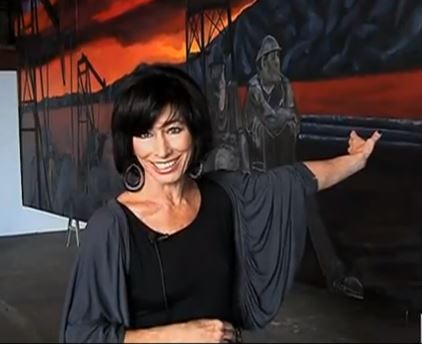
Barbara Fritsche seeks a buyer for her mural.
“My drawings and the landscape in my painting resemble the Buena Vista oilfields, as stated by roughnecks that offered their nods of appreciation,” she said in 2016.
“My concept for ‘Oil and Guts’ — a slice of time in the oil business, using a narrative, acknowledging the blue collar appeal and respect of the environment surrounded by a biblical sunset, famous in this area,” said the artist.
“An old Roughneck remembers the roughnecks that have passed on, depicted by workers drawn in chalk, then to the past, depicted by wooden platforms, archaic equipment — wooden platforms changed to metal — then to the present times, depicted by metal platforms and modern day workers,” she explained.
“In addition to the story, the mountains are sculpted with figures – surrealism – referencing fossil fuels,” Fritsche concluded. “Without people there would be no need for oil.”
Fritsche, whose studio is in Los Angeles, has contacted petroleum companies and museums seeking a purchaser of her epic oil patch mural. Visit the Barbara Fritsche website.
Oil on Broadway
On December 1, 1960, Lucille Ball debuted in “Wildcat,” her first and last foray onto Broadway. Critics loved Lucy — but hated the show. She played the penniless “Wildcat Jackson” scrambling to find an oil gusher in a dusty Texas border town, circa 1912.
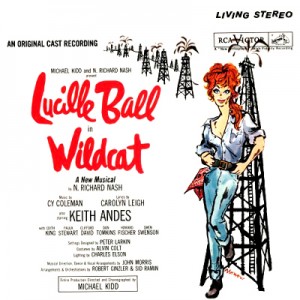
Oil gushers featured on album cover of 1960 Broadway musical “Wildcat.”
“Wildcat went prospecting for Broadway oil but drilled a dry hole,” proclaimed a New York Times critic. Although some audiences appreciated a rare oil patch musical, after 171 performances, the show closed.
Oil Patch Photographer
A famous image by photographer John Mather is often mistakenly identified as Drake and Smith standing in front of the historic derrick. In fact, it is Drake and his friend Peter Wilson, a Titusville druggist, standing in front of the second derrick.
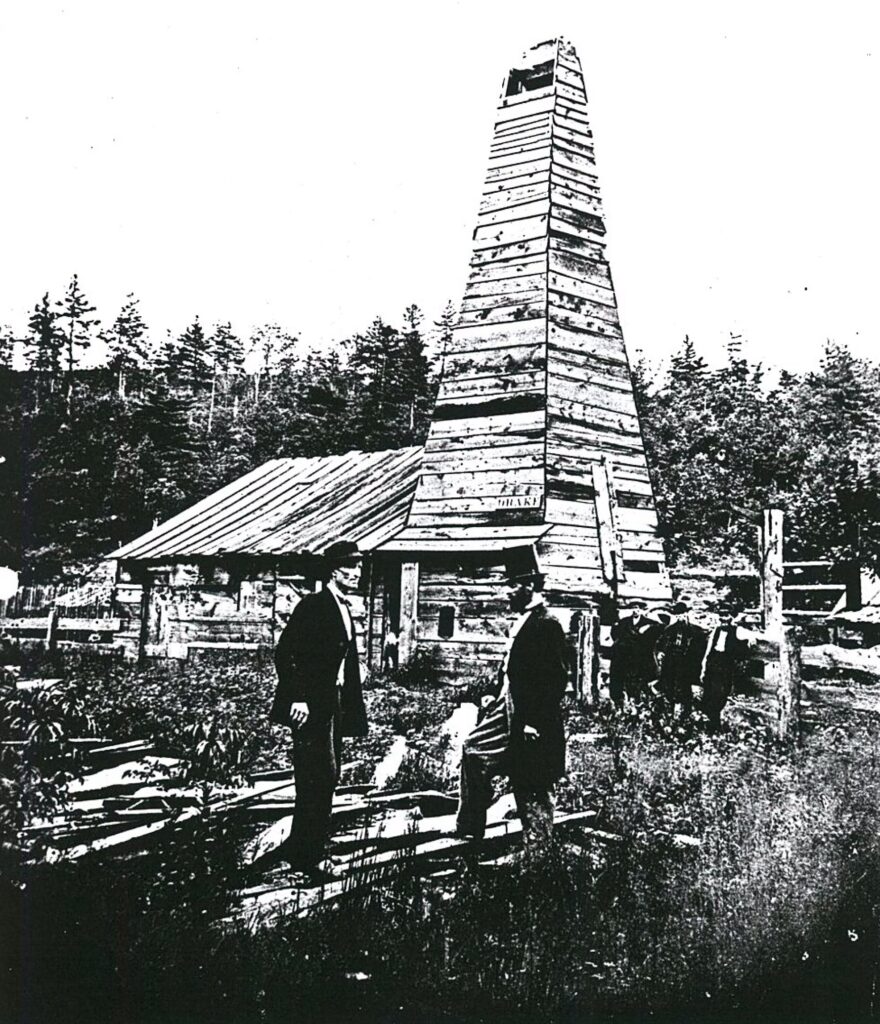
Iconic but often misidentified photo by John A. Mather shows Edwin L. Drake (at right) with a friend standing in front of the rebuilt engine house and derrick at the original site of the first U.S. commercial oil well of August 1859. An October fire destroyed the original structures. Photo courtesy Drake Well Museum.
Petroleum in Art and the Movies
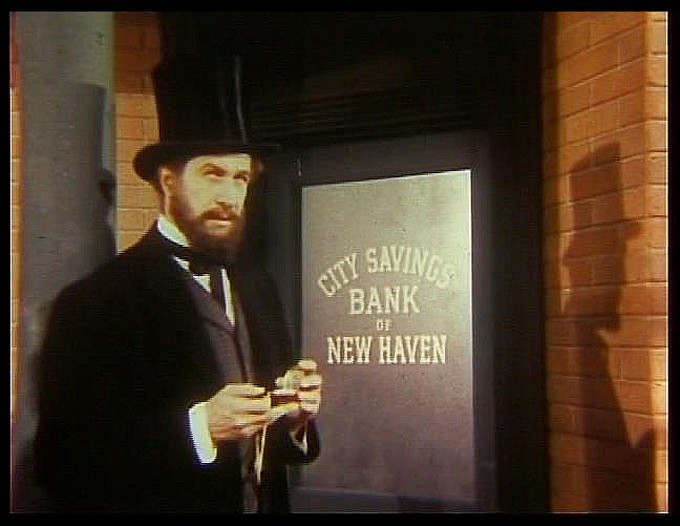
Vincent Price starred as Edwin Drake in the 1954 film sponsored by the American Petroleum Institute (API). A year earlier he had starred in “House of Wax,” Warner Bros.’ first 3-D movie.
Oil Patch Art and Wall Street
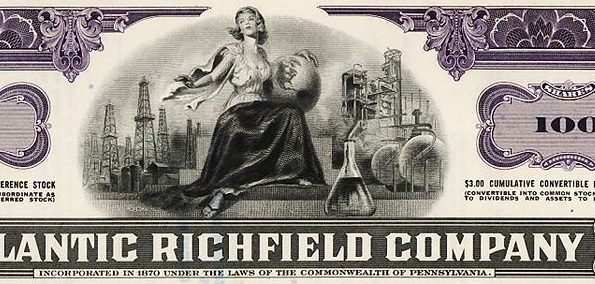
A petroleum stock certificate’s vignette often is an important part of its value for scripophily – the buying and selling of certificates as collectibles after they have no redeemable value as a security.
See other oilfield artists and artistically related petroleum works in Oil in Art.
_______________________
The American Oil & Gas Historical Society (AOGHS) preserves U.S. petroleum history. Become an AOGHS annual supporting member and help maintain this energy education website and expand historical research. For more information, contact bawells@aoghs.org. Copyright © 2023 Bruce A. Wells. All rights reserved.
Citation Information – Article Title: “Petroleum & Oilfield Artists.” Authors: B.A. Wells and K.L. Wells. Website Name: American Oil & Gas Historical Society. URL:https://aoghs.org/petroleum-art/petroleum-art. Last Updated: November 27, 2023. Original Published Date: December 30, 2016.