It took awhile, but the 1957 well drilled on Mrs. Houseknecht’s dairy farm found a giant oilfield.
An exploratory well in southern Michigan had been drilled on and off for almost two years before revealing the state’s only giant oilfield in January 1957. The Michigan oil discovery at “Rattlesnake Gulch” on Ferne Houseknecht’s dairy farm tapped a petroleum-rich basin that extended dozens of miles.
The story of the discovery of Michigan’s only giant oilfield is the stuff of dreams, according to Michigan historian and author Jack R. Westbrook. The state’s first oilfield, the Saginaw field, was found in 1925 and another field was discovered three years later, but there would be decades of “dry holes” before Mrs. Houseknecht convinced her uncle to finish drilling the well on her farm.
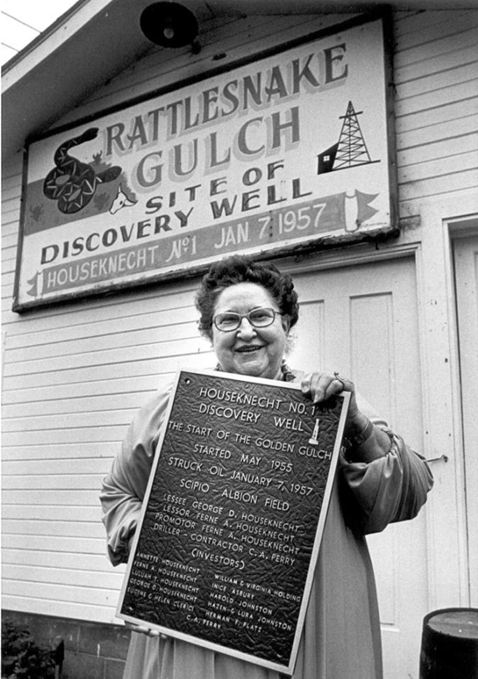
Ferne Houseknecht proudly displayed a plaque commemorating the oil well on her dairy farm. The Houseknecht No. 1 well of January 7, 1957, revealed the largest oilfield in Michigan. Photo courtesy Clarke Historical Library, Central Michigan University.
The 1928 Mt. Pleasant oilfield had made that community the “Oil Capital of Michigan,” but on January 7, 1957, the Houseknecht No. 1 well in uncovered a vast petroleum basin — a geologic formation 29 miles long and more than a mile wide. Drilling her wildcat well took about 20 months to discover Michigan’s largest oilfield, the “Golden Gulch” Albion-Scipio field.

The 3,576-foot-deep well near Scipio Township in Hillsdale County in southwestern Michigan produced from the Black River formation of the Trenton zone. The underground “trench,” which angled southeast to northwest, included parts of Hillsdale, Jackson, Calhoun and Eaton counties.
Michigan’s Only Giant
According to Westbrook, Mrs. Houseknect had spent months convincing her uncle Clifford Perry to drill her well one pipe connection at a time between other farm projects.
“The story of the discovery well of Michigan’s only ‘giant’ oil field, using the worldwide definition of having produced more than 100 million barrels of oil from a single contiguous reservoir is the stuff of dreams and of oilfield legends,” explained Westbrook, retired managing editor of the Michigan Oil & Gas News.
“One version of the legend says that a fortune teller told young Ferne Houseknect that a ‘black river of oil’ lay beneath her property in Hillsdale County,” Westbrook noted.
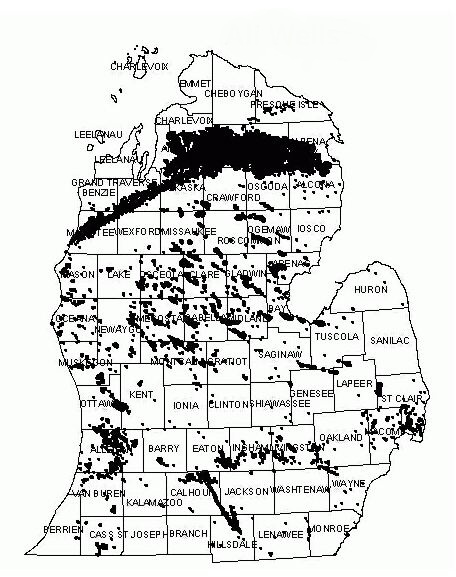
The southern oilfield revealed in 1957 in Hillsdale County (extending into Calhoun County) became the largest in Michigan, where the “Northern Pinnacle Reef Trend” also added to production.
“Another version of the story says that the Houseknects were taking a cow to be bred and on the way drove past a drilling rig where Perry was working and from their conversation a deal was struck,” Westbrook explained.
Drilling began in May 1954, but it took a lot of time to drill — often with entire months off between work, reported Westbrook, who added the exploratory attempt receive little or no encouragement from state geologists and other petroleum industry experts. The venture’s limited financial support came from Houseknecht family and friends.
Following its discovery, the giant oilfield became known as Michigan’s “golden gulch” of oil. New exploration fostered a boom for “a discovery-hungry petroleum industry to end a 15 year major discovery drought in Michigan,” noted Westbrook.
Ferne Houseknecht’s wildcat well triggered a drilling boom that resulted in 734 wells producing more than 150 million barrels of oil and almost a quarter-trillion cubic feet of natural gas from the Albion-Scipio field in the southern Michigan basin.
The formation represented a classic example of what geologists describe as a “fracture-controlled dolomite reservoir,” according to Westbrook, author of Michigan Natural Resources Trust Fund 1976-2011: A 35 year Michigan investment heritage in Michigan’s public recreation future.
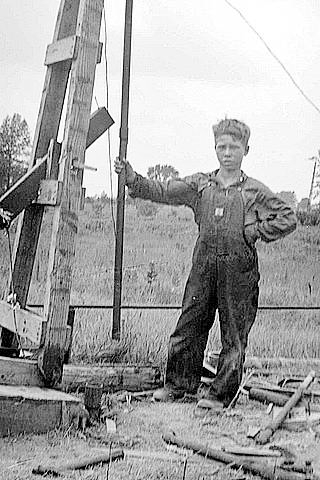
Earl “Red” Perry Jr., 12, stands by his homemade cable-tool rig in 1932. Uncle Cliff Perry would discover Michigan’s largest oilfield in 1957. Photo courtesy Clarke Historical Library, Central Michigan University.
As the 21st century began, Michigan’s oil and natural gas companies, armed with new detection and completion technology, returned to the Albion-Scipio area. Beginning 2006, increased statewide production reversed a 25 year downward trend in annual oil output and an eight-year decline in natural gas production.
The Michigan Natural Resources Trust Fund, created in the 1970s as an alliance of industry, government, and environmental groups, set an example for other producing states, according to Westbrook.
By 2010, Michigan produced over 1.25 billion barrels of oil and more than seven trillion feet of natural gas since the discovery of the Albion-Scipio field. The state’s petroleum industry drilled more than 14,000 producing wells. A September 2012 report from the Michigan Department of Environmental Quality Office of Oil, Gas, and Minerals, reported 14,542 oil wells (4,551 active); 13,269 natural gas wells (11,191 active); and 22,067 dry holes.
In 2004, a special exhibit at Clarke Historical Library in Mount Pleasant described Michigan’s petroleum history with examples from the library’s extensive holdings. Learn more in Michigan Petroleum History
Established in 1934, the Michigan Oil And Gas Association represents the state’s petroleum exploration and production companies. Retired Michigan Oil & Gas News Managing Editor Jack R. Westbrook authored At Home in Earlier Mt. Pleasant, Michigan and other books about Michigan history.
_______________________
Recommended Reading: At Home in Earlier Mt. Pleasant Michigan (2012); Michigan Oil and Gas, Images of America (2006); Michigan Natural Resources Trust Fund 1976-2011: A 35-year Michigan Oil and Gas Industry Investment Heritage in Michigan’s Public Recreation Future
_______________________
The American Oil & Gas Historical Society (AOGHS) preserves U.S. petroleum history. Become an AOGHS annual supporting member and help maintain this energy education website and expand historical research. For more information, contact bawells@aoghs.org. Copyright © 2024 Bruce A. Wells. All rights reserved.
Citation Information – Article Title: “Michigan’s Golden Gulch of Oil.” Authors: B.A. Wells and K.L. Wells. Website Name: American Oil & Gas Historical Society. URL: https://aoghs.org/petroleum-pioneers/michigan-oil-and-gas. Last Updated: December 29, 2023. Original Published Date: April 29, 2014.