Washington, D.C., Energy Economists take Field Trip to Titusville, Pennsylvania, to mark 150th Anniversary of First U.S. Oil Well.
Titusville or Bust! The Energy Economists Rock Oil Tour of 2009 was the educational adventure of Washington, D.C., professionals, August 21-22, courtesy members of the National Capital Area Chapter of the U.S. Association for Energy Economics.
Nearly 50 enthusiastic oil history buffs set off for an education-packed bus ride from Washington, D.C., early morning on August 21, heading for Oil City and Titusville, Pennsylvania, the birthplace of the U.S. petroleum industry 150 years ago on August 27, 1859.
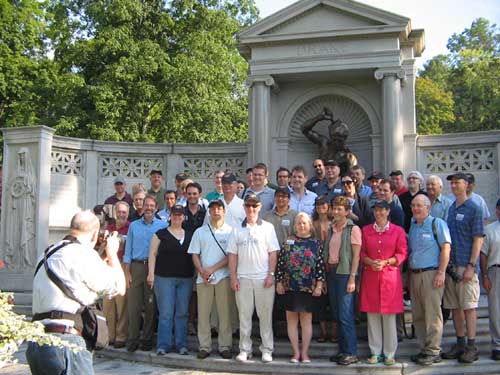
John Jennrich of the Federal Energy Regulatory Commission photographs the group during a 2009 visit to the Edwin L. Drake Memorial in Titusville, Pennslyvania. “The six-hour trip from Washington to the Pennsylvania oil region was enlivened by a series of videos presented by Bruce Wells, executive director of the American Oil and Gas Historical Society.”
Earlier, Adam Sieminski, chief energy economist at Deutsche Bank in 2009, had invited the American Oil & Gas Historical Society (AOGHS) to share oil history during the Rock Oil Tour. “Adam Sieminski, the originator of the Rock Oil Tour, developed the following release about the tour,” noted Mark Lively, NCAC treasurer, and chief organizer of a monthly luncheon for NCAC members.

The Rock Oil Tour two-day excursion was hosted by the National Capital Area Chapter of the U.S. Association for Energy Economics (NCACAEE).
The National Capital Area Chapter of the U.S. Association for Energy Economics hosts monthly in-depth energy discussions.
“There are a quite a few members in our chapter with a passion for energy history and our industrial heritage” said Adam Sieminski, Deutsche Bank energy analyst, who helped organize the trip along with Michelle McCaughey from the American Petroleum Institute (API), John Jennrich, from the Federal Energy Regulatory Commission, who volunteered to be the official photographer, and NCAC treasurer Mark Lively of Utility Economic Engineers.
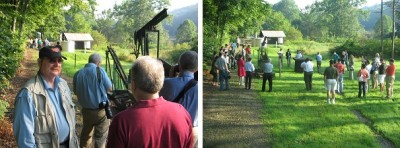
The tour included many stops at historic “oil patch” landmarks. John Felmy of the American Petroleum Institute, left, was among those who inspected the McClintock No. 1 — the world’s oldest continuously producing oil well. It has been producing just off PA 8 south of Rouseville since August 1861. Photos by Bruce Wells.
The six-hour trip from Washington to the Pennsylvania oil region was enlivened by a series of videos presented by Bruce Wells, AOGHS executive director, covering the early days of oil development in Pennsylvania, Oklahoma and Texas.
The group learned how whale oil and coal oil gave way to rock oil as Col. Edwin Drake made drilling for oil practical by coming up with the innovation of casing his cable-tool drilled well with iron pipe.
John Felmy from API lectured on one of the petroleum industry’s next big technical breakthroughs, the Tidewater Pipeline, built in 1878-79 from the Bradford field to Williamsport, Pennsylvania. This was the first true long-distance pipeline (six-inches in diameter, 109 miles) that eventually helped open up the East Coast markets for safer and less expensive energy for lighting.
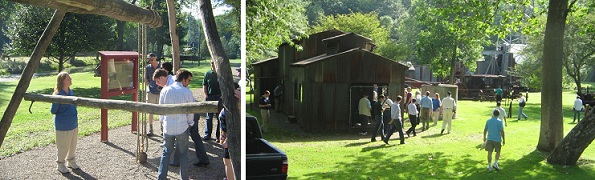
At the Drake Well Museum, Susan Beates, at left, a curator and historian, led a tour of the grounds and buildings. The museum tells the story of the beginning of the modern oil industry with operating oil field machinery and historic buildings in a beautiful park setting.
After the lunch stop, our crew was kept fully alert as they tried to complete the “Oil Industry Folklore Quiz” handed out Branko Terzic and concentrated on a rousing testimonial to the medicinal value of petroleum products from Sarah McKinley.
Upon arrival in Oil City, the group was welcomed by the staff of the Venango Museum, dedicated to the preservation and conservation of the oil region’s industrial legacy and rich cultural history, including its beautiful beaux arts building.
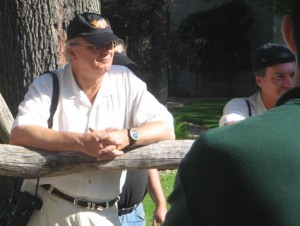
“Our crew was kept fully alert as they tried to complete the ‘Oil Industry Folklore Quiz’ of Branko Terzic,” noted Adam Sieminski. Branko is a past chairman of the Federal Energy Regulatory Commission. Photo by Bruce Wells.
That evening, Wells outlined the efforts underway at the AOGHS to encourage the preservation of the history of U.S. oil and natural gas exploration and production. The Society provides advocacy for museums and other organizations across the entire United States that work to preserve that rapidly disappearing early history through exhibitions, material preservation and educational programming.
On Saturday morning, Marilyn Black, of the Oil Region Alliance, joined the tour to provide a running commentary as the group explored the Oil Creek Valley. First stop was the McClintock Well No. 1, spudded in 1861 and believed to be the oldest well in continuous production in the world. Today, the well is pumped a few times a year, produces more brine than crude, but supplies enough for souvenir bottles sold at the celebrated Drake Well Museum.
After visiting the impressive memorial to Drake that was erected in Woodlawn Cemetery by his friends, the group saw the Titusville homes of John Mather, a famous oil region photographer who recorded the early days of the oil boom in Pennsylvania, and Ida Tarbell, a journalist, writer and social reformer known for her articles against big business and often credited with starting the movement that ultimately caused the dissolution of the Standard Oil Trust.
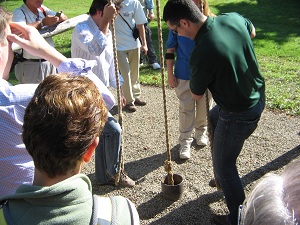
The tour included a chance to “make hole” using a spring pole outside the Drake Well Museum. Photo by Bruce Wells
At the Drake Well Museum, Susan Beates, a curator and historian, led a tour of the grounds and buildings. The museum tells the story of the beginning of the modern oil industry with operating oil field machinery and historic buildings in a beautiful park setting. Standing in the historically accurate replica of Drake’s first well was a highlight of the trip.
“We ended our tour to the area with a talk by regional experts at the oil ghost town of Pithole,” said Sieminski. Pithole went from woods, to a town of 15,000 people and back to woods again in the space of about two years in the mid-1860s, according the exhibits at the Pithole Visitors Center.
“It was a perfect reminder of the boom-and-bust, precarious and often controversial nature of the oil business,” Sieminski noted.
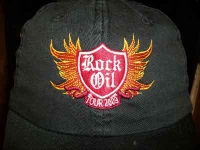
Sara Banaszak was widely praised for coming up with the “Rock Oil Tour 2009” baseball cap. More photographs are posted on NCAC’s website.
Joe Dukert and Larry Spancake made the front cover of Oil City’s newspaper on Saturday morning- in a feature article on the NCAC tour. Sara Banzakwas widely praised for coming up with the “Rock Oil Tour 2009” baseball cap that served as our admission ticket at all the stops.
Adam claimed to have been particularly impressed with an early description that turned up of our beloved first President, George Washington, as one of the nation’s early ‘oil speculators’ who bought land in what is now West Virginia because it was known to have oil seeps.
One of the trip’s many chroniclers noted many of them couldn’t get over the fact that the gasoline component of petroleum was initially considered to be a waste product dumped into Oil Creek, because early refiners only wanted the kerosene for lamps.
According to NCAC Treasurer Lively, “the overwhelming consensus opinion on the trip was that the camaraderie and educational value were exceptional, and many suggestions were made for a follow-up trip, including these possibilities: underground coal mine; LNG import facility; nuclear power plant, solar manufacturing factory, oil refinery. Branko said he will come up with an appropriate quiz for any eventuality!”
Editor’s Note — Thanks in part to this group of oil patch enthusiasts, in 2009 the AOGHS executive director was invited to speak at the 36th annual institute of the National Association of Division Order Analysts in Washington, D.C. Bruce Wells also co-chaired Titusville’s 150th anniversary committee and was interviewed by Cleanskies.tv — now EnergyNow — where he described the significance of America’s first oil discovery of 1859.
__________________________________________
The American Oil & Gas Historical Society preserves U.S. petroleum history. Join AOGHS today to help us maintain this energy education website, expand historical research, and extend public outreach. For more information, contact bawells@aoghs.org. © 2024 Bruce A. Wells.
Citation Information – Article Title: “Energy Economists Rock Oil Tour.” Author: Aoghs.org Editors. Website Name: American Oil & Gas Historical Society. URL: https://aoghs.org/energy-education-resources/oil-history-ncac-rock-oil-tour. Last Updated: January 27, 2020. Original Published Date: September 15, 2009.